


|

|

|

|
|
 |
 |
 |
||
VIII. — Withdrawal Of Workmen From The Inbye Side Of The Fire
(a) Warning Arrangements
When a dangerous occurrence, such as a fire, is known to have arisen in a mine, the speed and urgency with which men will start to withdraw from any parts of the workings which may be endangered will depend very largely upon the action taken by officials or men on the spot who are aware of the occurrence. Action on their part will, in turn, be determined by (1) their knowledge of the situation, nature and extent of the dangerous occurrence and its probable effects on the safety of men; (2) a proper assessment of the extent to which men's lives are endangered ; (3) the effectiveness of the arrangements by which warnings can be sent to the men concerned; and (4) the use made of these arrangements.
In any warning system in a mine, telephones play an important part. Three telephone messages concerning the happenings at the No. 2 transfer point were sent by Hird to Kirk in the pit-bottom telephone exchange between 3.40 and 3.45 a.m. The first was to ask for fitters to attend to the damaged belt, the second gave warning that a fire had started and asked for a fire party to be sent in, and the third was a request for the electric power to be cut off at the pit bottom. Kirk attended to these requests and on each occasion had to leave his switchboard to do so. When the power was cut off, Kirk had to work in his exchange by the light of his flame-safety lamp. The fact that the power was cut off brought J. Rodda, overman in the North-West District, to the telephone to ask what was wrong. Kirk told him there was a fire at No. 2 transfer point and asked him to come as quickly as possible. Rodda then told Kirk to inform the Manager and Undermanager. Kirk also received a call from G. Cooper, deputy for 68's face in the South-West District, asking why power was off, and was told that it was because there was a fire at No. 2 transfer point. Kirk then telephoned to the surface to be put through to the Undermanager and the Manager at their homes and informed them of the fire, but he was unable at this time to give them any information about its extent. This was about 3.55 a.m. After that Kirk tried to contact Godfrey, overman in the South-West District, but on ringing the telephones at 64's, 68's and 74's, he failed to get a reply at that time. Shortly afterwards Kirk got a call from T. Severn at 74's telephone and told him to find Godfrey who was somewhere in the district. To quote Kirk's own words from the notes of evidence, he said to Severn: "Whatever you do, send scouts out to find him and tell him there is a fire at 59's transfer point and also contact the deputies and tell the deputies if you see them." It was not until about 4.20 to 4.30 a.m. that Godfrey spoke to Kirk. What passed between them is best told by quoting from the notes of evidence when Kirk was examined by Mr. W. B. Brown.
| Q. | And you passed on the message to him that there was fire at No. 2 transfer point? | |
| A. | Yes; I passed on the message to Mr. Godfrey that there was fire at No. 2 transfer point. | |
| Q. | Did he tell you he would arrange for a fire-fighting party? | |
| A. | No, Sir, he just said on the 'phone, "Whatever has happened, Fred?" I told him there was a terrible fire at No. 2 transfer point and he just said, "Good God" and dropped the receiver, and that was the last message I had from Mr. Godfrey. |
Soon after Kirk had first spoken to the Manager and Undermanager at 3.55 a.m. he rang through to Hird and asked him for more information about the fire and was told that "it was getting well hold of the timber." Kirk then conveyed this information to the Manager. Kirk was examined by Mr. Watson on this matter.
| Q. | What time would that be? | |
| A. | Well, it was straight away after I got that call. Well, I expect the Manager was on the 'phone waiting for the reply. | |
| Q. | Did at any time any of the officials on the surface, the Manager or the Undermanager, if the latter had spoken to you, ask you to 'phone inbye to get the deputy to get the men out? | |
| A. | I cannot remember whether it was the Manager or the Undermanager who mentioned to get the men to the return, Sir. | |
| Q. | "Get the men straight to the return." That would be shortly after 4 o'clock? | |
| A. | Yes, Sir, it would. |
Following on these replies, Mr. Watson then questioned Kirk about his later conversation with the overman, Godfrey.
| Q. | Did you convey to Mr. Godfrey the Manager's instructions? | |
| A. | No, Sir. He never stopped long enough. | |
| Q. | So you never got the opportunity to convey to Mr. Godfrey the Manager's instructions that all the men must be got to the return side? | |
| A. | No, Sir, not to Mr. Godfrey. | |
| Q. | Did you speak to anyone in the mine round about that time and give those instructions on behalf of the Manager? | |
| A. | No, Sir. |
Kirk was further examined by Mr. Miron on this matter of telephone calls to the inbye faces in the South-West District.
| Q. | And then after you spoke to Mr. Godfrey did you speak to Mr. Hunt, Tom Hunt? | |
| A. | I heard Mr. Hunt, yes, but his was a very faint voice, and he had told me that his men were on their way, and I presumed it was his fire fighting party, and down his receiver went... . That was the only message, I presume, I got from Tom Hunt. | |
| Q. | And that was some time after twenty-past to half-past four? | |
| A. | Yes, Sir, it would be. |
Mr. Miron examined Kirk on the question of the accuracy of the various times he had given.
| Q. | Really, to be quite fair, on the whole question of times at this interval, and after the ordeal through which you went, you could not be certain of any times? | |
| A. | No, I am sorry I cannot. | |
| Q. | Or indeed about the sequence of all calls made, when you first spoke to the Manager or the Undermanager and Mr. Godfrey, you could not really be precise? | |
| A. | No. The Undermanager, when he came down, asked me to try and check the times of calls, but there were that many calls, it was impossible to keep the conversation going and take the times of all calls. |
Kirk was also asked by Mr. Watson if he had received calls from anyone in the return airway.
| Q. | Did you receive any telephone calls of any sort during the course of the morning after the fire in connection with the running of the paddy mail? | |
| A. | I got a call from out of the return, but I do not know what voice it was, calling for the paddy. I thought all power was off. | |
| Q. | Those who were telephoning were anxious to get out of the scene of the fire? | |
| A. | Yes, Sir. It must have been someone asking for the paddy. | |
| Q. | Was it a strong voice — clear? | |
| A. | Well, I should say reasonably. Just a reasonable voice, Sir. | |
| Q. | You have just told Mr. Brown your voice was affected by this fire? | |
| A. | Yes, Sir, it was up to the last quarter-of-an-hour I was in — quarter-past-five. | |
| Q. | Was this voice something similar? | |
| A. | Yes, Sir. |
About 5 a.m. the atmospheric conditions in the telephone exchange were becoming intolerable. On this matter, Kirk was examined by Mr. Brown.
| Q. | Were you later affected by the fumes? | |
| A. | Yes, Sir. | |
| Q. | Do you remember how you were affected? | |
| A. | Yes. It seemed to catch my voice first. It was taking my voice. I had a bottle of water, and practically after every telephone message I had to have a little sip of water. I had only a drop left, and I had to make it last out, and then it caught me further in my body. | |
| Q. | Your legs? | |
| A. | Yes. | |
| Q. | Your breathing? | |
| A. | Yes. | |
| Q. | Were you then sent to the surface for more water? | |
| A. | Yes. | |
| Q. | And who took your place? | |
| A. | Charlie Howe, the day telephone operator and office attendant; he came down about twenty-five past five, and we had a five minutes' conversation. I passed various messages on to him, and he said, "Have you any water, Fred?" I said "No, Charlie, I have not got a drop left." | |
| Q. | So that right up to 5.20 a.m. you could breathe in the return and carry on a conversation? | |
| A. | Yes. I was carrying on a conversation. | |
| Q. | Under difficulty? | |
| A. | Yes, in the fast quarter-hour it was under difficulties. | |
| Q. | And did you finally pass out, and were you put on a stretcher? | |
| A. | I felt myself going after I had been up to the surface. I fetched three bottles of water from the Baths, and I got down the pit again with much trouble with the banksman who did not want me to come down, and I went back into the office. As I was proceeding through the doors I met two men carrying Charlie out. He had been overcome. They were carrying him into the main No. 1 bottom. I proceeded past them and into the office to try to carry on with the 'phone messages as there was no one in the office, and then two or three minutes afterwards I collapsed and got down on my knees, and I was making my way out of the office when I met Herbert Ross who was coming back there after taking Charlie out through the doors. I said, "Herbert, it's got me." He said, "Fred, get down on the floor and get through the doors into No. 1, if possible." | |
| Q. | And before you left the telephone exchange after returning from the surface did anyone come in for the purpose of arranging the plugs so that the exchange in the return was no longer necessary? | |
| A. | No, Sir; not then. |
The siting of the pit-bottom telephone exchange should be in the main intake so as to minimize the risk of its being fouled, as happened in this case. At some pits, it might well be housed on the surface. The manning of the exchange during a disaster, when instant action and the keeping of a full log are necessary, should be planned and arranged before-hand as part of the general plan of action in an emergency.
From this record of telephone communications there is clear evidence that knowledge that a fire had occurred at No. 2 transfer point was known by G. Cooper, deputy in 68's district, about 4 a.m., about 15 minutes after the fire had been reported, and that a few minutes later, T. Severn also knew and had been told to contact the deputies and let them know about it. Whether the overman, Godfrey, knew of the fire before he reached the telephone between 4.20 a.m. and 4.30 a.m. is not known, but it seems fairly certain that by this time the ventilating current passing the inbye telephones would be polluted to a visible degree with smoke and fumes from the fire.
In the early messages sent inbye it does appear that no emphasis was laid on the need for all men in the district to leave their place of work immediately and hurry out by the return with all possible speed. This lack of emphasis no doubt arose from lack of precise knowledge of the nature and extent of the fire and the knowledge that good fire-fighting facilities were believed to exist. But there is evidence that even when smoke was plainly visible, some of the men did not hurry. This was to some extent emphasized by the evidence of F. W. Tomlinson. who said he "walked slowly down 68's gate." It is significant that the only coal-face men who were able to reach safety were from 65's panel. This was largely due to the deputy, W. Morris, who sensed the serious nature of the fire and, after collecting his men together, stressed upon them the need for speed and led them to 59's left airway. In this way he brought 30 men to safety. Face rippers from 74's and erectors from 64's escaped because they had finished their work and were already on the way out when the fire was in its early stages.
It was suggested that some of the workmen were slow to realize the need for urgency because of the high standard set for the installation and maintenance of the conveyors, for the safety of the mine in general and the apparent excellence of the fire-fighting arrangements. These factors may have had some influence. but I think the lack of effective warning was a more important factor. Men were known to have spent time in dressing and in hiding tools and some of the victims even carried tools out as far as the top of the Elmton Fault. Had there been a feeling or sense of urgency, especially in the early stages, the death roll might well have been shorter. There is reason to believe also that several men waited for the "Paddy" to come inbye in the hope of getting a ride before starting off outbye, and it is known that several got into the "Paddy" when it arrived inbye, for bodies were found in the train. On the other hand, some of the men must have appreciated the urgency, because their bodies were found on the outbye side of the top of the Elmton Drift, although they were known to have been working on the most distant faces. Some of the victims had travelled more than a mile, and there is little doubt that they had been in a smoke-laden atmosphere for most o the time.
Whilst there is no doubt that early warning of the existence of a fire reached inbye districts by telephone, there was no evidence to suggest that this warning reached many, if indeed any, of the men on the inbye faces. This was due in some measure to the distance of the inbye telephones from the working faces, the nearest being 350 yards from 65's face and the farthest, 430 yards, in 74's district. Inbye telephones should be sited as near as is practicable to the working faces.
Nor was there any evidence to suggest that a message urging the immediate withdrawal of the men was ever received. The position seems to be that before anyone on the outbye side of the fire realized its serious nature and the danger threatening the men inbye, the dense fumes had already passed the inbye telephones and their attendants were on their way outbye. Because of these circumstances, it is highly probable that the men on the working faces first became aware of the fire when the fumes actually reached them and would come out on their own initiative and not be fully aware of the need for extreme urgency.
By the very nature of mining, men are not all concentrated together as in a factory and there must inevitably be a delay in getting a warning to them. When a source of danger arises, such as a fire, which is likely to endanger persons employed in other parts of a mine, it would clearly be an advantage to include in the code of signals for transmission by the signalling and telephone systems of the mine, a distinctive signal to indicate that a state of emergency existed which required the immediate withdrawal of the men, and I recommend accordingly.
It would usually be necessary in such circumstances to ensure that the men made contact with the official, if any, in charge of the district at the time, or with the person in charge of the nearest telephone, so that they could receive instructions how to proceed. For this purpose the alarm signal would have to be followed with the minimum of delay by a telephonic message to the district to indicate the subsequent procedure best calculated to ensure safety. To this end, as already indicated, it would be an advantage if the inbye telephones were sited as near to the working faces as was reasonably practicable.
If, in addition, an alarm signal could be given of such a nature that it could be heard by as many as possible of the persons threatened by the danger, it would be an added advantage. I was pleased to hear at the Inquiry that a firm of telephone manufacturers had co-operated with officials of the National Coal Board in the East Midlands Division in an effort to devise a method of transmitting through the telephone system a distinctive warning by means of a Klaxon horn. If an inbye telephone was reasonably near to the working face, the piercing note of the horn would probably be heard by someone on the face. It was the intention that the Klaxon would be sounded intermittently until the telephone was answered and information given as to the nature of the emergency and the procedure to be adopted. A fire-alarm of this sort would be an advantage and I commend the problem of devising such an alarm to research workers and electrical engineers.
(b) Ways and Means of Escape
The following table gives particulars in respect of the men employed (Plan No. 2) on the different inbye faces :—
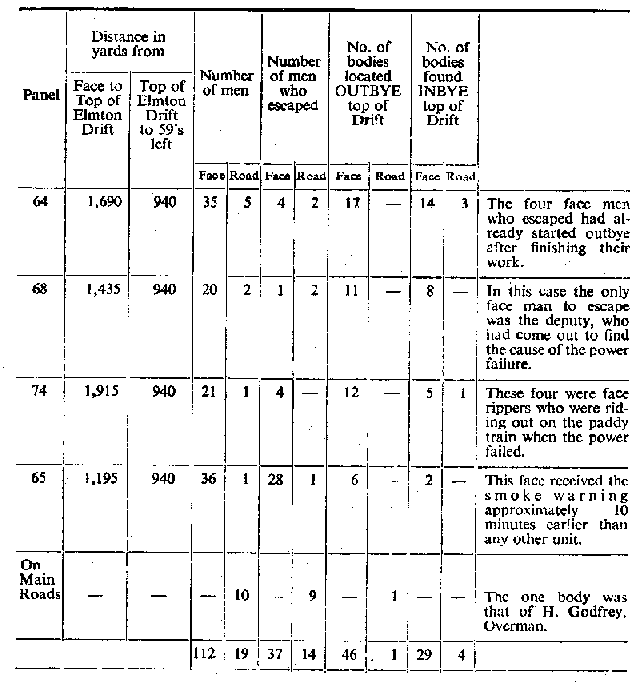
The only way of escape for all these men was by the return airway.
In any assessment of the chances of escape, the speed at which the fumes and noxious gases from the fire travelled inbye must be considered (Plan No. 2). It cannot be assumed, of course, that the air current after passing the fire contained lethal amounts of noxious gases immediately, nor can it be said with accuracy when the concentration of carbon monoxide or other poisonous gases in the air current reached sufficient proportions to cause serious distress or death to persons breathing it. The estimated time taken by the smoke-laden atmosphere to reach certain points inbye may help to explain why more men from the 65's face than from the other faces escaped. The estimated time — based on the air velocity — for fumes to reach 64's junction was 7¾ minutes, and to reach 64's face, 27 minutes. By then the fumes had reached 74's face, had passed round 65's face and had reached the return airway. From this it will be seen that when the smoke and fumes on 64's face indicated that the position was serious, part of the return was already fouled. It would take about 34 minutes for the fumes to travel round to 59's left return gate but it is known that W. Morris brought 30 men to that point at 4.55 a.m., some 75 minutes after the fire started. By that time the concentration of carbon monoxide was reaching such a proportion that men were collapsing, as happened in the case of R. Walker.
It was most unfortunate that, at the time of the fire and just when the inbye men had great need to get outbye in a hurry, the man-riding arrangements in the main return were not running as usual because work was being done on the roadway and track. Some days before the occurrence of the fire, the run of the "Paddy" had been extended inbye to 74's cross-heading — a total run of nearly 2¼ miles. To ensure smoother running of the haulage, this necessitated an improvement in the grading of the roadway and track near the foot of the Elmton Drift. Work to this end was in progress at the actual time of the fire, and to assist the workmen in the handling of tubs at the job, a pony was employed. In order that the "Paddy" could be used to the best advantage whilst the work was in progress, one train was detached from the rope and left at the "meetings" so that the other train could run freely between the pit bottom and the outbye end of the repair job at the foot of the Elmton Drift. It was the intention, of course, that at the end of the shift the track would be left in running order, the second train would be reattached to the rope, and the "Paddy" would run as usual for the transport of the men at the change of shifts. Thus it was that, when the fire occurred, the "Paddy" was not in its usual running order and there was, in addition, a pony employed in the roadway. And when the inbye men reached the "Paddy" terminus in the return before the end of the shift they had no knowledge of the arrangements that had been made to run the "Paddy" under the exceptional conditions prevailing at that time. What actually happened in the return airway when the inbye men, whose bodies were found there, were on their way outbye can only be a matter of conjecture.
The sequence of events in relation to the movement of the "Paddy" after the outbreak of the fire was known seems to be as follows. The one train attached to the rope was travelling outbye with face rippers from 74's panel when the power was switched off about 3.45 a.m. When power was restored, the train was brought outbye to the terminus near the pit bottom. The train remained at the outbye end until the overman, Rodda, and his fire-fighting team went inbye with it to 59's left gate, where it remained for several minutes until, in response to the usual signal, it was brought outbye again. When it did reach the terminus the train was found to be empty. The haulage engineman, F. W. Hicks, then received a telephone call from 74's asking for the" Paddy" to be sent in, but by this time, smoke and fumes had already almost reached the engine-house at the outbye end of the return. The engineman started to run the train inbye when he received a signal of "1" followed by "10," indicating that a pony or ponies were travelling and he stopped the haulage. The train was then a short distance outbye from the stable slit. During this stop, a workman in the main return, Leslie Hancock, speaking from the telephone at the foot of the Elmton Drift, called Hicks and asked for the "Paddy." According to the Undermanager, Payton, who overheard the conversation while listening on another telephone, Hancock said "This is Leslie Hancock, this is Leslie Hancock ; where is the train, where is the train. We are all about done here." That was the last time a voice was heard from the return airway. At least ten minutes later, although there is considerable doubt about this interval, the engineman received a signal of" 10" and "2," and he started the train on its way inbye. It had reached the "meetings" when the fixed electric lights in the engine-house failed. As the electric signalling system was supplied with power from the lighting circuit through a transformer, this meant that the signalling system was now also out of action. A few minutes later, the power came on again and the engineman once more started the haulage but the "Paddy" had only travelled inbye about 70 yards when the lighting and signalling systems again failed. When power was restored again, the engineman received a number of conflicting signals and, acting correctly, he did not start up the haulage but, knowing there was a telephone at the "meetings," he tried to get in touch by telephone with anyone who may have been in that vicinity at the time, but without success.
Ultimately, a clear signal was received from somewhere inbye and the engineman started the train once more on its inbye journey. When the train had reached the top of the Elmton Fault, the telephone rang and the engineman stopped the haulage to answer. It was a call from the Undermanager, who wanted to know where the train was and where it was going. The engineman gave him the information and started the haulage again, which took the train to the temporary inbye terminus near the foot of the Elmton Drift. Thereafter, no further signals were received from inbye nor was there any further telephone message ; nor was it ever ascertained who gave the various signals for no one came out alive. And yet, when the train arrived at the terminus some men must still have been alive, for they had boarded the train.
By this time, the atmosphere in the engine-house was so badly fouled with smoke and fumes that the engineman was partly overcome and was compelled to leave his post. He went about 30 yards towards a slit connecting the North-West District intake and return where he was revived by a leakage of fresh air. He was still within hearing distance of both the telephone and signal bells, but he heard no further signal. Had the engine-house been ventilated by intake air, it would have been an advantage.
Whilst it may have been true that, in the telephone messages sent inbye to warn the men of their danger, there was a certain lack of emphasis on the great need for speed in clearing out of the district, I do not think there can be any doubt that once the men reached the main-return airway they would be only too well aware of their danger and would be most anxious to get outbye with all possible speed. That the "Paddy" could run only under the restrictions imposed by the repair work in progress at the time was bad enough, but that its movements were hampered by the presence of a pony or ponies and by the intermittent failures of the electric power and signalling systems — by which not less than 30 valuable minutes were lost — was a double misfortune. The reason for these failures of the electric power was never satisfactorily explained. Had the "Paddy" been able to run inbye without interruption when the first telephone message from 74's was received about 4.30 a.m. it was just possible that more men would have escaped. Wherever practicable, repairs which would interfere with the running of man-riding trains in an emergency should not be undertaken when a full shift of men is at work inbye.
It was difficult to avoid the feeling that, in the early stages of the fire, more thought and action were given to the fighting of the fire than to means of ensuring the escape of the men on the inbye side of the fire by way of the return airway. In a time of serious emergency when everyone is working under great stress, when conditions are wholly abnormal, and when most of the personnel engaged are not fully acquainted with all the local details, it is hardly right to criticize the actions of those engaged in dealing with the emergency or to blame in any way those who, without doubt, had no other thought in their minds than to give of their best. Nor do I intend to do so. Nevertheless, I feel it my duty to point out that when an emergency arises which endangers life and limb, the first duty is to see that everything possible is done to save life. This does not mean that nothing should be done to deal with the actual danger itself but it does mean that it should not take priority over life saving. Whilst the evidence showed that early warning of the fire was telephoned inbye and that the manager and undermanager had been assured that the men had been warned and were on their way outbye, there was no conclusive evidence to show that the inbye men had, in fact, received warning to withdraw without delay and there was nothing to suggest that a high official had been specially designated to see that every possible step was taken from the outset to facilitate their escape.
(c) Provision of Two Intake Airways
When a serious conveyor fire occurs in any mine in the intake airway of a ventilating district which has only one intake, then the means of escape for the men on the inbye side of the fire may well be cut off, since the return airway (or airways) will in time become fouled with the noxious products of combustion from the fire. The time taken to foul the return airways will depend very largely on the extent of the fire, the distances involved and the velocity of the air current. Since there was only one main-intake and one main-return airway in the South-West District at Creswell, and since the large fire occurred in the intake on the outbye side of the main production faces, the men at work on these faces on the night-shift of the 25th/26th September, 1950, had only one road — the main return airway — along which they could make an attempt to escape. Moreover, the inbye production faces in the South-West required a large quantity of air for efficient ventilation and this quantity had to travel in beyond the fire along one road until it reached the first split at 64's face. Although the speed of the fan had been slightly reduced on the manager's instructions, nevertheless, the velocity of the air was still relatively high along this section of the intake and would, therefore, not only help to fan the fire but would carry the products of combustion rapidly inbye. The velocity of air in the single main-return airway for most if its length was also relatively high and, in fact, was not less than 500 feet per minute — a speed much in excess of that at which a man can walk on the level. But the men who were attempting to escape on this fateful night had to travel under very difficult conditions because the smoke of the fire reduced visibility, caused their eyes to smart and their throats to be irritated, while they had also to travel at one part for 250 yards up a gradient of 1 in 6 — a part so aptly named by Mr. Watson, "the hill of death." It is obvious, therefore, that unless the inbye men received an urgent warning to clear out of the district very soon after the start of the fire, they stood little chance of reaching safety by walking the long distance to 59's left-return airway, because the fumes, travelling at a much higher speed than the men, would overtake them. This, in some measure, accounts for the heavy death roll.
There is little doubt that if a second intake had been available in the South-West District, the danger to the inbye men would have been reduced and their chances of escape greatly increased. With a second intake, the velocity of the air on the conveyor road would have been reduced and so the fire would not have been fanned so quickly; the speed of travel of the fumes inbye would have been reduced, thus allowing more time to send a warning to the inbye men; and the provision of connections between the two intakes would have given the fire-fighters an opportunity of getting ahead of the fire and taking action to prevent its extension. To provide two main-intake airways to every main ventilating district of a seam would mean no more than compliance with the intention, if not the letter, of Section 42 of the Coal Mines Act, 1911, a Section which was based on recommendations made following an Inquiry into the disaster at Wellington Pit, Whitehaven, in 1910, when 136 lives were lost due to an outbreak of fire in a timbered main-intake airway.
With present methods of working and transport, the application of the double intake in many pits would require a good deal of thought in the planning and lay-out of the method of working and ventilation. Nevertheless, I am satisfied that for all major ventilating districts in a mine, the principle is right, that mining engineers can surmount the difficulties in its application and that the provision of two main intakes should be a statutory requirement for such districts in new mines and in new districts of existing mines, and I recommend accordingly.
I am pleased to report that, soon after the occurrence of the Creswell fire, the National Coal Board gave consideration to the question of the provision of two intake airways in all coal mines under their control, accepted the above recommendation and issued a directive to all managements to that effect on 9th July, 1951. A copy of this directive is given in Appendix III.





 Contains public sector information licensed under the

