


|

|

|

|
|
 |
 |
 |
||
II. — Management.
The total number of persons employed underground in the mine was 405. At the time of the explosion 248 persons were underground.
Mr. O. J. Bromley was, and had been, the Agent since September, 1916, Mr. Joseph Smith, the Manager since May, 1913, and Mr. Charles Herbert Weaver the Under-Manager since February, 1908. There were two overmen (one on the day and the other on the night shift), 14 firemen, 2 shot-firers (one on the day shift and one on the night shift), and one gob-stink or fire examiner.
The Bullhurst fireman's district commenced at the top of the Banbury Main Haulage Dip Crut. On the day shift in the Bullhurst Seam there were 97 men and boys, including one fireman, one shot-firer, and one gob-stink examiner. In the afternoon shift, the district was in charge of one fireman, who supervised the datallers on that shift and made two inspections, the second being made within two hours prior to the commencement of work in the night shift. In the night shift there were 71 men and boys, including one fireman and one shot-firer, who held a fireman's certificate. During the first part of the shift, the fireman inspected a part of the district and the shot-firer the remainder; during the latter part of the shift, the fireman made an inspection of the whole of the district, and this inspection constituted the inspection required to be made prior to the commencement of work in the day shift. The shot-firer was not the fireman in charge of the district, and it was not therefore competent for him to make any of the inspections required by Sections 64 and 65 of the Coal Mines Act, 1911.
In the Bullhurst Seam the shot-firer,. who held a fireman's certificate, made the first examination during the shift required by Section 65 of the Coal Mines Act, 1911, for part of the district. This was, in my opinion, a breach of Section 14 (1) and Section 65 of the Coal Mines Act, 1911. The district of the firemen varied in size during the inspections.
In the Banbury Seam there were 45 persons employed in the day, 5 in the after noon, and 30 in the night shifts, including a fireman in each shift.
The fireman fired shots as well as the shot-firer. From the, shot-firing book there was evidence that those fired by the fireman amounted at times to 40 per shift. The fireman, after being pressed by me, admitted that more than two hours of the shift were taken up with firing shots. He estimated that each shot took him 3 minutes, but in cross-examination by Mr. Twist he admitted that he had under-estimated the time required and that it would take nearly 10 minutes. The practice followed in the Bullhurst Seam was illegal. All inspections in a fireman's district under Sections 64 and 65 of the Act must be made by the fireman in charge of the district, and if a fireman is allowed to fire any shots the district assigned to him must be of such a size that shot-firing does not interfere with his statutory duties (Section 14). The fireman, H. Downing, in evidence stated that when the district was assigned to him by the Manager through the overman (Jones). he objected to taking it on the ground that it was too large and that the overman then appointed the shot-firer to assist him in making the statutory inspections.
The following table, taken from the evidence of the manager, gives the names of the firemen, their districts, the number of their working places, and the number of men and boys engaged on different classes of work in their districts.
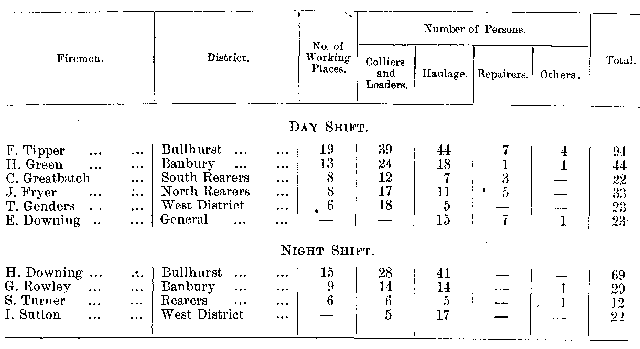
The workmen in each shift were accompanied by the fireman, who remained with them during the shift. The examination before the commencement of work in the day shift was made by the fireman in the night shift.


A copy of this report was kindly donated by
West Cumbria Mines Research.




 Contains public sector information licensed under the

