


|

|

|

|
|
 |
 |
 |
||
I. — Description Of The Colliery And Its Conditions.
Situation and History of the Colliery. — The Podmore Hall Colliery is situated at Halmerend in the Parish of Audley in the County of Stafford on the North-Western edge of the North Staffordshire coalfield.
This is not the first occasion upon which an explosion has occurred in this mine. In February, 1898, and in January, 1915, explosions occurred in the Bullhurst Seam; no lives were lost by the former but 9 persons were killed by the latter. Both explosions were attributed to gob fire.
The Workings of the Mine. — Seams Worked and System of Working. — The seams worked are the Four Feet, Five Feet, Banbury Seven Feet, and Bullhurst Seams. There are two shafts, viz. — No. 1 or Downcast Shaft, generally known as the Minnie, and No. 3 or Upcast Shaft. The former, which is used for raising coal and water and for lowering and raising persons employed on roads in the vicinity of the shaft and in the Four Feet and Five Feet Seams to the west (which were not affected by the explosion), is 16 feet in diameter and is sunk to a depth of 359 yards; the inset is 339 yards from the surface and the remaining 20 yards are used as a water lodgement. The other shaft, situated 845 yards in a south-easterly direction from the downcast shaft, is 280 yards in depth, but the hanging on is placed 20 yards from the bottom, the portion below this level being also utilised as a water lodgement. No coal is raised at this shaft but it is used for pumping water and for lowering and raising persons employed in the workings affected by the explosion and in the Bullhurst Rearer workings. Two main intake airways commence at the bottom of the downcast shaft; one in the direction of the workings to the west and the other in the direction (North-East) of workings affected by the explosion. Both these intakes were used for the haulage of coal, but as the one to the west played no part in the explosion there is no necessity to describe it. The other — leading to the area affected by the explosion — is flat and approximately in line with No. 3 shaft for 45 yards; it then turns slightly to the left and rises at an average gradient of 1 in 11 for 500 yards. It then turns again to the left and for a distance of 540 yards rises at an average gradient of 1 in 4½, whence it is level for 260 yards. The last 60 yards of this distance are driven in the Ten Feet Seam, in which no work was being done at the time of the disaster. The Banbury Seven Feet and Bullhurst Seams are cut by a crut or stone drift driven at this point, where they are highly inclined and known as Rearers. The Bullhurst Seam only was worked in this section, and all the men in it (57) were ultimately recovered alive. The workings are damp and free from firedamp. The haulage road is continued as a crut, known as the Banbury Dip, dipping at a gradient of 1 in 3 for a distance of 370 yards, where it intersects the Seven Feet Banbury Seam at about the same level as the "hanging on" level at No. 1 shaft. The road is driven level in that seam for 45 yards; it then turns to the left almost at right angles and is continued as a level cross measure crut for 210 yards, whence it dips at a gradient of 1 in 6 for 60 yards to intersect the Bullhurst Seam, which is 90 yards vertically below the Seven Feet Seam. The roads from both shafts to the foot of the Banbury Dip Cruts were wet or damp and this part of the mine did not, in consequence, suffer from the effects of the explosion. On the in-bye side of this point the roads generally were dry and dusty, and it was this area that was traversed by the explosion. The force and flame were confined to the Seven Feet and Bullhurst Seams beyond the bottom of the Banbury Dip Cruts.
The Seven Feet Seam was worked from this point by a system of modified longwall. The main roads were driven in the solid and pillars left to support the roadways, the longwall face being opened up off the counter heads. In one section, owing to the undulating character of the seam and the large number of faults, the pillar and stall method of working was adopted. At the date of the explosion the whole of the longwall work was completed and the pillars left to support the roadways were being extracted.
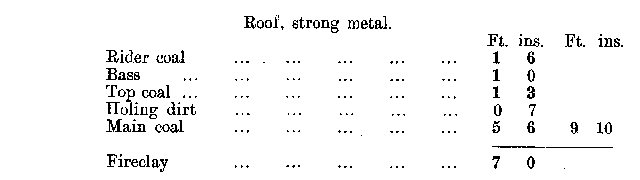
The Section of the Seven Feet Seam is :—
The Bullhurst Seam had been worked in two directions from the bottom of the Banbury Dip. A pair of dip cruts were driven some years ago and the seam was worked to the rise, until an explosion occurred in January, 1915, causing the loss of 9 lives and injury to three persons. These men were repairing the haulage gear at the bottom of Banbury Dips. No one was in the workings, which were abandoned and allowed to fill with water. A pair of level cruts were then driven and they intersected the Bullhurst Seam, known as No. 1, 2, 3 and 4 Districts (see Plate II).
Owing to its liability to spontaneous combustion, this area of the Bullhurst Seam was divided into separate and distinct panels, with 25 yard barriers of coal between them to ensure the coal being extracted as quickly as possible. Each panel had only two roads into it — intake and return — in both of which preparatory stoppings, four feet six inches thick, were built in readiness for the speedy sealing off of that panel on any symptom of heating or fire within. Each panel was formed into pillars 12 to 15 yards wide and these pillars- were extracted by working from the barrier in each case, starting at the highest point in each panel and working downwards, thus allowing the goaf above to be filled with gas in order to form, as far as possible, an atmosphere which would not support combustion. Four such panels had been worked out and sealed off, of which two, on the lower side, had become water-logged, and, so far as the evidence showed, there had been no indication of heating or gob fire. Four other panels had been headed out and only in a small area of two of them had pillars been extracted or partially extracted.
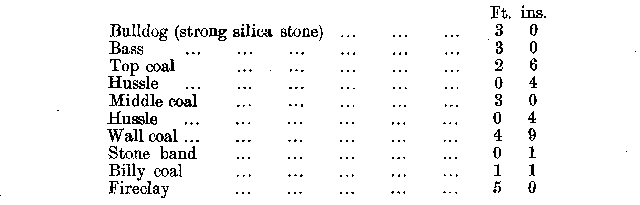
The section as given in the evidence of the Manager of the Bullhurst Seam is
Shot Firing. — Shots were fired in getting the coal in both the Seven Feet and the Bullhurst Seams. The explosive in use was Roburite No. 4, of which the maximum charge allowed by the Explosives in Coal Mines Order is 18 ounces.
Explosives were issued in locked canisters by authorised persons to the workmen, and the keys of the locks were only in the possession of authorised and certificated persons, viz., firemen and shot-firers.
Detonators were issued in locked cases by an authorised person to authorised and certificated persons. Clay from the surface was provided for stemming. All shots were charged and stemmed by, or under the supervision of, the authorised shot-firers and were fired by them by means of a magneto-battery provided with a push button and removable handle. Owing to some of the workings at the top end of No. 4 District in the Bullhurst Seam being in close proximity to goaf charged with gas, shot-firing had been prohibited by the management for about three weeks, but evidence was given at the inquest that shot-firing had taken place within this area a day or two before the explosion and a canister containing explosive was found after the explosion in Cartledge's Place (see Plate V). It is clear, however, from the position of the shot-firing batteries that no firing of a shot took place at the time of the explosion.
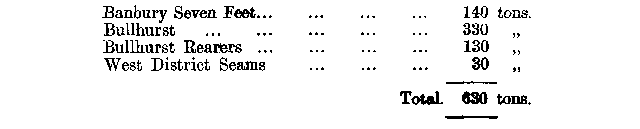
Output and Haulage. — The output of coal was about 630 tons per day of two shifts, the quantity from each seam being.
The main haulage from each seam to the shaft was in the intake airways. The tubs were constructed so as to prevent dust escaping through their sides, ends, or floor, and they were not filled above the level of the top. For the first 1,300 yards from the downcast shaft the main haulage was by means of two self-acting endless rope haulage sets, 500 and 800 yards long respectively, with a speed of about two miles per hour. The haulage up the Banbury Dip, up which the outputs from the Seven Feet and Bullhurst Seams were hauled, was effected by means of an endless over rope actuated by a band rope from the surface of No. 3 shaft, with a speed of about 1½ miles per hour.
Secondary haulage was by means of horses, self-acting inclines, and, in three cases, by direct rope. The drums in the last method were revolved through friction clutches keyed on to a counter shaft, which was driven by gearing off a main shaft worked by the Banbury Dip endless haulage rope. The speed of the direct ropes was about 1½ miles per hour.
Along the Bullhurst Main Level Crut and the Main North Level in the Bullhurst Seam (see Plate II) the haulage was done by horses, the distances being 210 and 700 yards respectively.
It appeared from the evidence that at the time of the explosion none of the self-acting inclines was in operation in the Bullhurst Seam.
Electric Signalling and Telephones. — An electrical system of signalling was installed and used from the surface of No. 3 shaft to the bottom of the Banbury Main Dip and the intermediate station; also from the top of the Banbury Main Dip and station. A telephonic system was also in use from the same stations. There was an additional electrical system from the distribution engine house at the bottom of the Banbury Dip to the Bullhurst Seam, but it was only carried into the seam itself about 70 yards in the direction of No. 1 district. The voltage of the main system at the surface of No. 3 Pit was stated in evidence to be 24 and of the secondary system 12 volts.
The following are particulars of the apparatus in use
Signal Bells. — Wigan Ironclad type, totally enclosed, gas and dust proof.
Telephones. — "Sterling" and "General Electric," magneto instruments, ironclad totally enclosed, gas and dust proof.
Ringing Keys. — Ironclad stirrup type, totally enclosed, gas and dust proof.
Cables. — Two and three core conductors 1/16 S.W.G. V.I.R. 600 Megohm grade insulation, single wire armoured and jute compounded overall.
There was no other electrical installation in the mine.
Ventilation. — Ventilation of the mine was produced by a Bumstead and Chandler fan, placed on the surface at No. 3 shaft. The fan is 9 feet in diameter and 2 feet wide, and is directly driven by high speed steam engines running at 350 revolutions per minute, inducing a current of approximately 60,000 cubic feet of air per minute at the bottom of the downcast shaft. It was provided with an arrangement for the immediate reversal of the air current in case of necessity.
There is also a standby fan of the Walker "Indestructible" type. It is 20 feet in diameter and 7 feet wide, rope driven. It was run for about two hours every Sunday morning during the examination of the Bumstead and Chandler fan and engines. The quantity of air usually entering the mine was maintained during the week-ends.
The last measurements, prior to the explosion, of the air in the various parts of the mine were recorded as below
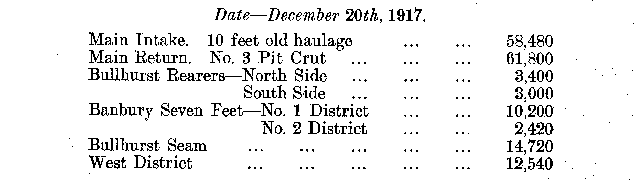
It is required by Section 29 (2) of the Coal Mines Act, 1911, that the quantity of air in the main current, in every split and at such points as may be determined by the Regulations of the mine shall at least once a month be measured and entered in a book to be kept for the purpose at the mine. General Regulation 77 specifies these points as (a) in the main intake airways of every seam as near as practicable to the downcast shaft, (b) in every split as near as practicable to the point at which the split commences; and (c) in each ventilating district at or as near as practicable to a point 100 yards back from the first working place at the working face which the air enters.
The measurements in the Bullhurst Seam required by (b) and (c) of General Regulation 77 had not been entered in the form prescribed by the Secretary of State. The management, therefore, contravened Sections 24 (1) and 29 (2) of the Coal Mines Act, 1911. The manager's explanation was that these measurements were made by Jones, an overman, who was one of the victims of the explosion and were entered in his note book, but not in the prescribed book. As the note book has not been recovered, I am unable to state the volume of air which travelled the faces of the various districts and whether or not there was any undue leakage between the entrance to the ventilating districts and the faces.
Safety Lamps. — The safety lamp used at the mine was Richard Johnson, Clapham and Morris' Marsaut type.
All lamps were examined by the lampman, by the workmen, and, at the shaft bottom, by the fireman. The cause and nature of any damage were entered in the book prescribed by the Secretary of State for the purpose. There were no relighting stations underground. The oil used was mineral-colza, the flash point of which was stated in evidence to be 260 to 265 degrees Fahr.
Searching for Matches, etc. — Searching of men took place at the commencement of each shift by two persons who were themselves searched in the first place. The number of men in each shift and the number searched, with the result of the search, were entered in a book provided for the purpose. It was stated in evidence that an average of at least 25 per cent. of the men in each shift was examined and that a surprise search was made at least once every three months of everyone in each shift. Every person not forming part of a shift was searched on each occasion on which he descended the pit.
Firedamp. — In the working of the Banbury Seven Feet and Bullhurst Seams firedamp was given off freely. The manager stated that, realising this, his instructions to his officials were that men were to be withdrawn when 2 per cent. or more was found in a working place and that a report was to be entered in the book kept for the purpose. The men were not to be allowed to return to a working place, except for the purpose of assisting the fireman or other competent person in the removal of gas, until the gas was cleared. Rise and level places were ventilated by pipes 18 inches or 12 inches in diameter, and near the face a pipe, specially made to slide within the others, was inserted to enable the ventilation to be carried close up to the face. His instructions were that wherever possible the ventilation through these pipes must be by suction.
Coal Dust. — Water was wound in the cages of No. 1 or Downcast Shaft and this caused the shaft to be wet, so that little, if any, of the dust made in screening the coal, or dust from the full tubs ascending, was carried into the mine.
The manager, in his evidence, stated that the tubs were constructed and maintained in a dust tight condition, but in cross examination at the Inquest he admitted that the joints between the boards were not in all cases tongued and grooved and that they had a tally-hole in them through which dust could pass. The speed of the various methods of haulage was comparatively speaking low. The faces, particularly in No. 4 district, were dry and dusty and the roads in the Bullhurst Seam contained dry coal dust in sufficient quantity to allow an explosion to be propagated and force and flame to traverse practically the whole of the roads in both the Seven Feet and Bullhurst Seams.
The means adopted for dealing with the dust on the roads was to clean up the floor by means of spades or shovels. The roof and sides were not cleaned at all, and no watering was done beyond slight spraying of the floor from water barrels, as it is said watering would have caused the floor to heave and the roof and sides to fall to such an extent as to make maintenance of the roads impossible. In his evidence the manager stated that he did not realise before the explosion that the condition of the roads and faces, so far as dust is concerned, was dangerous, and that he thought the cleaning up of coal dust on the floor, in conjunction with the creation of inert dust from the fireclay floor by horses and men walking in and out, was sufficient to cause the dust on the roof and sides to contain at least 50 per cent. of inert matter. This, however, was merely an assumption, and was not based on sampling or analysing the dust on the roads prior to the explosion. He frankly admitted that, to prevent explosions of coal dust in this mine, under conditions such as existed in the Bullhurst and Banbury Seven Feet Seams at the time of the explosion, systematic stone dusting and sampling should be done in future throughout the roads and up to the faces. Draft Regulations recently issued under Section 86 of the Coal Mines Act provide for precautions being taken by stone dusting, etc., on the lines recommended by the Explosions in Mines Committee to prevent explosions of coal dust.


A copy of this report was kindly donated by
West Cumbria Mines Research.




 Contains public sector information licensed under the

