


|

|

|

|
|
 |
 |
 |
||
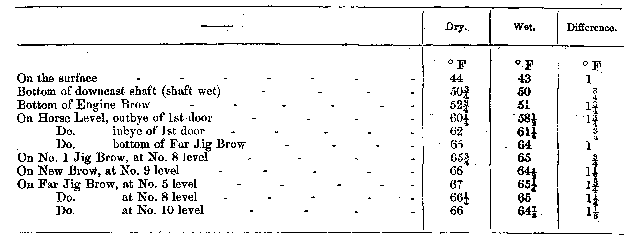
The following hygrometrical observations were made on the 30th January 1889 :—
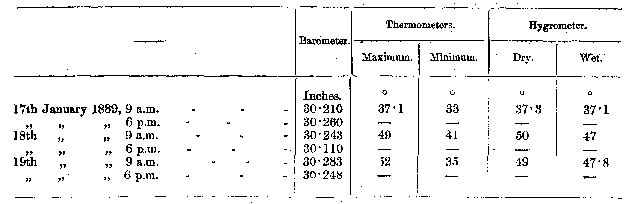
The following meteorological observations, taken on the day of the explosion, and on the preceding and succeeding days, have been kindly furnished by Mr. Alfred Chadwick, M.D., F.R.M.S., &c. They were taken at Heywood Observatory, about 10 miles from Hyde Colliery.
The official staff of the colliery consisted of the certificated manager, Mr. Jos. Goodwin (who had also under his charge the Broomstair Colliery belonging to the same owners), an under-manager named Edward Jackson, and five firemen. Of the firemen, two, named Jos. Wilde and Jas. Davis, were employed in the Two-feet mine. They were assisted by a third named Eli Bradbury, who was employed partly in the Two-feet mine, and partly in the Peacock mine.
The morning shift in the Two-feet mine consisted of 1 fireman, 26 colliers, 10 waggoners, 4 jiggers and takers-off, 2 drivers and 1 dataler. An afternoon shift of 30 men and boys succeeded the morning shift.
On the morning of the 18th January, the workmen descended the pit about 5.30 a.m. They were met at the bottom of the shaft by the fireman, Jos. Wylde, and informed by him that all was safe. He also made a written report, of his previous inspection, made that morning, to the same effect, and it was initialled by the under-manager. The men and boys proceeded to their working places.
All appears to have gone on as usual until about 9.30 a.m., when the explosion occurred. It caused a reversal of the air at the downcast shaft, and an alarm was given. The work of rescue and exploration was at once undertaken by the owners, officials, and workmen, assisted by volunteers from neighbouring collieries. Some of the explorers were severely affected by the after-damp in their endeavours to penetrate the workings, Mr. Goodwin, the manager, so much so as to be completely incapacitated for several days.* No other difficulties were met with, and the last of the bodies was brought to the surface about 12 hours after the explosion:
The following is a list of the persons who were killed or injured by the explosion :—
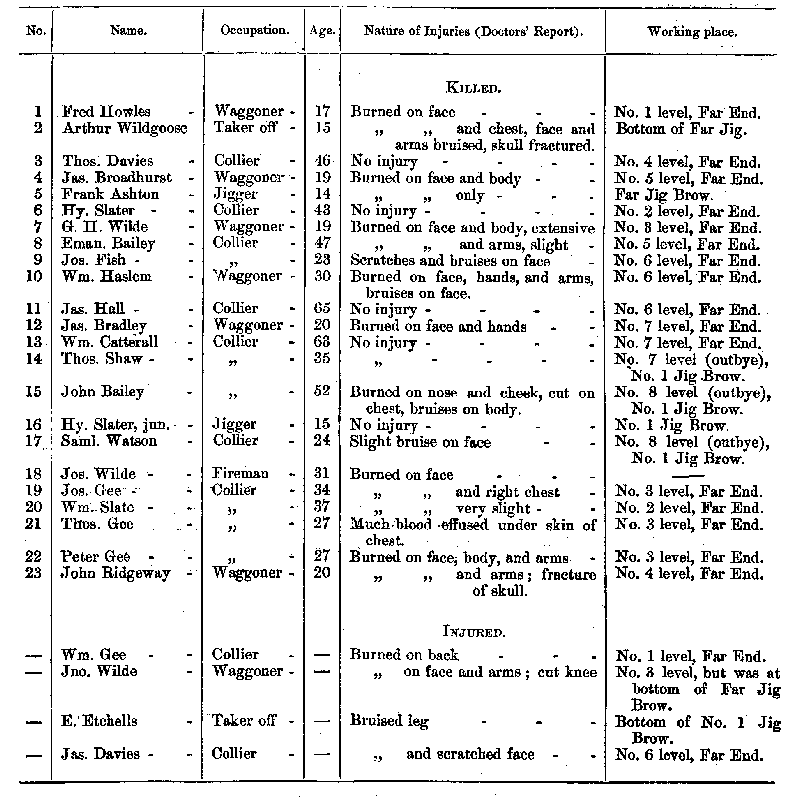
All the burns were of the second degree only. Although there were fractured skulls in two cases that was probably not the immediate cause of death. The immediate cause of death is ascribed to asphyxia in every case.
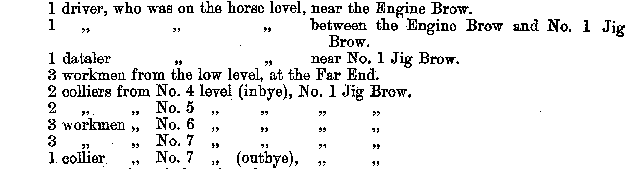
Seventeen persons escaped uninjured from the district of the explosion, except that some of them were affected by the after-damp. The following is an account of them :—
The examination of the mine showed that the explosion had been confined to the workings in the Two-feet mine between the New Brow and the working face or goaf edge at the far end, and above the horse level, with the exception that it had also passed along the upper level outbye of the New Brow. The explosion had not developed great force. The bodies of none of the men were mutilated. Little or no timber was displaced. No tubs were broken. Nearly all the canvas sheets and stoppings within the field of the explosion were blown out.
When the workings were first explored, the air passing along No. 10 level, the return air-way, was heavily charged with fire-damp, and in No. 8 level fire-damp was found near the goaf. It could also be detected in the goaf behind the working face above No. 7 level. The source of the gas evidently lay in the goaf. The air-way from the working face above No. 7 level on to No. 8 level was found to be impassable, and apparently nearly closed.
The following indications of force were observed. Unfeathered arrows On plan No. 2, at the points named, show the direction in which the force had been exerted.
On the horse level the first and second doors were uninjured; these doors opened outward. The third door was broken and blown outward; this door opened inward. The fourth door was uninjured; this door opened outward.
On the Far Jig Brow was a barricade formed of loose stones, built partly across the bottom of the brow for the protection of the taker-off. The upper part of this walling was blown outward. Further up this jig brow, at No. 6 level, a "landing sill." was blown outward. (This is a piece of timber laid across the floor of the brow. at a level end in order to form a horizontal landing place for the tubs coming on to the brow out of the level.) Still further up the Far Jig Brow, at No. 7 level, the timber connected with the jig frame was forced outward, and a fence above-the jig was blown outward onto it.
In the levels on the inbye side of the Far Jig Brow. — In the deep level there was no disturbance. The explosion had not traversed any part of this level. In No. 1 level a wood door, just beyond the bottom of the Far Jig Brow, was not displaced; this door opened inward. The sheet which had hung just beyond it was gone. In No. 2 level the two sheets were gone. About half way along this level was a piece of canvas, which may have formed part of the sheet; it was caught round a prop as if it had been blown outward. At the far end of this level a tub was blown inward over the rail ends and against a pack wall. In No. 3 level a full tub stood near where the sheets had hung. Portions of the sheets were blown against the sides and wheels of the tub as if by an outward force. About one-third way along the level a piece of canvas was caught round a prop as if blown outward, and about half way along a piece of newspaper was similarly blown. On No. 4 level the sheets appeared to have been blown inward, and at the far end of this level a tub had been blown inward. In Nos. 5, 6, 7, 8 and 9 levels the sheets appeared to have been blown inward.
In the levels on the outbye side of the Far Jig Brow. — In No. 2 level was a packed dirt stopping, and this was not disturbed. In Nos. 3, 4, 5, 6, 7, 8 and 9 levels the canvas stoppings and sheets all appeared to have been blown outward or away from the brow. In No. 5 level, about half way along, the corner of a pack wall was swept in the same direction, and at the outbye end of this level was a tub which appeared to have been forced outward over the rail ends.
In the upper of the two levels, connecting the New Brow with No. 1 Jig Brow, a regulating sheet near the New Brow,, and the frame in which it had hung, were blown outward; and a door and a sheet, on the same level, near No. 1 Jig Brow, were also blown outward. In the lower of the two levels a regulating sheet near the New Brow was undisturbed; but a prop said to have stood in the frame in which the sheet hung was found 8 yards outbye of that frame.
The effects of fire were observed on the bodies of 14 of the victims, and two men who escaped were burned. The names of these men and boys are given in the list, as also the places where they worked. The places where the bodies were found are shown on plan 2. Besides the burning on the bodies of these persons, signs of fire in the shape of caked or partially coked coal dust, were observed in most of the levels to the right and left of the Far Jig Brow.
This caked dust was found on props or on projecting surfaces of coal. The approximate situation of the places where caked coal dust was observed, and the direction in which it appeared to have been thrown when deposited, are shown by small red arrows on plan 2. The direction in which the caked dust had been thrown is in most cases contrary to the direction in which it is supposed the explosion had passed, and this is in accordance with my previous experience, and has been corroborated by other observers, particularly by Mr. W. Galloway. It will be observed that in No. 6 level, on the outbye side of the Far Jig Brow, the red arrows point in the contrary direction to those in the levels above and below. This is the level along which the air current passed on account of the obstruction in the New Brow between Nos. 5 and 6 levels. It is an interesting speculation as to whether the flame may not have been carried down the New Brow and into this level at its outer end, by the inflammable air current, and thus account for the difference, the New Brow and the levels for a short distance from it being damp. Nothing was observed to corroborate this idea, but as the principles governing the deposition of caked or coked coal dust in colliery explosions are still obscure, it is mentioned as a possible explanation of a difference which appears otherwise inexplicable.
* It may not be out of place here to say a word of warning to persons who, without experience of large explosions, are called upon to enter a mine after an explosion has taken place. They should bear in mind that the resulting afterdamp is of an extremely poisonous nature, and that it may be fatal to men when its presence cannot be detected by the lamps, or directly by any of the senses. It frequently occurs that men proceed into the workings before the ventilation is restored, and are not aware of the poisonous nature of the atmosphere until they are so far overcome as to be hardly able to retrace their steps into purer air, and sometimes they perish. It is probably carbonic oxide which poisons them. A minute proportion of this gas in the air is fatal to animal life. It is invisible, and has very little odour. The lamp, on which the miner chiefly depends for information as to the state of the air, is useless to warn him that carbonic oxide is present, even when in such proportion as to be rapidly fatal.


A copy of this report was kindly donated by
West Cumbria Mines Research.




 Contains public sector information licensed under the

