


|

|

|

|
|
 |
 |
 |
||
12. General Observations.
(a) Ventilation. — Adequacy of ventilation is not measured by quantity but by quality. Nevertheless, in addition to the requirement contained in Section 29 (1) of the Coal Mines Act, 1911, that "an adequate amount of ventilation shall be constantly produced in every mine to dilute and render harmless inflammable and noxious gases . .", it would be an advantage to prescribe a minimum quantity per minute for each district of a seam relative to the output of coal per day or per week from that district.
By this means increased output from any district, due to intensive working or any other factor, and consequent increased emission of gas, would be accompanied by an increased amount of ventilation.
The average weekly output of coal from the Dennis Section for the 10 weeks ended 22nd September was :—
| Tons | ||
| 20's and 61's | district | 1,651 |
| 14's | 1,617 | |
| 109's | 813 | |
| 29's | 1,340 |
On the basis of cubic feet of ventilation per minute per ton of coal per week, 14's district should have had as much air as 20's and 61's; twice as much as 109's and more than 29's. In fact, it probably had less on the face than any of the other districts.
Main airways. — By Section 36 (3) of the Coal Mines Act, 1911, every part of the mine in which ten or more persons are employed at the same time must be provided with at least two ways affording means of egress to the surface.
By Section 42 (1) every seam of every mine newly opened after the coming into force of the Act, and not exempted by General Regulations, must be provided with two main intake airways of such a size and condition as will afford a ready means of ingress to and egress from the workings, and one of which must not be used for the haulage of coal.
Gresford Colliery was not a mine newly opened after the coming into force of the Coal Mines Act, 1911, but it is necessary to consider whether, if it had been and, accordingly, two main intakes had been provided in the Dennis Section of the mine, any of the persons who were killed might have escaped.
If the explosion was an explosion of gas propagated by coal dust, it is reasonable to assume that, as one of the main intakes would not have been used for the haulage of coal, that particular road would have been practically free from coal dust and would therefore be less likely to be damaged or to have inflammable material in it, such as timber, set on fire. A possible means of escape would thus have been provided for any who survived the explosion and the resulting afterdamp, and those going to their aid might not have been held up by the fire at 29's Turn.
Even had this been so, whilst it is impossible to be definite, I do not think anyone would have been found alive.
I wish, however, to point out that Section 42 of the Coal Mines Act, 1911, was enacted before the General Regulations of 1920, setting out the precautions to be taken against coal dust, were established, and to express the opinion that instead of two main intakes in every seam it is desirable that two main return airways should be provided in connexion with every main intake airway and that these main return airways should be placed one on either side of each main intake airway.
By these means, I consider each district of a mine could be efficiently ventilated and the chance of any explosion occurring and, in consequence the risk of fire due to explosion, would both be mitigated.
Reporting of gas. — Some of the deputies said if they found gas and cleared it, they did not report it in their report books. All findings of gas should in my opinion be reported in the statutory report book. It was said there was no place in that book for reports of gas found other than during an inspection: that is a small matter which can easily be rectified, but to require any gas found at any time to be reported will need an amendment of Sections 64 and 65 of the Act.
(b) Underground fires. — Fires occur in mines from other causes as well as from explosions and it is desirable that means of fighting such fires should at all times be readily available.
Since the Gresford Explosion a Joint Committee representing the Institution of Mining Engineers, the Mining Association of Great Britain, and the National Association of Colliery Managers, has been set up and has issued a Report.
There seems to be no doubt that water under pressure is the best means of extinguishing a fire. At some mines water pipes are laid along all the main roads; it is a question whether they should not be required to be so laid in all main roads which are dry and are supported by material of an inflammable nature.
(c) Precautions against coal-dust. — The General Regulations embodying the precautions to be taken against coal-dust came into force on 1st January, 1921. During the previous 15 years, 1,899 persons were killed in 231 explosions and during the subsequent 15 years 977 were killed in 187 explosions. The reduction in the number of deaths during the latter period by nearly 50 per cent. may fairly be claimed to be due to the use of stone-dust, but it may be asked whether some amendment of the Regulations would not result in a further reduction.
Opportunity for investigation after the original explosion at Gresford Colliery on 22nd September was very limited, but after the sealing of the shafts at least two further explosions occurred. The effect of these extended to the surface and when several months later the mine was re-entered, it was found that these or other explosions had extended into the face of the Slant district, a distance of over 2,000 yards from the Dennis Main.
At the outer end of the Slant Main Intake considerable damage was done, but little or no evidence of force was visible for the next 1,200 yards inbye along that road. Samples of the dust on this road were taken as soon as was possible after the re-entry of the mine and were analysed with result, to the nearest round number, as follows:—
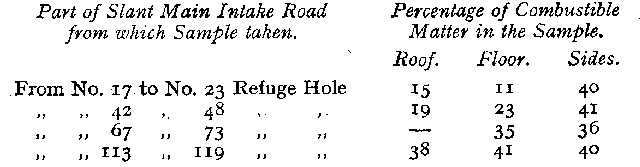
No coked dust was found on this road when it was examined on the mine being re-entered or on that part of 142's Deep down to 29's Turn which was examined before the sealing of the shafts, and on that account it may be thought that neither the original explosion nor those which occurred afterwards were propagated by coal-dust. It falls to be remarked, however, that the late Professor Sir William Galloway, whose work on the influence of coal-dust in colliery explosions is well known, in a Paper read before the Royal Society in 1882, pointed out that the impossibility of tracing the continuity of the flame in explosions by means of deposits of coked coal-dust had been a source of very great difficulty and doubt, for it had seemed exceedingly strange that "marks of burning" should be observable in widely separated districts and that none should be found in the only roadways connecting them. He then gave the explanation, as follows :— "The dust in the main roadways is inflammable and propagates the explosion; but it cannot cohere when heated on account of the presence of foreign substances other than coal; and, consequently, when it is thrown against timber and other objects, it does not adhere to them."
The presence of incombustible dust in the dust at Gresford Colliery may account for the absence of coked dust, but, if it be the case that an explosion originating at the known fire at 29's Turn was propagated by coal-dust some 1,100 yards up the Dennis Main Intake and over 2,000 yards into the Slant district, then, in view of the combustible matter contained in the samples collected from the Slant Main Intake and referred to above, it would appear that the dust from the coal worked at Gresford, even when containing less than the 50 per cent. of
combustible matter allowed by the General Regulations, was still dangerous.
That the 50 per cent. of combustible matter is the maximum allowed by the Regulations has been stressed on many occasions and many Managers of mines have taken care to keep well below that maximum.
Professor Wheeler, as Director of the Safety in Mines Research Board Experimental Stations, has also pointed out that experiments at the Board's Research Stations at Sheffield and Buxton have shown, inter alia, that, while some coal-dusts need to be mixed with less than 50 per cent. of incombustible matter to make them safe, others require more; that the presence of even a small percentage of inflammable gas necessitates a higher percentage of stone dust; and that some stone dusts are chemically more effective than others but have in different degrees the disadvantage that they are less readily dispersed into the air than coal dust.
These results have been carefully considered but there is considerable difficulty in framing a practicable code of Regulations which, without undue complication, will cover these factors under a great variety of working conditions. The question is one which awaits solution and is being pursued, but until it is solved, all Managers, even those who manage mines where 50 per cent. of incombustible matter, according to the experiments, may be more than sufficient to counteract the inflammability of the coal-dust, should remember that the Explosives in Mines Committee in their Fifth Report said — It should be clearly understood that in recommending this limit of 50 per cent. of ash we are putting it forward provisionally and as a minimum."
Road Dust Samples. — At some collieries a plan is kept showing the zones from which dust samples are taken. Such a plan should be required to be kept at every colliery; the zones should be numbered and the sample taken from any zone should be numbered with the same number as the zone from which it has been taken and the result of the analysis of the sample entered in the dust record* under that number. By this means it could readily be seen whether the General Regulations in respect of dust sampling were being carried out.
* Mines and Quarries Form No. 41.
(d) Management and Supervision. — As regards the general management and supervision of the mine, it is right in fairness that I should first draw attention to the fact that the average killed and injury rate per 100,000 manshifts worked at Gresford Colliery, during the five years ended 31st December, 1933, was lower than the rate for the remainder of the mines in North Wales and the rate for Great Britain; and that the fatal accident rate at Gresford, on the same basis, was almost 19 per cent. lower than that for either North Wales or Great Britain.
The relative figures are shown in Appendix IV.
I think it is a mistake to work large collieries without some able mining engineer in authority and superior to a manager, known under the Act as "Agent."
The person appointed to such a post needs to be of strong character and able if necessary to resist those in control of the commercial side of the concern.
At Gresford the Agent retired in the autumn of 1932. Whether he was a man of strong character or not I do not know but, although the mine was begun as recently as 1908 and coal was not drawn until the summer of 1911, it is remarkable that there was no proper air-lock over the top of the upcast shaft. The absence of such an air-lock could only result in waste by reason of air being drawn in at the top of that shaft without having done any useful work whatever.
At the beginning of 1935, when it was decided to re-enter the mine, the first step to that end was the erection of an airlock over the top of the upcast shaft at a cost, I believe, of some Ј1,400. Such a relatively small sum should not have prevented the erection of an air-lock during the opening of so large a mine and had one been erected its cost would have been much more than saved subsequently.
Earlier in this Report I have stated that I consider the initial mistake which led eventually to the explosion was the failure to drive three drifts through the 75 feet fault beyond the "Clutch" and to maintain two main return airways, one on each side both of the Dennis Main Intake and of 142's Deep. That failure occurred during the late Agent's tenure of office, but whether it was he who was in fault or whether he knew what ought to be done and was prevented by those in charge of the commercial side from doing it, I have no means of knowing.
Mr. Bonsall did say, in evidence, that in the matter of finances there had never been any stint; that it was for him to consider what appliances or safety precautions were desirable or necessary and that he had always found that he could get what he wanted in the way of money to carry out his wishes in those respects.
That may be, but after the Agent retired Mr. Bonsall said there had been no consulting engineer except Mr. Harrap, who was the Secretary of the Company; that he had nobody at all with whom he could consult on purely technical matters and was left wholly to himself to run the mine.
That, as I have said, I think was a mistake but, in addition, I have an uneasy feeling that Mr. Bonsall was overridden. I ask myself why was the driving of 37's place stopped and the men sent to produce coal? Why was 105's drift not being worked continuously on all three shifts? Why was the scouring in 14's stopped instead of being pushed on continuously? Why were men taken out of 14's return airway to work on the coal when there were absentees in the face? And, above all, why were not 29's, 14's and 95's districts stopped until the necessary alterations had been made in order to provide adequate ventilation? And my uneasy feeling remains.
It may be that Mr. Bonsall was incapable of seeing the position as it existed, but I feel sure that Mr. Williams, the Undermanager, saw it. But what could he — a newcomer — do?
He might have persuaded the Manager to call in the Inspector. That might be considered by some standards to be a disloyal act. Perhaps so, but there was much at stake and I feel some means should be evolved to meet such a position — some means by which, in such circumstances, Managers can retain their posts and, at the same time, have the mines which they manage kept in safe condition.
In this connexion, I consider that Section 83 of the Coal Mines Act, 1911, should be so amended as to give power to the Secretary for Mines to direct a formal investigation into the conditions and circumstances existing as regards safety at any mine, whether any accident has happened or not.
It is not surprising that the Under-manager, Mr. Andrew Williams, was only able to visit the mine twice on the night shift during the eight months he was there, seeing that his normal working hours were from 5 a.m. to 5 or 5.30 p.m. each day and that very often he was back at the surface of the mine afterwards.
Such hours day after day are not conducive to good work or alertness of mind and should not be allowed. There should be one or more Under-managers on each shift and none should be expected to work longer hours than the deputies. The hours of overmen should also be regulated to the same extent.
(e) Inspections on Behalf of Workmen. — I am of opinion that all persons working underground. in a mine should be members of a Trade Union and, for their own satisfaction, should take advantage of the provisions of Section 16 of the Coal Mines Act, 1911, and have inspections made at intervals of not more than three months.
(f) Mines Inspection Divisions. — I have always considered that the incorporation of two Mines Inspection Districts, as they existed before 1st June, 1910, in one Division was a mistake and, so far as has been possible, I have tried to correct that mistake.
"The actual visiting and inspection of mines and quarries form by far the most important part of the duties of an Inspector" according to the Instructions issued to the Inspectors years ago by the Home Office, yet the present unwieldy Divisions were created.
I think for the better administration of the Act and to enable the Inspectors to discharge "by far the most important part of their duties," a reversion to the original position should be made. By so doing, the Inspector in charge of each district would be able to become familiar with the workings of the mines in his District, a position which at present, except in one or two smaller Divisions which need not be altered, is not possible. And there would be no division of responsibility which now, with Divisional Inspectors and Senior Inspectors, exists. Each District Inspector would be in charge of a District and would know that he, and he alone, was responsible for it.
Conclusion.
I regret to record the death of Mr. Peter Lee, past President of the Mineworkers' Federation of Great Britain, who, with Mr. Joseph A. Hall, represented that Federation during the first 28 days of the Inquiry. I had known Mr. Lee for very many years and for him had a great respect. His place was taken by Mr. Herbert Smith.
I conclude by expressing my thanks to the two Assessors, Mr. John Brass and Mr. Joseph Jones, and to all who took part in the Inquiry — Advocates, Representatives and Witnesses alike — and to Mr. E. A. Shearing, Clerk to the Court.
I have the honour to be,
Sir,
Your obedient Servant,
Henry Walker.


A copy of this report was kindly donated by
West Cumbria Mines Research.




 Contains public sector information licensed under the

