


|

|

|

|
|
 |
 |
 |
||
6. Precautions Against Coal Dust.
(a) Stonedust. Quality and Quantity. — The material used for stonedusting the roads was a residue from the water-softening plant installed at the surface of the mine.
The Manager gave an analysis of this material which agreed substantially with that made by Captain C. B. Platt, Superintending Testing Officer of the Mines Department. These analyses showed that slightly more than 90 per cent. of this material consisted of Calcium Carbonate; 1 per cent. of combustible matter and the remainder of small percentages of alumina, calcium sulphate, sodium carbonate, sodium chloride, magnesium carbonate and siliceous matter.
The material, when dry, on being spread out and beaten with a shovel, fell into powder. According to Captain Platt, 90 per cent. of a sample of the sludge, when dried for one week at 105 degrees Centigrade, was fine enough to pass through a 200 I.M.M. sieve. There was no evidence that the dust tended to cake. The material was therefore quite suitable for the purpose.
The sludge was sent down the Martin Shaft at the rate, it was said, of six or seven tubs per day on five days per week; no record was kept. The tubs were about three parts full, each tub carrying about 22 hundredweights of sludge equivalent to 12 hundredweights of dry dust. These tubs were tipped on the side of the return airway, not far from the Martin Shaft, where the sludge was left to dry before being beaten to powder and filled into tubs for despatch to the several districts.
There were therefore about 16 tons of the dry material available for dusting purposes throughout the mine each week, and these, on the average, were distributed equally between the Dennis and the other sections of the mine. The output from the Dennis Section during the last ten full weeks prior to the explosion was 54,214 tons. On these figures, the amount of "stonedust" available in the Section, including any used in connection with shotfiring, was 3.3 pounds per ton of coal drawn.
The Manager, in evidence, gave six pounds of stonedust used per ton of coal produced from the Dennis Section but he had taken the tubs sent down the pit as full tubs whereas, according to the evidence of the onsetter, they were only three parts full. This figure of 3.3 pounds per ton of coal drawn would be, in many instances, if the stonedust were efficiently distributed, more than sufficient to raise the incombustible matter in the dust throughout the roadways to well over 50 per cent. The quantity of stonedust required per ton of coal drawn depends however on the nature of the coal and a number of other factors, for example, the method of working, the state of the tubs and of the rail track, and the kind and speed of haulage.
The relating of pounds of incombustible dust to tons of coal drawn is merely a rough and ready means of comparing one mine with another in this respect, but the real criterion is, and can only be, in the results found by actual sampling.
(b) Cleaning up, Stonedusting and Sampling on Main Roads. — Cleaning up and stonedusting of the main roads were done during the night shift. Evidence was given by men who actually cleaned up and stonedusted and there was evidence by officials and by workmen who had either seen these operations being carried out or had observed the effects of them. There was also evidence to the contrary, by workmen who travelled these roads, to the effect that they had neither seen stonedust being spread nor noticed the effects of its having been spread.
I accept the evidence of Henry Tomlinson, rope-splicer, whose work took him into all the main roads of the mine. He said that he worked every other week on the night shift and when, on that shift, he visited the Dennis Section he had always found stonedusting and cleaning going on.
Whether these operations were sufficient to comply with the requirements of Clause 2 of the General Regulations* in respect of precautions against coal dust could only be proved by sampling as prescribed by Clause 4 of those Regulations.
Such proof was not however forthcoming. The regulation requires that "Tests of samples of dust so taken as to be representative of the normal composition of the dust throughout the roads of the mine on the floor, roof and sides respectively, shall be made as often as may be necessary but not less frequently than once a month".
That requirement was not carried out. Chart 1 shows the zones marked on Plan 4 in which, and the dates at which, samples were taken in the main haulage road and the results of the analyses of those samples. It shows that during the period June, 1930, to March, 1932, sampling of the dust was done not at intervals of one month but at intervals of six months, five months, four months and six months respectively. It shows, also, for the same period, that no sample was taken in 142's Deep beyond zone No. 7.
It will be seen, too, that from March, 1932, when dust samples containing more than 50 per cent. combustible matter were collected from the floor of zones four and five and the roof of zone six, until December, 1933, a period of 21 months, no samples of the dust on 142's Deep were taken and that sampling of the dust on the Dennis Main was practically limited to zone No. 1 adjacent to the Dennis shaft bottom.
* General Regulations dated 30th July. 1920, as amended 20th November, 1924. Part 1. — Precautions against Coal Dust.
After December, 1933, until the date of the explosion, samples were collected covering a longer length of the road, but there was still an interval of five months between the taking of samples, and none had been collected on the Dennis Main since May, 1934, and none on 142's Deep since June, 1934.
This chart has been constructed since the Inquiry, but all the information on which it is based was available to H.M. Inspectors of Mines who, between June, 1930, and the date of the explosion, made 129 visits to the Colliery and ought to have examined that information from time to time.
In May and June, 1932, Mr. J. T. Shaw, Sub-Inspector of Mines, made a complete inspection of the mine covering a period of 14 days, and during his inspections collected representative samples of the dust from various roads, the Manager being given a portion of each sample.
The results of the analyses of these samples at the Mines Department Testing Station at Sheffield were as follows :—
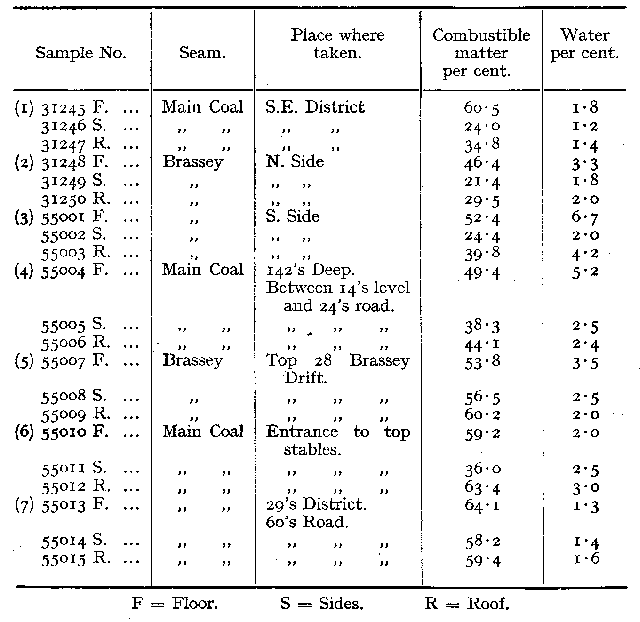
Numbers (4) and (7) of the above groups of samples were collected in the Dennis Section from places where the Management had not taken samples, and despite the high combustible content of group (7) the Management did not take any samples subsequently in or near the same place.
Correspondence between Mr. Charlton and the Colliery Company regarding those samples not in compliance with the Regulations was put in evidence. In a letter advising Mr. Charlton that the defects had been remedied, the Management drew his attention to the results of analyses by their own Chemist, Mr. Lewis E. Thomas, of the part of each sample left with the Manager by Mr. Shaw. These results showed in some cases wide variations as compared with those of the Mines. Department Testing Station. According to Mr. Thomas, samples 55008, 55009, 55012, 55013, 55014 and 55015 contained less than 50 per cent. combustible matter; whilst sample 55004 contained over 50 per cent. combustible matter.
On noting these discrepancies, Mr. Charlton on 2nd August, 1932, wrote to Mr. T. H. Cockin, then Agent of the Colliery, as follows :—
". . . At the same time even Mr. Thomas's results indicate an unsatisfactory state of the roads of the colliery. I have to remind you that the 50 per cent. of combustible matter mentioned in the Regulations is the maximum allowed and it would appear that the whole question of stonedusting the roads at Gresford calls for serious attention."
Unfortunately owing, as Mr. Charlton explained, to pressure of other work he did not pursue the question of these discrepancies beyond instructing Mr. Boydell to see the Manager about them and, in fact, nothing was done to clear up the discrepancies at that time.
In evidence at the Inquiry, Captain Platt agreed with a suggestion put to him by Professor R. V. Wheeler that discrepancies might, in part, have been due to a possible source of error in the method of analysing the samples at that time; an error not general in such analyses, but liable to have arisen in a few cases from the special character of the incombustible dust, and an error the possibility of which at that time was not fully appreciated but had since been studied experimentally and fully remedied.
Counsel for the North Wales Miners' Association saw fit to suggest that the examination of Captain Platt on this point by Professor Wheeler was with the object of supporting the Owners of the colliery by implying that the results of the analyses made by the colliery chemist, generally more favourable as regards incombustible matter, were more likely to be accurate than the official results. I dismiss that suggestion entirely and I am sure that the sole object of both Professor Wheeler and Captain Platt was to bring out the facts for the benefit of the Court, even at the cost of admitting on their own part past liability to error.
Mr. Shaw, who stated that he was perturbed by the results of the samples, had a conversation with Mr. Bonsall on 19th July, 1932, in which he pointed out that he did not think the residue from the water softening plant, together with an occasional truck of stonedust purchased, was quite sufficient. Mr. Bonsall promised attention to the matter.
A further sample of dust taken by Mr. Shaw at the top of 28 Brassey Drift on the same day — 19th July, 1932 — proving not to comply with the Regulations, Mr. Charlton, on 2nd August, 1932, sent a copy of the analyses to Mr. Cockin in a letter, an abstract from which has already been given.
On 4th August, 1932, Mr. Cockin replied to Mr. Charlton as follows :— Until recently our analyses have been quite satisfactory, and I think the falling off is attributable to the short time we are now working. It would appear that the amount of stonedust required is not proportional to the tonnage of coal which passes over the roads.
"I have discussed the matter fully with Mr. Bonsall and he is giving it serious and immediate attention."
Mr. Boydell, H.M. Senior Inspector of Mines, to whom Mr. Charlton sent the correspondence for his information, wrote on it a note dated 6th August, 1932, as follows :—
"A larger quantity of stonedust is now being bought from outside. The average percentage of combustible matter for the various roadways and throughout the whole of the pit is well below 50 per cent."
In evidence, Mr. Boydell at first said that the assertion in the second part of this note was based on Mr. Shaw's report of 19th July, which stated, in reference to dust:— "As far as inspected to-day along the main roads, conditions are satisfactory" but, on being recalled on the following day and having in the meantime obtained his reports for the year 1932 and found from them that he had been at the Gresford Colliery on 6th August, he then said that he had discussed the use of stonedust on that day with Mr. Bonsall and he wrote the note on the correspondence after that discussion.
The statement in Mr. Boydell's note about the buying of a larger quantity of stonedust was not correct for such dust was not bought until later and, samples in the various roadways throughout the mine not having been taken, he had no justification for the second part of his note.
On 13th September, 1932, Mr. Shaw reported, in regard to the South Side District, 33, Brassey Seam, that ". . . it is very evident that much more inert dust is being spread on the roadways, the Under-manager informed me that this is the case
It may be that more inert dust was being spread on the main haulage road in the Dennis Section too, but it is not possible to state this as a fact, for, as will be seen from the chart, from September, 1932, until December, 1933, the odd samples taken at the outbye end of the Dennis Main were quite useless to determine the condition throughout the main haulage road. Whilst it is true that these samples showed results of well below 50 per cent. combustible matter, a sample taken by Mr. Shaw on 16th December, 1932, from this length of roadway gave a much higher combustible content, namely: Floor 49.7 per cent.; Sides 31.9 per cent.; and Roof 36.2 per cent.
The only other samples taken by an Inspector of Mines on the main haulage road before the explosion were taken by Mr. Dominy on 5th September, 1933, from the Dennis Main between the Brassey and Bates' junctions, that is over zones 1, 2 and 3. which gave the following analyses: Floor 25.3 per cent.; Sides 3.4 per cent. combustible matter.
The Manager said that sampling was done according to a system. This may be so, but a glance at the chart shows that the system was not adhered to and, in any case, was not in accordance with the requirements of the General Regulations. When, in November, 1931, Mr. Cuffin, the Assistant Surveyor, was told by the Manager to take dust samples, he, according to his evidence, received no instructions other than just to take samples; he said he asked the Manager if he was to take samples in the workings and was told by him that it was unnecessary.
Mr. Dominy, in evidence, stated that during his inspections in the Dennis Section, he saw plainly that the main roads were being thoroughly stonedusted and on the auxiliary roads he did not see any coal dust. He took two samples on the main haulage road, the results of which have already been given. He examined the prescribed record of the results of tests of dust samples but, like Mr. Shaw, he failed to observe that samples were not being taken on the main haulage road and on the roads in the districts in accordance with the requirements of the General Regulations. Similarly, Mr. Boydell judged the stonedusting of the roads by visual examination and not by taking samples. He said as the result of this examination that the condition as to dust seemed to be quite satisfactory and he too failed to observe that samples were not being taken as required by the Regulations. Mr. L. C. A. Benson, Sub-Inspector in the North Staffordshire Coalfield, made one inspection at the mine, namely on 26th June, 1933, and he reported that the condition of the roads as regards stonedust appeared to be satisfactory.
All these Inspectors appeared to be of opinion that a sufficient idea of the state of the roadways with regard to stonedusting could be gained by visual examination. It may be possible by visual examination to determine whether stonedust has been recently applied and it is possible when, as at Gresford Colliery, the stonedust used was practically white. But it is not possible to determine the combustible content of an intimate mixture of coal dust and stonedust by looking at it. This was clearly demonstrated during the Inquiry when three samples of coal dust mixed with the actual stonedust used at this Colliery were produced by Professor R. V. Wheeler. All three samples were to all intents and purposes of the same shade of grey, but Professor Wheeler has informed me that one contained 40, the second 50 and the third 6o per cent. of combustible matter. The danger of guesswork is that it may put the combustible content of the dust at too low a figure, but a guess may err in the other direction as was shown by a sample of dust which had been collected from 142's Deep after the explosion. This dust was black and most people would have guessed it to be almost pure coal dust but when analysed at the Mines Department Testing Station it was found to contain only 34.2 per cent. of combustible matter.
(c) Cleaning up, Stonedusting and Sampling on District Roads. — The case of the roads in the several districts is the same as that of the Main Roads, namely, there was evidence by workmen who actually did the stonedusting and by officials and workmen who had seen it being done or had noticed that it had been done. There was evidence to the contrary by workmen who said that they had neither seen it done nor seen any signs that it had been done.
I am satisfied that some cleaning up and stonedusting of these roads was done, but, as samples were never taken by the management in 14's district or in the 95's part of 109's district, and as in 109's district proper and in 29's district samples had not been taken since September, 1932, and as in 61's district samples had not been taken except at the outbye end of the haulage road, since September, 1931, there is no sufficient evidence on which to base a judgment of the condition of those roads at the time of the explosion.
The Manager said that in his opinion the dust on the roads in the districts, except in 14's, although stonedust was in fact applied to those roads, would have complied with the General Regulations even if stonedust had not been applied. He had no real ground on which to form such an opinion. On the contrary, in spite of the stonedusting, of 16 samples taken during 1930 and 1931 from the roof, the floor and the sides respectively (48 samples in all) of the roads in 61's district, those last taken, namely on 30th September, 1931, showed generally an increasing percentage in the amount of combustible matter present.
But even if the Manager had faith in his opinion, it was not open to him to act upon it as he thought fit. His duty under the General Regulations was to prove by representative tests that the natural conditions were such as to comply with those Regulations and that proof established — and not otherwise — he would have become entitled to the relief of repeating representative tests at intervals not exceeding three months or at such longer intervals as might have been approved in writing by the Inspector of the Division. No such step was taken, the Manager giving as his reason merely that he did not think it was "necessary".
The last sample in a district road before the explosion was taken by Mr. Dominy in the district return airway, 99's road, from 29's district on 10th September, 1934. It was a sample taken from the sides over a distance of 6o yards and on being analysed was found to contain 16.7 per cent. of combustible matter.
Stonedust appears to have been regularly provided but, as in other matters, the Manager was content to rely hopefully on vague general impressions of the working and adequacy of his arrangements for its distribution and the results of that distribution, instead of on specific checks based on reliable records and reports kept and made by his subordinates.


A copy of this report was kindly donated by
West Cumbria Mines Research.




 Contains public sector information licensed under the

