


 |

|

|

|
|
 |
 |
|||
Volume 5 (V), 1856-1857, published 1857
On the 23rd day of October, 1851, after having opened out the Eston mines, Mr. Vaughan and myself made a tour into this district, commencing at Thirsk; but our attention being directed solely to the main bed, we passed over the so-called top seam, not knowing then of its existence as a working bed of ironstone, and came to the conclusion that if the lias was its full thickness here, the bottom or main bed would lie very deep, so that we made a very cursory examination of the hills until we got to Osmotherly, where the old alum works gave a more definite character to the strata in which lies the ironstone we were seeking. In October, 1852, Mr. Vaughan and myself were again asked to visit this district with Mr. C. Bradley, of Richmond, which we did, and made an examination of the seam now known as the top seam of Cleveland, in a drift in the property of C. H. Elsley, Esq., at Kirkby Knowle — the seam being about seven feet high. We then decided that it was not the main bed of Eston or Cleveland, but a higher seam, which is now proved to be correct. Since 1852, and up to the present time, several openings have been made in this district in the Rev. C. Johnstone's property, at Thirlby, Dr. Verity's at Boltby, and at Mount St. John's, near Felis-Kirk.
I re-examined part of this district in April last, and the so-called top seam is exposed in several places in the properties named. Having had placed in my hands a general section of the strata made, I understand, by the said Dr. Verity, I cannot do better than give it in this place, as it will be of great importance in further examinations of the district. (See Diagram.)
Dr. Verity here indicates the position of the Northamptonshire ironstone, alluded to in this paper as having been seen by Mr. Attwood. The latter part of this section is corroborated by Professor Phillips (whom I had the pleasure of meeting at Rosedale Abbey the day before I was in the Thirsk district). He kindly furnished me with a section, which is as follows :—
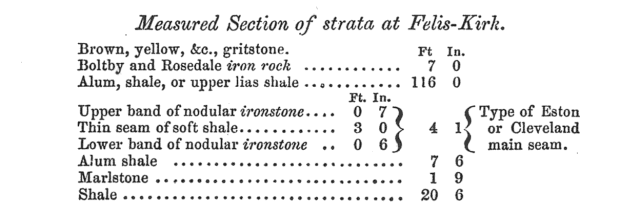
And, in writing me, he states that "great care was taken in making the section," and that he believes it "contains the Eston measures in a reduced state," and considers the "marlstone is unequivocally exposed in the fields immediately north of the section, and is seen in the road cutting ;" and hence draws the conclusion that, although the so-called top seam of Cleveland, Boltby, and Rosedale (called dogger and inferior oolite in his work already named), may be here worth working, that the Eston or main bed is not so. These conclusions, of course, depend altogether on the marlstone being correctly identified.
Dr. Verity's section not only gives us a seam to tally with the "Ingleby" top or third seam, but several others in the higher geological formation, as well as one below — the second seam above the so-called top seam apparently agreeing with the "Ingleby" top seam. Want of time in my last visit prevented me examining this district in such a manner as to test the accuracy of the section with regard to the upper seams. In passing Kennicow limestone quarry, I found several ironstone bands, but none sufficiently good to be worthy of special notice. Three yards of the limestone seemed to contain a large per centage of iron also.
This ironstone district is still closed for want of railway communication, although by some it is considered the most likely to supply the West Yorkshire district iron-works, with the so-called top seam as a mixing stone.
The only special district to which I think it necessary now to allude, is the Rosedale Abbey district, the ironstone from which has attracted a large amount of attention, on account of the large per centage, immense deposit, and magnetic properties. In this district, as by the quotations already given, iron-making must have taken place upwards of 600 years ago; and it also appears that, about 1834, it was reported on; but it was not until the spring of the year 1853 that attention was directed to it as an ironstone. About 1851, East Rosedale district being in want of material to mend the public roads, an arrangement was obtained for carting this magnetic iron ore (as it is now called) at 6d. per load, from the present quarry, for that purpose. The roads so mended, were observed by Mr. W. Thompson, a collector and shipper of ironstone at Staithes, who had occasion to be over in this district seeking for jet. This he soon communicated to Mr. George Park, of Whitby, Mr. Hartas, of Wrelton, and to Messrs. Sheriff, Mason, and others connected with the railway company. Hence the matter was soon before the public, and the district has perhaps been most examined of any part of Cleveland, by parties interested in the iron trade. The attention of the parties opening out this ironstone, viz., Messrs. Leeman, Sheriff, and Hartas, as lessees, has been principally confined to the place known as "The Quarry," and the drift and pit near thereto, shewn on the Plan attached hereto, called the No. 6 or Rosedale Abbey Plan. The principal lessor on the west side of Rosedale, is H. B. Parley, Esq.. The quarrystone is entirely unproved as to its extent or thickness; it is lying in a conglomerated state, as though it were a disjointed and isolated batch, forming concentric rings in the hill-end, and not uniformly stratified in any one direction, nor at any regular points, either vertical or horizontal. The depth in the quarry may be called 35 to 60 feet, and not yet at the bottom of the ironstone, from which quarry the ironstone led away as an experimental stone has been taken. The analysis of this stone will be given with the others — the bluish black being the richest. Looking at the Plan, not many yards to the south, a drift is shewn, and also two pits, one sunk and the other not completed. I examined the ironstone proved between the pit sunk and face of the drift, which appears more stratified, but not really so, — in one instance there is a cheek or slip, running nearly parallel to the drift, hading at an angle of 45° to the south. The particulars of the strata and the stone proved will be best understood by the annexed sketch. (See Diagram.)
The quality of this ironstone, both from this drift and the quarry adjacent, varies in itself, the bulk of the drift ironstone being nonmagnetic (so-called). It will be observed from the Plan, that no cross drift in behind the quarry has been driven, so that, as yet, no correct idea can be formed as to the relative position of the two. However, on the road from Hutton-le-Hole, at the point marked A on the said No. 6 Plan, a seam of ironstone, coarse and silicious, is cropping out, but also in a confused state, and is at a much higher elevation than "The Quarry" ironstone, viz., about 65 fathoms, and although the ironstone itself is very much different to that in "The Quarry," it seems a question of considerable importance, whether it is not the regular se-am meeting first with the disturbance, in approaching from the north, and this view is to some extent confirmed by the regular freestone strata capping the hills on the west side of Rosedale, in the continuation of Rosedale Vale northwards, where, about two miles up, we come to the drift called "Sheriff's Drift" (shewn on the Plan), where a seam of ironstone is drifted into for about 40 or 50 yards, and the following is a section :—
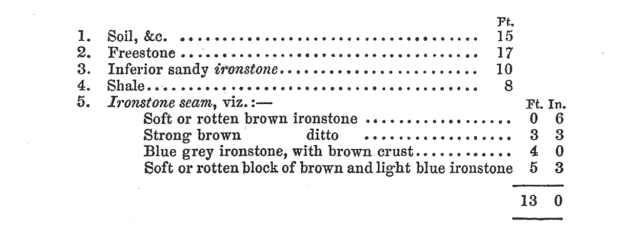
This ironstone is about 41 fathoms more in elevation, than the ironstone at the quarry, but is about 24 fathoms lower than the point A on the plan at the outcrop.
The analysis of this ironstone will be given, shewing the different value it has from the so-called magnetic "Quarry" ironstone. I have no doubt that this seam is the same as the seam at the point A on the Plan, as also the same as that found on the east side of Rosedale, in Captain Vardon's property, of varied thickness, as well as the same seam as that at Grosmont, Fryupdale, Swainby, and Boltby, known as the top seam of Cleveland — the nine inches of coal in the pit sunk agreeing with Beckhole, near Grosmont, in particular; so that the only doubtful point is as to the portion from the outcrop at A to the so called magnetic "Quarry," the most feasible solution being, that it is a disjointed patch of the regular seam, known as the top seam, and not a vein, as has been said; and, with all due deference to the parties who have had more opportunity for examining this district than I have I propose leaving the extent of the magnetic and extra per centage tract as an unsolved problem, as it may vary from one or two acres to any indefinite extent, not being at all proved to the south.
About two miles south-west of the magnetic "Quarry," near to a place called Loskey Bridge, on the road to Hutton-le-Hole, a trial pit, called the "Hutton Pit," has been sunk so far, to test the stone, but without any definite result. Near to the said Loskey Bridge is a soft blue sandy rock, thought to be an outcrop of this stone, and is about 20 fathoms lower in elevation than the magnetic "Quarry." Whether it is the outcrop or not is very doubtful. This ironstone is not a true magnetic — that is, it will not attract iron itself, hut is attracted by the magnet before calcining. I cannot make out., from the results of the experiments, that the iron from here, is better in any of its qualities than the iron from the main seam of Cleveland, and if so, the commercial value of this district, will resolve itself into a pure question of calculation, at the same time involving many elements, the item of railways being the principal one.
The ironstone for experiments has now to be carted upwards of ten miles to Pickering, at from 6s. 8d. to 7s. per ton, and thence via Malton and Thirsk to the northern iron furnaces. The Derwent Iron Company have got about 2,000 tons of this stone, the result of a portion of which, in quantity, was from 48 to 49 per cent. About 200 tons and 450 tons have been sent to two firms in the Middlesbro' district for experiments, besides small quantities to Masbro' Iron-works, and to South Durham Iron-works near Darlington, making an aggregate of from 3,000 to 4,000 tons vended. The nearest railway is the Whitby and Pickering Railway, having the South and West Yorkshire Iron-works in view; but this route is, I believe, abandoned, the promoters being wishful to get on to the North Yorkshire and Cleveland Railway, either by Fryupdale, Danbydale, or, as is said to he most feasible, by Ingleby Manor mines, and so join the railway there, thus making about 14 miles to the North Yorkshire and Cleveland Railway, and thus have (by the intended junction of the North Yorkshire and Cleveland Railway with the Middlesbro' and Guisbro' Railway) direct access to the centre of the North Cleveland iron furnaces. But before much outlay is incurred for the transit of this ironstone, further tests ought to be applied as to the extent of stone of equal quality to "The Quarry" ironstone.
Before following up the account of the iron-works built since 1846, it now only remains for me shortly to refer to some of the various analyses made at various times, of the ironstone from the different places, and, in so doing, I would wish to caution speculators in ironstone mines from placing too great confidence in such analyses, however chemically correct they may be as to the identical piece of ore subjected to examination. They alone are not sufficient data on which to open out or condemn ironstone mines, particularly in Cleveland, as so much depends on the getting of fair average samples of the ore, and applying such analyses, mathematically correct, to the bulk of the stone; as also in respect to the difference of such at the outcrop, to that in the solid, arising from long exposure to the air and other causes; as also the difference in the shell or crusts from the internal bulk — in the latter item alone varying in some cases from 10 to 15 per cent. of metallic iron.
If, however, we perform our analyses upon a large scale — say a few hundred or thousand tons in the blast furnace — we subject it to a practical test, the objections as to good or bad workmanship applying equally to the chemical test as to this. On the other band, I believe chemical analyses have been and are too much neglected in iron making, and would, probably, if more generally applied in regular work to all the materials used, be the means of important results as to quality.
The analyses I have tabulated, as far as is practicable, having been made in various ways by various parties. Where they have been published, reference is made thereto for description of process and other details. The various works may be consulted advantageously, and, although the results are very various indeed, they are, in all probability, chemically and practically correct with regard to the actual specimens experimented on, and, at the same time, are perhaps in many instances wide of the real results of the bulk of the mines.
I first give analyses of the main or thick bed. — (See Table annexed.) The practical calculation is, that three tons of the north part of Cleveland main seam will make one ton of iron, and that it requires nearly four tons of Whitby main seam to one of iron. Notwithstanding the foregoing analyses, the main bed of Eston ironstone has often exceeded Dr. Maugham's estimate of 85 per cent. from the blast furnaces, I have no doubt up to 37 per cent. Of course allowance ought to be made for the difference there is between the pig iron from the blast furnace and pure iron. I now give the analysis of the seam called the top seam of Cleveland. — (See annexed Table.)
The foregoing analyses clearly shew the truth of the remark as to the irregularity of quality of this seam.
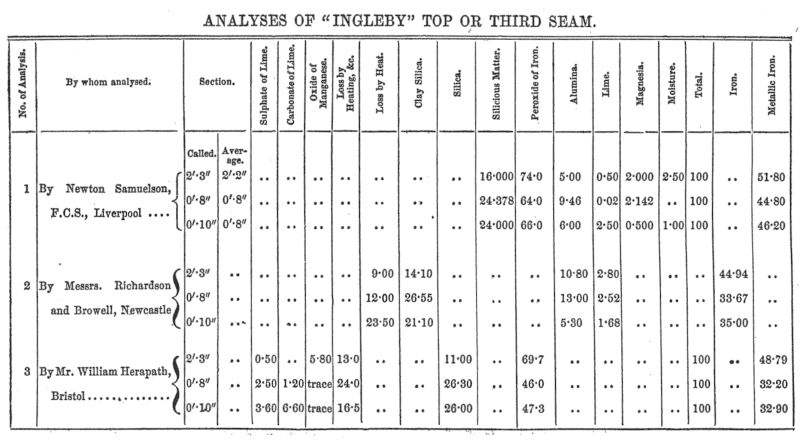
I next give the analyses of the "Ingleby" top or third seam as follows:—
The top band of this seam averaging two feet two inches is the main feature of these mines, and what effect it will have on the quality of the iron, by its use as a mixing stone, is as yet untested by actual proof, considerable weight being placed thereon by the lessees, on account of the large per centage of manganese named by Mr. Herapath.
The only other analyses I have now to allude to are those named in Mr. Crowder's first paper, in April, 1856, as to (Scugdale) Swainby, viz. :—
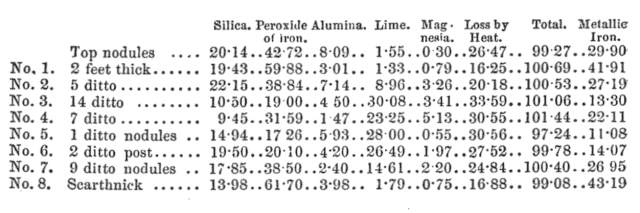
Mr. Crowder calls attention to "the three top and two bottom beds" being similar "to Hutton-Lowcross and other places, whilst the middle beds are very poor in iron and rich in lime," having formerly been tried for a true limestone. From the section already given, Nos. 1 to and with No. 7, being from the seam known as the top seam, and No. 8 or Scarthnick being the same as the present working scam, and identical with the main bed of Cleveland.
I now continue the account of the erection of the blast furnaces since 1846.
The iron-works having now the advantage of an almost unlimited supply of ironstone by rail from the north part of Cleveland, with the extra incentive of high rates for pig iron during most of this period, the erection of blast furnaces increased very fast, and in the following order, (beginning where we left off,) viz.
12th. Bedlington Iron-works. — Belonging to Messrs. Longridge, and consisting of two blast furnaces. The first was erected about 1849, and the last in 1854, and were intended for a mixture of local coal-measures ironstone with Cleveland (Whitby) stone. They have been out of blast since September, 1855.
13th. Middlesbro' Iron-works. — Belonging to Messrs. Bolckow and Vaughan, consist of three furnaces, and were erected about 1852, for Eston ironstone.
14th. Eston Iron-works. — Belonging to Messrs. Bolckow and Vaughan, consisting of six furnaces, were erected about 1853, for Eston ironstone.
15th. Cleveland Iron-works.17 — Consisting of three furnaces, were erected in 1853 and 1854; belong to Messrs. T. L. Elwon and Co., and were intended for Eston ironstone.
16th. South Bank Iron-works. — Consist of three furnaces, were erected in 1854 and 1855, and belong to Messrs. Bernhard Samuelson, and Co., and were also intended for Eston ironstone.
17th. Tees Iron-works. — Consist of four furnaces, were erected about 1854, and belong to Messrs. Gilkes, Wilson, & Co., being intended for Hutton-Lowcross and other Cleveland ironstone.
18th. Darlington Albert Hill Iron works. — Belong to the South Durham Iron Company, and consist of three furnaces. Two were erected about 1854, and one in 1857,18 for Hutton-Lowcross and other Cleveland ironstone.
19th. Ormesby Iron-works. — Belong to Messrs. Cochrane and Co., consist of four furnaces, and were erected in 1854 and 1855, for Hutton-Lowcross and other Cleveland ironstone.
20th. Clarence Iron-works. — Belong to Messrs. Bell Brothers, consist of three furnaces, and were erected in 1854 and 1855, principally for Normanby ironstone.
21st. Stockton Iron-works. — Belong to Messrs. Holdsworth, Benington, Byers, and Co., and consist of three furnaces, erected in 1854 and 1855, for Swainby and other Cleveland ironstone.
22nd. Wallsend Iron-works. — Belong to Messrs. Palmer and Co. (lately to Messrs. Carr & Co.), and consist of two furnaces, and were erected in 1854 and 1855, for the so-called top seam ironstone from the coast.
23rd. Felling Iron-works. — Belong to Messrs. Pattinson and Bell, consist of two furnaces, and were erected in 1854 and 1855, for Normanby and other Cleveland ironstone.
24th. Bradley Iron-works. — Belong to Messrs. Richardson and Co., consist of four furnaces, and were erected in 1854 and 1855, partly for local ironstone as well as Cleveland ironstone.
25th. Norton Iron-works.19 — Belong to Messrs. Warner & Co., consist of two furnaces, and were erected in 1856, principally for the Swainby and North Yorkshire and Cleveland Railway ironstones.
26th. Washington Iron-works. — Belong to the Washington Chemical Company and Messrs. Bell Brothers, consist of one furnace, and were erected in 1856, for Normanby and other Cleveland ironstone.
27th. Haltwhistle Iron-works. — Belong to Mr. Joseph Beasley, jun., from Birmingham, consist of one furnace, and were erected in 1856, for local clay ironstone and brown hematite from near Alston; still, by railway communication, they may be considered to belong to the northeast part of the North of England.
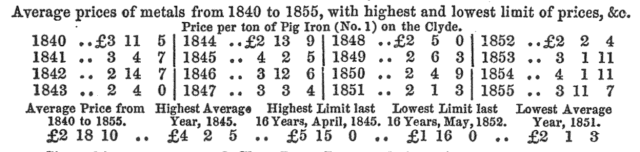
Thus, it will be seen that, from 1846 to and with 1851, a period of five years, we have only one new furnace erected, viz., at Bedlington, in 1849. But it is to be remembered that it was during this period that a severe financial crisis existed, as also that the price of pig iron was very low during part of this time ;20 then, from 1851 to the present year 1857, or say a period of only six years, we have the large number of forty-eight more furnaces erected, and nearly all for Cleveland ironstone; making now a total of eighty-six blast furnaces, besides the following ten21 furnaces, either in course of erection or under arrangements for the same, as well as others said to be contemplated, viz.
28th. Brenkburne Iron and Coal-works. — Consisting of two furnaces, are situated six miles from the North-Eastern Railway, north of Morpeth, in Northumberland (and come into the list under the head of North of England), and are intended primarily for local ironstone from the carboniferous limestone measures, similar to Ridsdale Iron-works.
29th. Victoria Iron-works (Wreck Hill, near Hinderwell). — Have been already alluded to, being on the sea coast, and are intended to consist of two furnaces.
30th. Jarrow Iron-works. — -Belong to Messrs. Palmer & Co., and are intended to consist of two furnaces for the (sea coast) Rosedale ironstone.
31st. Middlesbro' New or Tees-side Iron-works. — Belong to Messrs. Snowdon and Hopkins, and consist of two furnaces, being intended for Cleveland ironstone.
32nd. Beckhole Iron-works. — These works are intended to consist of two furnaces, and have been already alluded to as belonging to a public company called the Whitby Iron Company (Limited).
17 — Since this paper was read, an arrangement has been made, by which these ironworks have become the property of Messrs. Bolckow and Vaughan; and Messrs. Elwon, Malcolm, and Co., have commenced the erection of new iron-works, near Eston Junction, to consist of two or three furnaces, and to be called the Clay Lane Iron-works.
18 — Has been put into blast since this paper was read.
19 — The "Big Ben" bell of Westminster Parliament Houses, was cast at these works.
20 — The price of pig iron (No. 1) on the Clyde, from 1840 to and with 1855, is as follows :—See "Chart of the Properties and Prices of the Metals chiefly used in the Arts and Manufacture," &c., by William Johnston, metal merchant. Glasgow.
21 — Since this paper was read Clay Lane Iron-works have been begun, thus making eleven new ones, and thirty-three in all.





 Contains public sector information licensed under the

