


 |

|

|

|
|
 |
 |
|||
Volume 5 (V), 1856-1857, published 1857
It now only remains to notice a few of the most prominent results in the district; and the first is a most direct one, on the Stockton and Darlington Railway, raising that railway from its somewhat depressed state of 1850, to one of extreme financial prosperity at the present time. The following extracts from the Company's accounts (including Wear Valley, Redcar, and Weardale Extension Railways) will shew the extraordinary increase of traffic, viz. :—
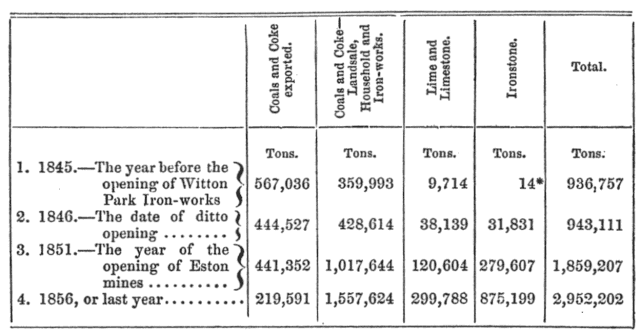
The increase of ironstone, limestone, coke, and coals for iron-works, will be seen to be as marked as the decrease of coals and coke for export, the aggregate increase being very marked within the last five years: and the aggregate tonnage of all kinds being about 3½ million tons in 1856. Of course this extension of traffic applies, in a modified extent, to the other railways and means of transit in the district.
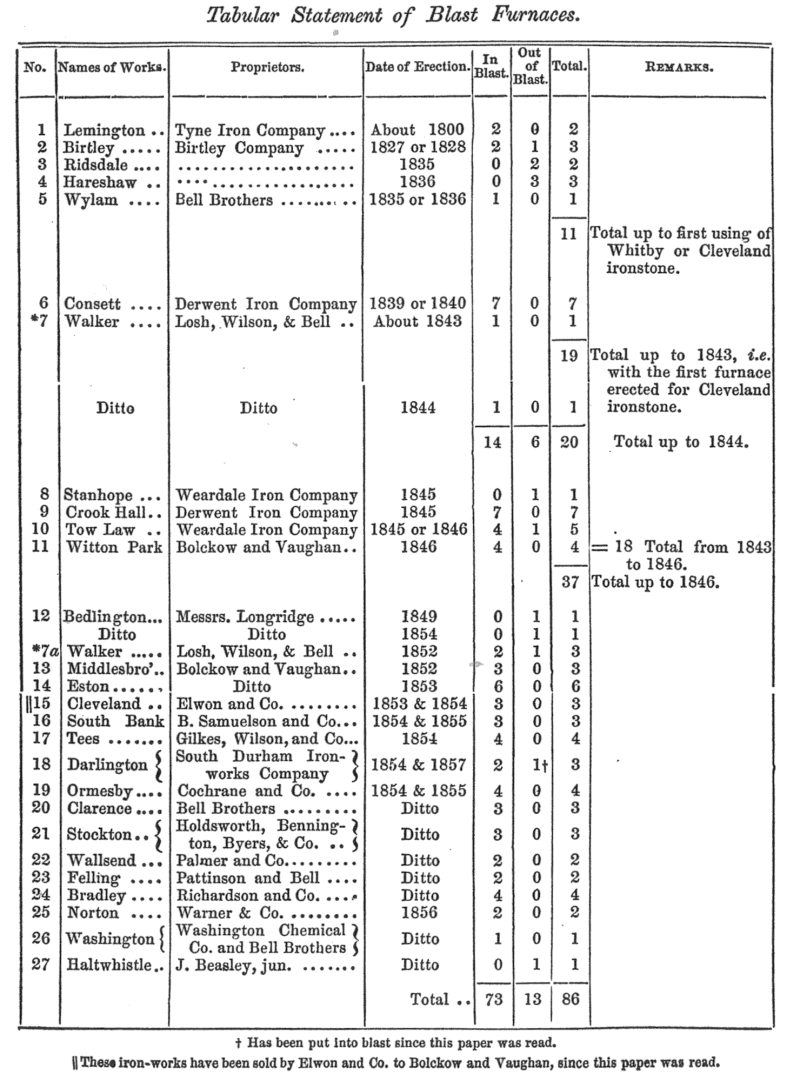
On the South Durham Coal-field this great extension of iron-making cannot but have had, and will continue to have, a most wonderful effect, when we consider that there are eighty-six blast furnaces altogether, of which seventy-three are at present in blast, to which the supply of Cleveland ironstone is equal to sixty-five furnaces, leaving only eight furnaces in extent to be supplied from other sources. And out of these sixty-five furnaces about two-thirds are drawing their supply of coal from the South Durham coal-field. These seventy-three blast furnaces will produce about five hundred and eighty-four thousand tons of pig iron, or upwards of half a million per annum, requiring for such production about three million tons of coals or coke. And in the capacity of either coals or coke, we have from this coal-field nearly one and three-quarter million tons of coals consumed yearly for pig iron making. But, in order to shew more strikingly this consumption of coal, it may be stated that the seventy-three furnaces in blast are consuming coal equal in extent to 60023 acres, at least, of four-feet seam per annum, of which I estimate 350 acres to be got from the South Durham Coal-field — equal to the drawings of at least fifteen moderately-sized collieries. Also, taking different yields from the various districts into account, we have not less than 1,690,000 tons of ironstone vended from this Cleveland district yearly,24 being equal to about forty-six acres of a seam, five yards thick, of ironstone; and thus a square mile of such a seam would supply the sixty-five furnaces for about fourteen years.
Further, these seventy-three blast furnaces are consuming at least 879,600 tons of limestone yearly, for fluxing; so that these items combined will shew the extent to which the professional members of this Institute must be interested in the said Cleveland district.
It is neither necessary nor essential to this paper to compare the present production and make of iron with that of former periods. For the sake of contrast, however, let us take one or two years, viz., in 1820, the consumption of iron in England was only 400,000 tons, or 184,000 less than the quantity now made from these seventy-three blast furnaces; and even in 1840 it was only 1,000,000 tons, or not twice the make by the said furnaces. In 1854, the make of pig iron in the British Isles was 3,069,838 tons — the North of England thus furnishing nearly twenty per cent of the whole.
I now wish to draw attention to the last result that I think worthy of notice, and that is an important one, viz., the value of coals and coke, when delivered from the South Durham coal field into the Cleveland iron making district, which is so great that trials are going on with the view of finding the continuation of that coal field under the lias formation. It is not my intention to express any opinion hereon, beyond admitting its possibility, and giving a few facts in connection therewith: as, if coal of suitable thickness, quality, and depth from the surface, be obtained, I need hardly say its importance cannot well be overrated.
Both a sinking and borings have been made within the last eighteen months at Coatham, near Redcar, to the depth of about thirty-two fathoms, but, although rumour said a four feet seam of coal was found in the first boring, (on which, if there, the usual value of lessors' interest, stipulated for by a mining engineer of experience, was quadrupled), such scam, if ever there, disappeared on the approach of the sinking and further boring. These parties stopped boring in April last, being then, I understand, about thirty fathoms down, but no coal has been found, only shale and thin limestone beds.25 At Kirklevington, (near Yarm), Lord Falkland has bored to a depth of upwards of 100 fathoms, in which he has gone through various beds of sandstone, and is said to have gone through the magnesian limestone, and now to be boring in the lower new red sandstone, having previously passed through two or three thin coal seams of two to three inches thick. These two places represent the present trials. As regards the former, W. W. Smyth, M.A., in the "Geological Survey, 1856," (already quoted from), has a foot-note as follows, — "It is intelligible that the discovery of neighbouring coal should be regarded as a desideratum; but it says little for the spread of sound knowledge in the district, that at the present time a trial for coal should be in operation at Redcar, whore people, more sanguine than prudent, are founding their hopes on the very shales, loaded with has fossils, which, as has been pointed out to them by a geological neighbour, distinctly warn them to desist." The warning here alluded to I presume to be that of Professor Phillips, in his work, already mentioned, of 1829, and from which I now quote :— "the opinions of working colliers on this point have too often been preferred to the legitimate deductions of science, and even yet persons will, perhaps, be found willing to credit the delusive tale of finding good coal by going deeper. But the warning must be given though it be disregarded, and from all the natural exhibitions on the coast, as well as from the result of every experiment inland, I am compelled to state, that any hope of discovering seams of coal more than eighteen inches or two feet in thickness, in any part of the strata above the upper lias or alum shale, is entirely unsupported by reason and experience. That the coal measures of Durham and Western Yorkshire exist (covered by magnesian limestone and red sandstone) beneath the lias, is probable, but the practicability of reaching them by pits, even in Cleveland, or near York, is very questionable, and the expense of the experiment may be ruinous." Still, as I have said before, it is possible to find the South Durham coal measures, but, of course, below the lias. I quite agree with the Professor's remarks as to no thick coal seams being above the has, but, notwithstanding the remarks just quoted, nothing has yet been shown to prove that the South Durham coal-field does not lie within reasonable depth below the lias. Others have bored on the coast, amongst them are, Zachary Moore, about 1740, and Lord Dundas in 1794. (See J. W. Ord's work of 1846.)
At Dinsdale, on the Tees, in 1789, several trials for coal were made, two of the borings being carried to the respective depths of sixty-six and seventy-four fathoms, of which thirty-two fathoms of the lowest beds met with consisted of white and grey sandstone, without any mixture of the red strata. The deepest Dinsdale boring, viz., Woodhead, is the one from which Middleton Spa now issues, being from a blue stratum lying under gypsum, at the depth of about 19½ fathoms.
At Entercommon, near Smeaton, three miles south of Dinsdale, a boring was made to the depth of 111¾ fathoms, with a similar bottom to the two at Dinsdale, and fifty fathoms, near the surface, of red sandstone with a few bands of bard stone.
These last particulars I take from the works of the Rev. G. Young, and G. C. Greenwell, respectively; from the latter of which I transcribe a section of the strata at Oughton, near Hartlepool, viz. :—
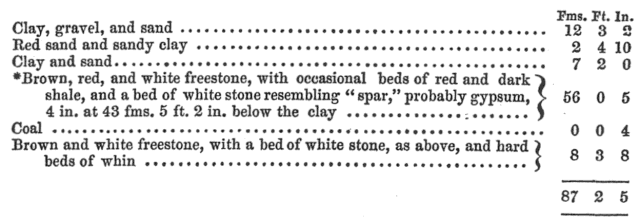
Mr. Greenwell, in his work just quoted, in order to make the likelihood of coal being found in Cleveland greater, supposes that the red sandstone and coal measures may become conformable at this point; and without calling this in question, I think other reasons may be given why the finding of coal here may be possible, and in order to give data for judgment hereon, I have appended hereto an outline section of the coast from Hartlepool to Castle Eden (see Map No. 7), and thence northward to Seaton pit, the latter part of the section being taken from the paper of Mr. Wood, President of this Institute,27 and I also give the following sketch in illustration of the possible effect of an assumed heaving of the primary rocks in the vale of the Tees. (See Diagram.)
On the other hand, if no change in the disposition of the new formations, with the coal and other older formations, either by dislocations,. upheaving, or otherwise, after leaving Castle Eden, then Professor Phillips is likely to be correct; but, of course, the whole, as said before, is, until proved, ideal, and only a possible fact. In conclusion, I must not omit to notice the expected greater facilities of importing hematite from the Ulverstone and Whitehaven districts by the now expected railway from Barnard Castle to join the Lancaster and Carlisle Railway, viz.,28 the South Durham and Lancashire Union Railway, and with a very small per centage of which hematite, and reasonable care on the part of the proprietors of blast furnaces, there can be no doubt of iron of the best quality, and at a reasonable rate, continuing to be made in the district.
22 — Sent from Middlesbro' to Witton Park Iron-works.
23 — This equals near 8¼ acres per furnace per annum; but with the coals consumed in production and transit of such to the furnaces, even ten acres per furnace per annum may be considered a fair estimate.
24 — Instead of commenting on the shipments and prices of the pig iron from Cleveland I have thought it better to append Messrs. Pauls, Buck, & Co.'s Circular, dated 14th January, 1857, minus their list of furnaces. (See Appendix A.)
25 — In 1778, a boring was made at Coatham, by the late Sir Charles Turner, to the depth of forty or fifty fathoms, but no coal was found. (See J. W. Ord's History of Cleveland, 1846.)
26 — A copy of this account in my possession makes this 4 ft. 6 in. more, and thus the total 88 fathoms 0 ft. 11 in.
27 — On the Magnesian Limestone at the Seaham and Seaton Winning, read before this Institute. (See Vol. V. of this Institute's "Transactions.")
28 — The Royal Assent has been given to the Act for this railway since this paper was read.





 Contains public sector information licensed under the

