


 |

|

|

|
|
 |
 |
|||
Volume 5 (V), 1856-1857, published 1857
Still further south, we come to the Victoria Docks and Ironworks, on the north of Runwick Bay, at a place called Wreck Hill, not far from Hinderwell, and belonging to a Leeds company, called the Victoria Iron-works Company. At this place, which is situate within ten yards of the sea, two blast furnaces are in course of erection, the machinery and necessary apparatus being, I understand, so far ready that, if all go well, they are to be in blast in the autumn of this year. The extent of royalty here is about forty-three acres, and of docks about one-eighth of an acre — the latter not finished: There being no railway or inland communication, the sea is their highway and railway, and sole inlet and outlet, not more than seven months shipping being calculated on as practicable; and everything required (except ironstone) having to be imported.
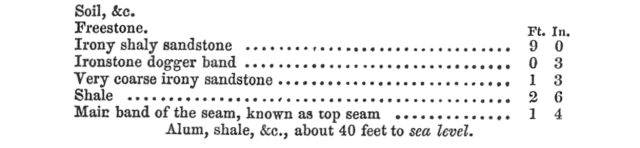
The seam, known as the top seam of ironstone, is here apparently not so good as at Rosedale (coast), the following being the section, viz. :—
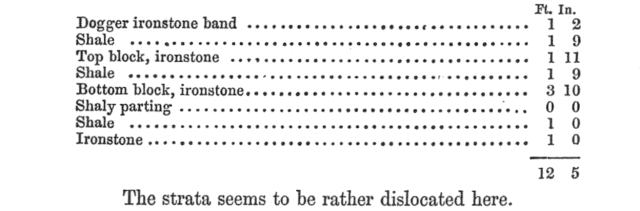
Below this, the company have sunk a shaft about twenty-six fathoms further down to the main seam, and, I understand, with the following as a section :—
Continuing along the coast round Runswick Bay, we then come to Kettleness Alum-works, the point where the main bed forms the beach, and, as already named, is now in course of working by Mr. John Watson, being first begun by Mr. J. Bewick, sen., in 1837.
The next point worthy of notice is Sandsend, where, at the alum works, the top seam (so-called) has been tried and abandoned within the last few years. It varied, in about half a mile, from one-and-a-half to four feet thick, but of inferior quality.
To the south of Sandsend we come to the Raithwaite mines, belonging to the Esdale Ironstone Company, worked out of the low cliff on the sea side, and vended by beach shipping.
It is only a small place, the section being as follows :—
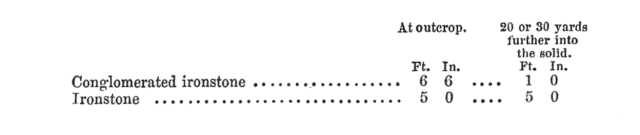
The quality here varies considerably, being very silicious, and part of the seam is thrown aside as useless. In the analysis, hereafter quoted, it will be seen how capricious in quality this so-called top seam is here. The vend for 1856 being 5916 tons.
There being no further mines, we now come to Whitby; but, before leaving the coast, let me first remark that as there are no mines on the south side of Whitby, although nodules have been collected off the beach at the Old Peak, I have not thought it necessary to detail the coast any further, but have appended a section from Whitby to Flambro' Head (see Map No. 5), which brings us to the chalk formation.
It is at the port of Whitby that the Esk Vale, and Whitby and Pickering Railway ironstone, has been shipped, not only by the Whitby Stone Company, and Mrs. Clark, (the latter's shipments being previously named), but also by the Birtley Iron Company, who shipped during 1856 about 10,000 tons (22½ cwts), besides a few small quantities by small proprietors from the neighbourhood of Sleights Bridge and other places on the said railway; amongst others the Esdale Iron Company vended 5438 tons. The Whitby Stone Company's maximum vend per annum being about 40,000 tons (22½ cwts.), and for 1850 about 20,000 tons (22½ cwts.).
It was the "pecten" portion of the main bed that was first sent from this vale by the said Whitby Stone Company, this is said to be easier to work in the furnace than the "avicula" band, In the latter bed in this vale small balls of sulphur pyrites are sometimes met with, and have occasionally been collected and sold at 21s. per ton.
Before closing my remarks on Whitby, I may state that ironworks have often been contemplated in that locality, and by different parties, Mr. Hunt, of the Birtley Ironworks, offering to take shares about the latter part of 1840. About 1843 or 1844, the late George Stephenson, C.E., was sanguine as to the success of ironworks in that neighbourhood, but I understand that when the papers were laid before his son, Robert Stephenson, Esq., M.P., he was not so sanguine, owing to his having at that time great expectations as to the results of the Weardale iron-ore just then being opened out. However there is now something more like certainty- as to the erection of blast furnaces in the district. At Beckhole, eight miles from Whitby, on the Whitby and Pickering Railway, a company has been formed called the Whitby Iron Company (limited), to work mines and make iron. The mines at Beckhole have been opening out during the last eighteen months and are as yet in the seam so called the top seam, which varies here from 4 feet to 14½ feet thick and thus irregular. I subjoin a section, viz. :—
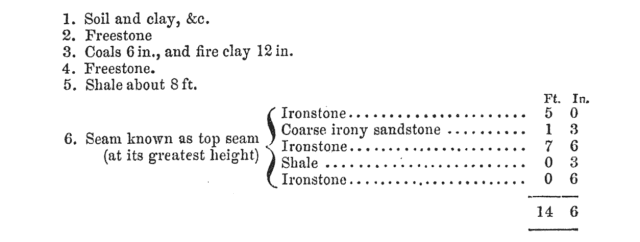
The company purpose also sinking down to the "pecten" and "avicula" beds, the so-called top seam being wrought by drifts or adits.
There are other three or four small ironstone workings between Beckhole and Grosmont station, all in the so-called top seam of Cleveland. It is near the Grosmont station where the North Yorkshire and Cleveland Railway is to join the Whitby and Pickering Railway, and from which to Stokesley this line is incomplete.
There is no doubt that the main bed of ironstone will exist on nearly the whole length of this portion of the railway in some form or quality, but it is lying under level except at the head of some of the branch dales, where it is exposed to the surface. I examined some of Mr. J. S. Pratt's ironstone, sunk to in Fryupdale, on the 10th day of January, 1856, and found that it was the seam known as the top seam. As no ironstone is as yet working in this part of Cleveland, I do not consider it necessary to do more than give the following section15 made from the various outcrops in Fryupdale and beside the river Esk, viz :—
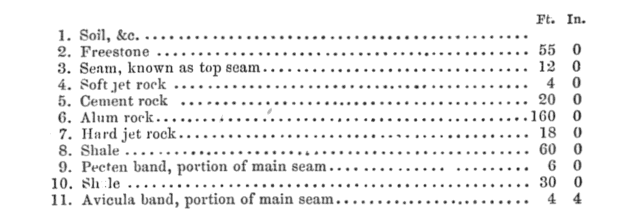
The analysis of the stone from the top seam will be given hereafter. The "pecten," Mr. Pratt states at 32 per cent., and the "avicula" as richer. The North Yorkshire and Cleveland Railway is only opened out from Picton to Stokesly, with also the Whorlton Branch, but a few miles before arriving at Stokesly from the south we come to Ingleby Manor Mines, leased under Lord Delisle, by the Ingleby Mining Co., who have been engaged proving the stone; but from the want of the completion of the public railway, as well as of a private branch from it to these mines (which will be about three miles in length) no ironstone has as yet been vended. I append the following section of the strata at these mines, viz.: Burton Head at Ingleby Manor Mines — full rise nearly north.
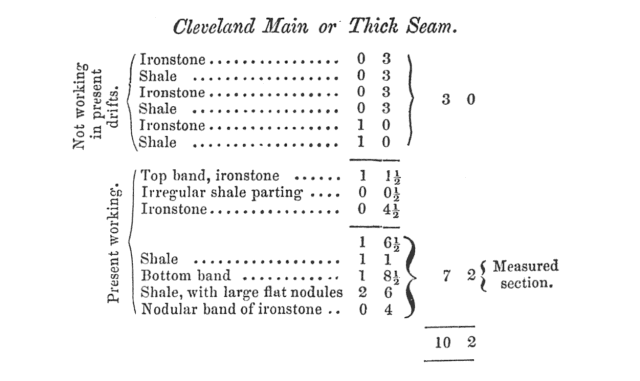
From the above section it will be seen that a third seam comes into view for the first time as a working seam, and is higher geologically than the seam called the top seam of Cleveland, and, therefore, I have called this seam the "Ingleby" top or third seam. The top band of this seam has somewhat the appearance of some parts of the other two seams, and partially as regards the shell or crust having a greater per centage of iron than the bulk. In one of the analyses given, attention is directed to the oxide of manganese, said to be an important element in the manufacture of steel.
The second seam, known as the top seam, has not been seen or sought for here, and when I made my examination of these mines, I was unable to account for the three freestones; but, on comparing the strata in one of the Eston borings (see Diagram), I found they agreed geologically, and satisfactorily proved the true position of the third seam. Whether any type of this third seam may exist in the said Eston boring is uncertain, but, after comparing notes with John Bell, Esq., of the firm of Bell Brothers, who has examined the Cleveland district more minutely than almost any other ironmaster, it appears he has discovered types of the "Ingleby" third seam both at Crainimoor and at Carlton, to the west of Ingleby Manor mines, the result of which I give by the annexed sketch. (See Diagram.)
The "Ingleby" top seam, therefore, evidently decreases to the west, and is only typified in the hills in that direction; and, vice versa,16 the so-called top seam at Swainby is evidently decreased in the above hills to the east, and there only typified. The main or thick bed, as will be seen by the section, is much divided here, and about two months ago a blower of gas was met with in it, issuing from a very small fissure in the 2 feet 6 inches shale, which, when first lit up, continued to burn for some time, but the flame was of a bluish colour — this being the third place in this district in which there have been indications of gas. In all probability it comes from the jet rock, where such rock is in a state of perfection, as the rock is so highly bituminous and sulphureous that (as named in Mr. Louis Hunton's paper, before-mentioned), when a small heap was once calcined "at Loftus Works," "the melted bitumen and sulphur flowed in flaming streams."
It may be as well here to remark, that the ironstone proprietors on the line of the North Yorkshire and Cleveland Railway will get more immediate access to the blast furnaces in the Middlesbro' district, by the branch railway called the Middlesbro' and Guisbro' Branch, joining the Middlesbro' and Guisbro' Railway near Morton Grange, and the North Yorkshire and Cleveland Railway near Potto. The length of this branch will be about five miles, but it is not yet made.
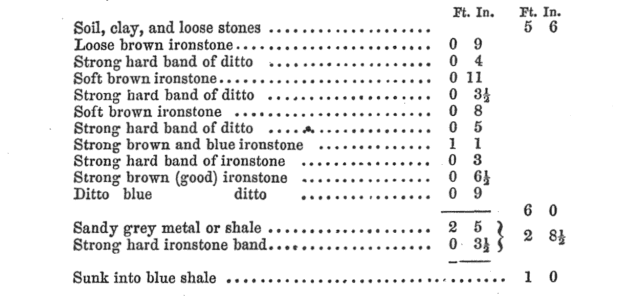
On the 23rd June, and in the following month, 1851, I examined the main bed of ironstone at Carlton, and found the following section, taken in a staple sunk on the flat ground to the east of the quarries of the old alum works, viz.:—
From none of these hills, however, are there as yet any opened mines after leaving Ingleby Manor and going west, until we come to Swainby district, which is opened out by the Whorlton Branch Railway from off the North Yorkshire and Cleveland Railway, being, about 2½ miles in length.
These royalties, I understand, are held by lease from the Marquis of Aylesbury, to Messrs. R. W. Jackson, C. Barrett, and R. Watson, and the portion opened out is subleased to Messrs. Holdsworth, Bennington,. Byers, & Co., and are called the Swainby mines. These mines only commenced to vend ironstone about the 3rd of March this year, and are now vending about 120 tons per day — 200 tons per day as yet being their maximum vend. The seam wrought is the main seam, as will be seen by the following section of the strata at the mines, viz. :—
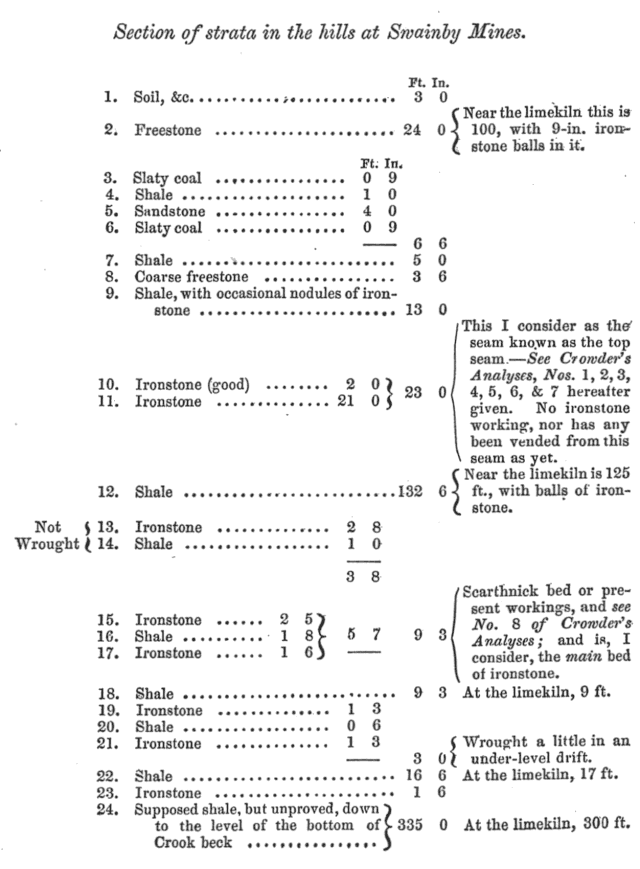
The seam, which above is shewn 23 feet, where cropping out at the top of the dale southwards, has decreased to as follows :—

Again, near to Mr. Pattinson's farm, on the late Mr. Mauliverer's property, the seam supposed to be the so-called top seam is 30 feet below the 24-feet freestone in the above section, and at 220 feet below the said freestone is the main seam, as follows :—

Proceeding along this range of hills to the west and south, and passing Osmotherly, where trials have been made for this ironstone by one of the proprietors (but it is as yet completely closed, there being no means of transit), we come to the villages of Kirkby Knowle, Boltby, Thirlby, and Felis-Kirk, &c., or what may be properly termed the Thirsk district.
15 — Furnished by J. S. Pratt, Esq., and made by his mine surveyor, Mr. Joseph Greenhough.
16 — This seam is now being sought for at Kildale on the south and east by Messrs. Bell Brothers.





 Contains public sector information licensed under the

