


 |

|

|

|
|
 |
 |
|||
Volume 5 (V), 1856-1857, published 1857
The first surveys and levels were completed for the present Eston Branch Railway, on the 17th day of August, 1850; which said railway was commenced in the October following, and by December, 1850, was so far completed, that 136 17/20 tons of ironstone were seat over it, being carted to the same from the tramway previously named, thus making a total from these mines in 1850 of 4177 4/20 tans; but it was not until the 4th of January 1851, that the first locomotive passed along this line prior to the public opening of this railway and the mines, which took place on the 6th day of January, 1851. The event then celebrated was considered, and has since proved to be, an important one for the district. The proceedings of this public opening, were all duly recorded by the newspapers of the day.
The first instructions relative to these mines were that 1000 tons of ironstone would be required weekly, but before the permanent rails were laid down, these instructions were changed to 1000 tons daily, and even this was found unequal to the requirements, as during the year 1851, 187,950 15/20 tons were wrought and vended; and during the following five years, ending with 1856, 1,719,507 12/20 tons were vended, of which, during 1856, there were 508,156 11/20 tons shewing a large increase over 1851; the quantities during 1856 running from 10,000 to 12,000 tons (20 cwts) per week. The greatest day's-work, week's-work, and fortnight's-work being respectively thus, in 1856

Up to the end of 1856 the total vend since the commencement is nearly two million tons. Thus, will be seen the great magnitude to which these mines have attained. The mode of working adopted, is as yet the "board and pillar;" the sizes of the pillars now being from 14 to 16 x 30 yards, and the boards 4 to 6 yards, the general height taken away in mining, varying from 14 to 16 feet, the pillars next the outcrop not being so large. The greatest cover actually explored under being about 65 fathoms. A few small experiments in taking out these pillars have been tried, and have been so far successful, obtaining fully 80 per cent. These being, however, only experiments, and a further test being required before any particular plan be adopted, at present the pillars are left large on that account. Many thousands of tons have been and can be quarried. The present mines are as yet carried on by drifts or adits.
The Eston Branch Railway is two miles in length from the Middlesbro' and Redcar Railway, (its junction thereon being three miles from Middlesbro'), and to this branch railway the ironstone is brought in waggonetts down self-acting inclines of 400 and 600 yards long, each waggonett carrying about 31½ cwts. These mines and the works in connection will shortly have the advantage of an independent communication with the shipping in the river Tees, by the extension of their branch railway under the public railway, and thence by a jetty into the channel of the river. A private Act of Parliament had to be got for these mines and the said railways, the principal lessor's lands being in Chancery, viz., that of Stapylton Stapylton, Esq.
Having now brought this matter to the time of practical results, I will next give a short sketch of the principal mines opened out since 1850.
The first, therefore, in order of time, are the Upleatham mines, in the Earl of Zetland's property, and under lease to the Derwent Iron Company. They obtain an outlet on the Middlesbro' and Redcar Railway, by a tramway about four to five miles in length, (leaving the main line about seven miles from Middlesbro'), and although this tramway is only about two feet wide, part of it is wrought by miniature locomotives, and the remainder by hauling engines. The vend from here has, I believe, been up to about 1,000 tons per day, that of 1856 being only 171,860 tons (20 cwt.).
The following is a section of the main thick bed (having already given one of the so-called top seam), viz. :—
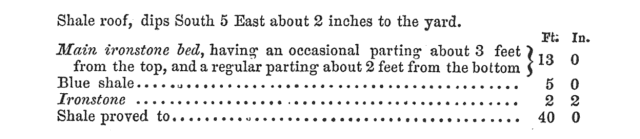
No pillars, properly speaking, have been taken out (except five or six adjoining the outcrop), and, therefore, not to be taken as any criterion, the pillars varying from four to five yards x ten, twenty, and thirty yards respectively, the boards being from six to seven yards. The whole of this ironstone has been got by quarrying and drifts or adits.
The next and important application of this ironstone discovery, was the obtaining of the Act of Parliament for, and consequent making of, the Middlesbro' and Guisbro' Railway, with branches to Hutton-Lowcross, or Codhill mines, and to Roseberry Topping, it being opened in 1853; and by way of shewing the rapid increase of the mineral traffic, which is nearly all ironstone, I subjoin the following abstract from the Railway Company's accounts, (Roseberry Branch not being yet made), viz. :—

being a total since the opening of Ј26,064 16s. 0d. from minerals only, other traffic receipts having increased each year also.
The principal mines opened on the line of this railway are, first, the Hutton-Lowcross, or Codhill mines belonging to Messrs. Joseph and Joseph Whitwell Pease. A section of this ironstone and the per centages thereof, as at these mines, were furnished me in 1853, by one of the promoters of the Middlesbro' and Guisbro' Railway. This I subjoin as an example of the difference between the appearances at the outcrop and the interior section, especially as regards such parts as have become oxidised or crusted, and as a proof that the analysis of such ought not to be the only criterion of value, although the stone, in its natural state, may be improving as the workings advance, which I believe is the case here.
"The section of the main bed was taken in the West Gill, viz.:—
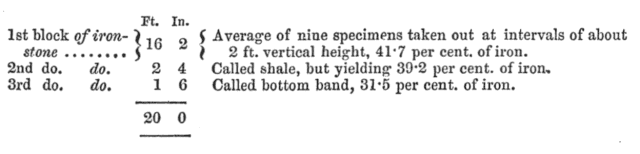
The average of the whole seam equalling 40.6 per cent. of metallic iron."
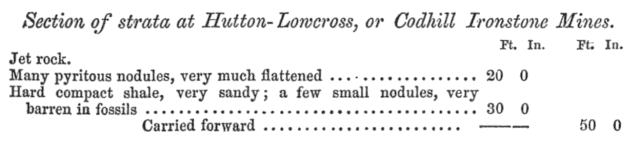
I next give a correct section of the strata at these mines, and, following it, a section of the average of present workings, viz., 6 ft. 1 in. of good ironstone, with an average of 33.09 per cent, of metallic iron, as per analysis hereafter given. The section is as follows
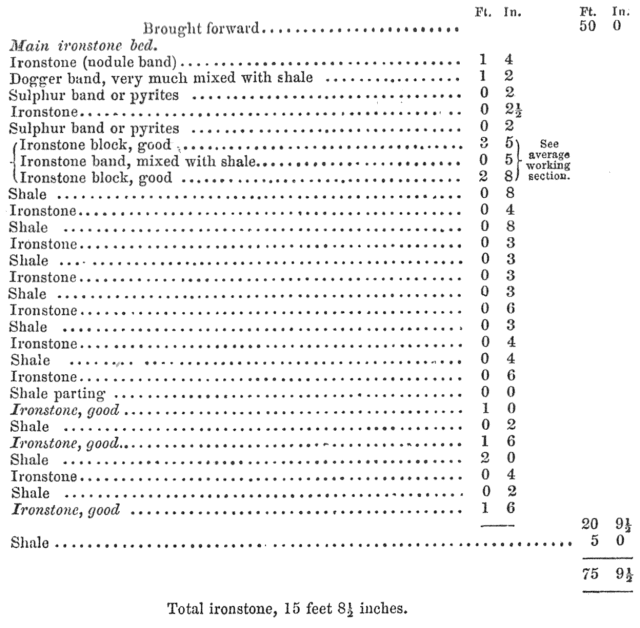
The average working section of this main bed being as follows :—
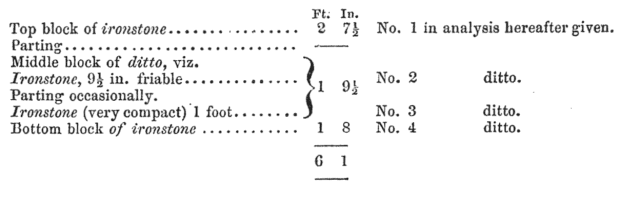
The ironstone here has been quarried to a very large extent, as well as being wrought by means of day drifts or adits. No pillars have been removed as yet, the sizes being about 4 x 24 yards, and boards 4 yards laid out to 6 yards. The ironstone from these mines is brought by a short self-acting incline plane, on to the Codhill branch of the Middlesbro' and Guisbro' Railway, and the workings during 1856 have been about 220,000 tons, of which 217,253 tons (20 cwts.) have been vended.
On the 26th December, 1856, a small blower of inflammable gas made its appearance in these mines, from a large gullet only 340 yards in from the surface, with 13½ fathoms of cover on. It heft altogether in four days, and in no other place in these mines has any gas been discovered. There was a large bog on the surface, which, it was thought, might have something to do with it.
The next mines opened on the line of the said Middlesbro' and Guisbro' Railway are the Normanby mines, adjoining the Eston mines on the west, belonging to Messrs. Bell Brothers, and are on the estate of the late W. W. Jackson, Esq., from which ironstone was taken in 1811. They, consequently, partake of the character of the Eston mines in many respects, but at the outcrop to the west are not of the same thickness, and are dipping to the north, south, and east, being similar to one end of a boat at the west. The following is an average section of the main bed, viz.:—
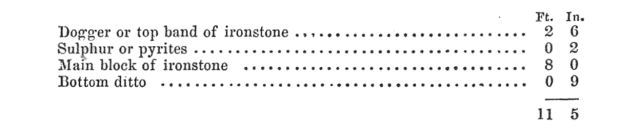
The vend from these mines in 1856 was 131,575 17/20 tons.
These mines are all wrought as yet by quarrying and drifts or adits, and by a short private branch railway, the ironstone is taken on to the said Middlesbro' and Guisbro' Railway.
The next and hast opened mines on the line of this railway are the Belmont or Belman Bank mines, Guisbro', belonging to the Weardale Iron Company, and are held over an immense tract of surface. They are connected with the main line by a private branch, but as yet have not been opened out to any great extent. The following is an average section of the main bed, viz., full rise N. 70 W.
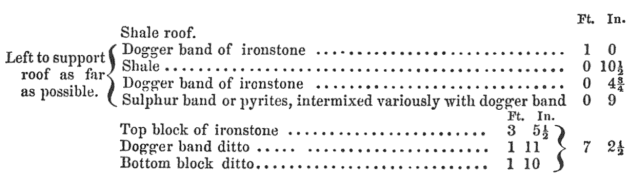
The vend for 1856 was 73164 10/20 tons.
The next district I wish to draw attention to, is the sea coast — and to this paper I append a section from Hartlepool to Whitby, marked No. 4 Map. Beginning at the Hartlepool end, we have ironstone first at Redcar viz.: nodules that have been collected off the rocks. Further along the coast towards Whitby we find the same class of nodules at Saltburn, Huntcliff, and all the way to Skinningrove, where the Skinningrove mines stone is shipped by a jetty. Between Huntcliff and Skinningrove the main bed only once approaches the shore, but has not been wrought. Going still further in the same direction we come to the Earl of Zetland's sea coast stone, at Lofthouse Alum Works, which was first shipped in 1819 and 1850, i.e., both nodules and the main thick bed — first by the Messrs. Roseby, and afterwards by the Derwent Iron Company. From Lofthouse to Boulby, several parties, since 1849, have shipped from the main bed, but nothing of any importance. At Boulby, the ironstone is under lease to the Marchioness of Londonderry. This royalty has been taken with the view of promoting iron-works at Seaham Harbour. The ironstone a little north of the alum works has been drifted into, but nothing wrought. The drifts and workings being closed over with a slip of the cliff.
I give the following section, taken a short distance to the north of these drifts.
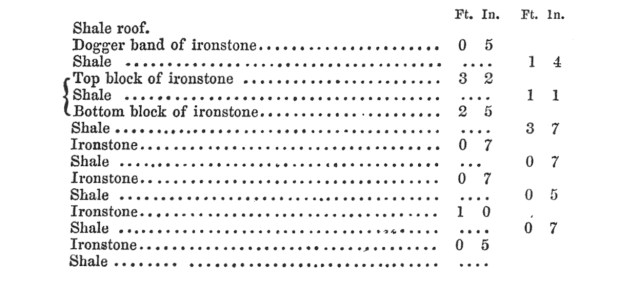
The main bed of ironstone is first split with a shale parting, a little to the north of these alum works. The ironstone will have to be got away from here by beach shipping. There is a pit or staple already which could be applied as a drop, it being now used for lifting the coals from the beach for the alum works.
The next ironstone place on the coast is at Staithes, and is now under lease and in course of being wrought by the Messrs. Palmer, of Newcastle-on-Tyne, and the stone is taken from here by beach shipping.
The section of the strata here found, (and by which it will be seen that the main bed is now very much intersected with shale and divided), is as follows, viz.
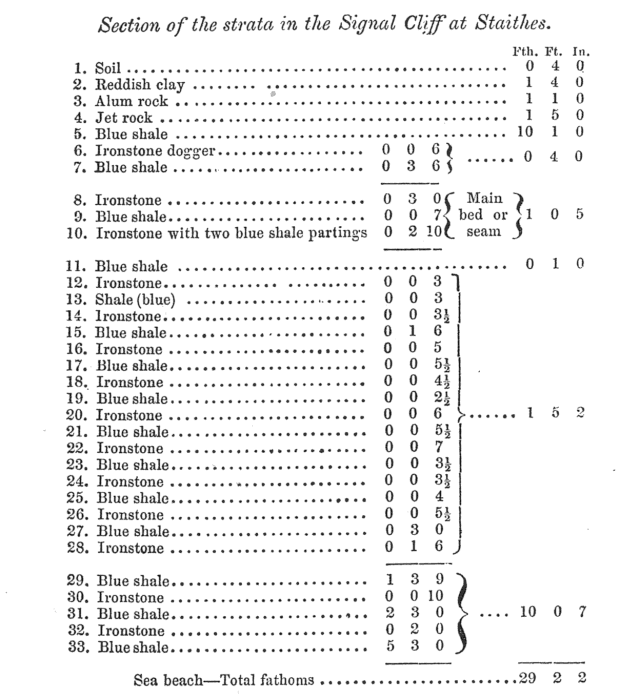
Aggregate of ironstone, including the shaly partings in No. 10, is 13ft. 10in.
I now come to a somewhat extensive place, viz.: Rosedale Docks and mines. The ironstone workings at this place have as yet been confined to the so-called top seam, and the stone was formerly lowered on to the beach shipping jetty by a self-acting incline plane, but is now dropped down a shaft by a self-acting drop about 22½ fathoms, and thence by a short tunnel to the spouts at the docks newly constructed, which are about three acres in extent, and by the side of which they were, at my last visit, busy sinking two shafts to the main bed of ironstone.
I next append a section of this Rosedale Cliff; as follows, viz. :—
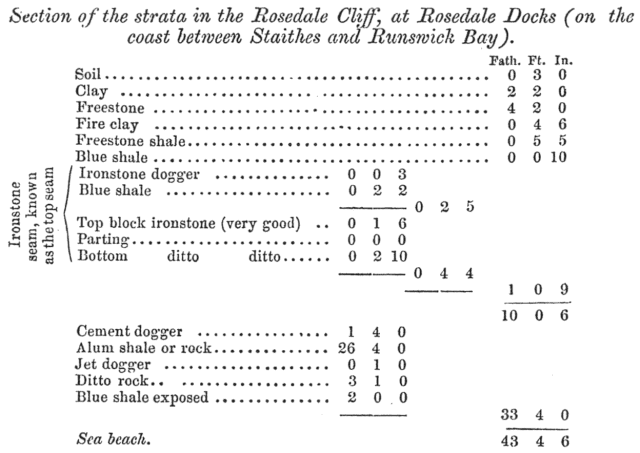
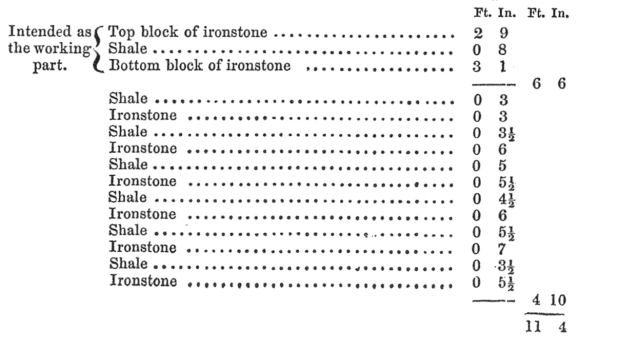
Now, sinking in blue shale, and with Staithes as the data, has eight fathoms one foot more of the last-named shale, and then on to the dogger band of six inches, lying 3½ feet above the main bands. In this sinking inflammable gas, in small quantities, has been met with. Since my visit to this place, I understand the main seam has been got at the depth expected, or a total of about 43 fathoms 8 feet 5 inches from the bottom of the seam, known as the top seam; and, assuming the main seam to be the same as at Staithes, it will make an aggregate of ironstone beds here of 18 feet 6 inches.14 The plant at present is such that 70,000 tons per annum, it is estimated can be vended, if necessary; but, in 1856, the vends from here and Staithes were only about 23,500 tons. The propriety of changing the name of this place is, I believe, at present under consideration, in consequence of Rosedale Abbey district often being confounded with it.
Immediately to the south is a small place vending ironstone from the so-called top seam of Cleveland, belonging to Messrs. Seymour, Thompson and Co., their vend during 1856, being 12,500 tons.
14 — Since this paper was read I have been favoured with the following section of this main seam of ironstone, as sunk through, viz.





 Contains public sector information licensed under the

