


 |

|

|

|
|
 |
 |
|||
Volume 5 (V), 1856-1857, published 1857
In 1839, Mr. D. Nesham, of the late firm of Nesham and Co., of the Portrack Lane Iron-works, at Stockton-on-Tees, became identified with the Cleveland ironstone. Happening to be in company with the late H. Vansittart, Esq., of Kirkleatham Hall, he had his attention directed by that gentleman to some ironstone near Coatham, and after examination, he shipped a small cargo from that place, about 150 yards from the flagstaff, to the Devon iron-works, Alloa, near Stirling, for trial; and, in answer, received a letter advising him not to be at any further expense about it, as it was not worth trying, there being no iron in it. He replied thereto, leaving himself in the manager's hands (a Mr. Leslie Meldrum, I believe). And so, on Mr. Nesham having occasion to be in that district about 1850, he, on enquiry, found his cargo deposited in the ballast heap; of course, it had never been tried. (This ironstone is alluded to in Messrs. Walker and King's report, hereafter named.) During, 1839, 1840, and 1841, however, he prosecuted many examinations of Cleveland, in connection with a Mr. Alexander Byrne, of London, and a Mr. Scale, of Aberaman, South Wales; and in order to be certain, got arrangements made for the first refusal of the respective royalties with the late Mr. H. Vansittart, the late Sir J. H. Lowther, the late Martin Stapylton, Esq., and the late Sir William Pennyman, but never became assured of its value, although the parties were extensively engaged in analyses, with a Mr. Maugham, of London, and in personal inspections, (as appears from the correspondence which then passed, part of which I have had the opportunity of perusing, by favour of Mr. Nesham.)
Coal, hematite, and peat seem to have also engaged their attention, although at last they give up the hematite idea. In one letter Mr. Scale says, "The Whitby stone may extend within a few miles of your town" (i. e. Stockton). Mr. A. Byrne, in his anticipations of iron-ore, near "Stockton, Stokesley, and Yarm," speaks of "a mighty company" to be established, and a railway "from Stokesley to Hartlepool." One rather wide idea, however, he names, in one of his letters dated 14th March, 1840. He reports that he has seen Dr. Buckland at Oxford, who "is of opinion that iron ore of a better quality than you now work at Whitby exists in great abundance near Stokesley, and all across for several miles, from Whitby to Whitehaven." He also states some of the ores from the north of Cleveland, analysed by him, to contain "30 to 40 per cent. of iron, 25 per cent. of lime, no sulphur, no manganese, no magnesia, nor in fact anything bad, being a very rich flux stone of the oolitic order," and says, "if you can get plenty of the stone at a cheap rate, you have a treasure with which to compete with any market in the world." Other ores are named as "35 per cent, of iron and 26¼ of lime." Mr. Nesham's transactions in the iron trade not having been very profitable and the result of his examinations doubtful, he gave up all claim to the royalties.
In 1840 the Messrs. Bewick made further examinations of the coast, and, amongst other places, discovered the ironstone at Skinningrove, and at the same time examined part of the interior country, and in so doing found it at Slapewath, near Guisbro'; traced it westward past the Guisbro' old alum works, and judged as to other places where it might be found; but want of railways, and a fallacious view (as now proved) of the quality of the stone at those places, caused it again to be allowed to rest.
In 1840 (the same year in which Messrs. Bewick made their last tour) the Whitby Stone Company were also bestirring themselves, and sent deputations to the north part of Cleveland to explore; and on the 7th, 8th, and 9th of July, 1840 (after Mr. Scale and others had reported) Mr. Nicholas King, of Whitby, (manager of the Whitby Stone Company prior to the entry of the present manager, Mr. John Waddington, in November, 1830,) with Mr. James Walker, solicitor, of Whitby, made their examination, and their report thereon bears date Whitby, 10th July, 1840.11 On the first day they examined the Huntcliffe and Redcar district, and allude to a "2 feet bed of ironstone at East Coatham," "of 37 per cent. yield," "but only 10 to 15 yards broad," and "200 to 800 yards long" (this being the bed shipped from by Mr. Nesham). On the second day, however, viz., 8th July, 1840, they state that they found "on the Knowles," "midway on Hillside, near Lazenby, near Eston Nab," "ironstone in large quantities," "not less than 8 feet deep, but the quality is hard, harsh sort, and very unlike good ironstone — coarse." And on the same day the report shews they "next examined the Knowles on the south side of' that ridge in Mr. Jackson's estate," and found "indications of a similar stone, but not opened out." They also had an interview with the late Mr. Rutter, land agent to Sir J. H. Lowther and others, and report that he informed them of "ironstone 6 yards thick, in a well near West Coatham," but that after examination they were satisfied that the 6 yards rock could not be ironstone. They also had samples of ironstone bands shewn them by Mr. Rutter, from Roseberry Topping, but thought them "very unlike ironstone." The third day they devoted to the Hartlepool district, and the acquiring of information as to "coals and coke suitable for iron making."
Now, here is an actual re-examination of those parts of the present Eston and Normanby ironstone mines which are alluded to in 3811 and 1812, and by parties fully acquainted with the Whitby ironstone, and their report closes with "quality is hard, harsh sort, and very unlike good ironstone — coarse."
This ironstone also rises and crops out before arriving at Redcar, and does not "dip down towards Redcar" as stated in this report.
Somewhere between the years 1844 and 1846 I understand the "pecten" portion of this main hand of ironstone was seen in the hills near to Ingleby Greenhow, by Mr. J. Waddington, of Whitby, but was thought worthless.
In 1846 Mr. J. W. Ord published his work, already named, and in order to show his view of the then value of this ironstone I quote as follows :— "It is at present of little value except as ballast, and is scarcely of sufficient importance to encourage speculation." He gives several quotations from other works, to indicate the presence of ironstone, and amongst others he states that "just above the Alum rock in Roseberry Topping is iron ore," this being the position this main bed of ironstone occupies there and elsewhere.
Having now brought the different examinations to the year 1840, and it being difficult to assign the discovery specially to any one, (although it and the application may be said to have been in 1811), I would next draw attention to the fact that the whole of the iron-works already named, with the exception of Walker iron-works, were originally intended for the smelting of local ironstone, and that such local ironstone, either from quality, quantity, or cost, and more particularly the latter two, invariably failed to answer the required end, so that all had to look elsewhere for additional and cheaper supply, and some parties took royalties, even at high rates, after the year 1832, in the Whitby district, and others in Scotland. Hence a similar remark equally applies to Messrs. Bolckow and Vaughan's Witton Park iron-works, notwithstanding their central position for ironstone, from the coal measures and carboniferous limestone measures, as also the "vein" or "rider" stone from both Teesdale and Weardale, and in course of which, in addition to getting ironstone from the Whitby district, this firm collected several thousand tons off the coast, between Redcar and Skinningrove, in the spring of 1848, and brought the same by beach shipping to Middlesbro', and thence per rail to these works; and, arising out of this operation, we have the first practical application of the discovery of this thick bed to the north part of Cleveland. One Mr. James Burlinson, of Bishop Auckland, was engaged in the collecting and shipping of these nodules, and was succeeded by the Messrs. Roseby, of Witton-le-Wear.
Mr. A. L. Maynard, one of the lessors of the ironstone at Skinningrove, called Mr. Burlinson's attention to this bed of ironstone in his (Mr. Maynard's) estate, inland, as a stone which some had thought contained iron. Mr. Burlinson, after examination, applied to Mr. John Anderson, railway contractor, of Middlesbro', for money or other assistance to open out and test it, In the meantime, Mr. S. F. Okey was sent by Mr. Burlinson's solicitor, (Mr. Bowser, of Bishop Auckland,) to examine it thoroughly, but his report was not sufficiently flattering to warrant any further proceedings being taken by them. On the Messrs. Roseby succeeding Mr. Burlinson, and being informed of these matters, they observed that some portions of the ironstone in course of shipment were from this seam, and had fallen off the cliffs, and which stone had got worn by the action of the waves of the sea into something like the shape of nodular balls, as well as oxidized into proper colour to pass inspection with the other stone, and finding such to be the case, were not long in tracing this main or thick bed, (here running from twelve to eighteen feet thick in the cliffs), and securing agreements for leases for working the same, under the Earl of Zetland, A. L. Maynard, Esq., and some others; and they made arrangements and commenced work on 7th August, 1848, preparatory to shipping this ironstone to Messrs. Bolckow and Vaughan's works at Middlesbro', for their Witton Park iron-works. To show the prejudice with which the first cargo was treated by the then furnace-manager, it is a fact that he had teamed the first few waggons of the stone into the refuse heap as "freestone stuff," before receiving instructions from Mr. Vaughan thereon, and reported unfavourably on the first trial. Thus then on the 26th August, 1848, the first shipment of fifty-six tons (22½ cwts. each), of the main bed of ironstone, was made from Skinningrove, the north part of Cleveland, The Messrs. Roseby not having the means of carrying the matter out, entered into arrangements with Messrs. Bolckow and Vaughan as to Mr. A. L. Maynard's agreement for lease, in consideration of money advances. Mr. John Anderson, railway contractor, of Middlesbro,' in his evidence on the Shildon Tunnel Branch before the House of Lords, in 1854, taking credit for this ironstone being opened out with his money, he having advanced the Messrs. Roseby fifty pounds for getting the trial cargoes. It was in consequence of Messrs. Bolckow and Vaughan's advances that I was first called upon by them on the 22nd day of September, 1848, to examine this main bed of ironstone, and which led my attention to be directed to it.
The Messrs. Roseby not being able to fulfil their contracts, the mines of Mr. Maynard (Skinningrove) came into the hands of Messrs. Bolckow and Vaughan, about July, 1849, and were worked by them unto the 19th day of October, 1850, inclusive, when they were transferred to Messrs. Losh, Wilson, and Bell, who have continued to work them, and ship stone from them to their Walker iron-works, as required. Messrs. Roseby shipped from here 747 5/6 tons, (22½ cwts.), Messrs. Bolckow and Vaughan about 5,418 tons, (22½ cwts.), Messrs. Losh, Wilson, and Bell's highest quantity per annum being 6,025 5/22.5 tons, and for 1856, about 5,500 tons of 22½ cwts. each.
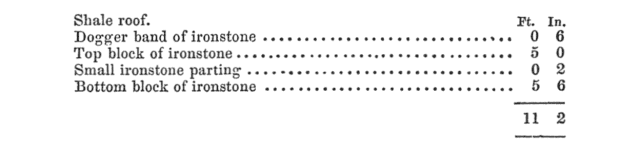
This ironstone here rises in direction N. 45 E., and the following is a section of the main seam, as now in course of working, viz:
Messrs. Bolckow and Vaughan having thus in 1848, begun to use the Skinningrove ironstone, and finding it so much better in yield than the Whitby ironstone, although, from the same bed, their attention was turned to the Eston and Upleatham hills, not from any geological reasoning at first, but from their proximity to Middlesbro' and to railway communication, as Mr. Bolckow then said, if found there, this stone would really be of use, as, having railway communication, all the drawbacks of beach shipping, which were great, would be avoided, In the latter part of 1848 and early in 1849, trial drifts were made in the Upleatham hills, in the Earl of Zetland's grounds, as well as in those of the trustees of Lady Hewley's, at Eston, and in the late George W. Jackson, Esq.'s property at Normanby, by Messrs. Campbell, and Stephen Forster; which trials, I examined first early in 1849, but the seam then discovered, was only the seam now known as the "top seam" of Cleveland. This seam is the most irregular in Cleveland, both in thickness and quality, and is here divided into thin bands, very different from Fryupdale, Grosmont, Rosedale, and Thirsk districts, as will be seen by the sections given. This seam may be said to vary from only a "type" to 20 feet thick, and in some places, not even a "type" is found. The section taken in Lady Hewley's, I give as follows :—
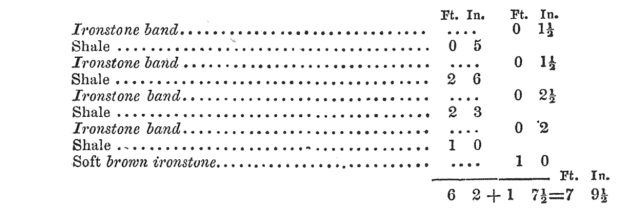
which varies very much from the section of this seam , given hereafter as taken in S. Stapylton, Esq.'s property.
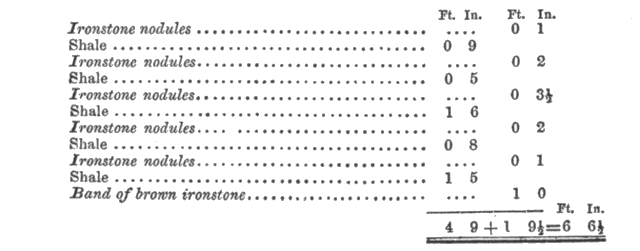
The section taken in Upleatham grounds is as follows :—
From the examination of these drifts, and the strata in the hills, I was of opinion that this main bed of ironstone (or Skinningrove seam, as it was then called), would be found at Eston; I, therefore, on Messrs. Bolckow and Vaughan's behalf, as far back as March, 1849, entered into correspondence with the agent for the late G. W. Jackson, Esq., for leave to search for the ironstone, and enter into leases, but the latter said it had formerly been well tested in his father's life-time, (viz. the late W. W. Jackson, Esq., in 1811), and would not listen to it. He told me he would "not assist me to ruin Messrs. Bolckow & Vaughan, and spoil the estate," and thus it was not till early in 1850, that negotiations were so far advanced with the adjoining proprietors, viz., the Trustees of Lady Hewley's Charities, that they engaged Mr. T. E. Forster, Mining Engineer, of Newcastle, to examine, report, and advise terms, which he did, I accompanying him to the drifts in the seam now called the "top seam," in his examination (without happening to come on this thick seam exposed), and it was under these terms that, on the 8th day of June, 1850, the re-discovery of this bed was made in the Eston Hills, being effected in the following manner. Mr. Vaughan and myself having gone to examine the hills for the most suitable place for boring, we decided to go up the hills to the east, adjoining Sir J. H. Lowther's grounds, and so walk along to Lady Hewley's grounds on the west. In ascending the hill. in Mr. C. Dryden's grounds, we picked up two or three small pieces, we, therefore, continued our ascent until we came to a quarry-hole, from whence this ironstone had been taken for roads, and next on entering Sir J. H. Lowther's grounds to the west, a solid rock of ironstone was lying bare, upwards of sixteen feet thick. I need scarcely say that having once found this bed, we bad no difficulty in following the outcrop in going westward, without any boring, as the rabbit and fox holes therein were plentiful as we went. We also examined the place in Lackenby Banks, squared down in 1811 or 1812, by the late Mr. Thomas Jackson, of Lackenby. The period from the 8th June, 1850, until the middle of August following was occupied in completing arrangements for opening out this ironstone, and the first trial quarry was begun on the 13th of August, 1850; a temporary tramway was soon laid down, and by the 2nd of September, 1850, the first lot of about seven tons was brought down in small tubs to the highway side, from thence carted to Cargo Fleet, and thence by rail to Witton Park Iron-works, being about twelve weeks after actually seeing the ironstone, and by this method 4040 7/20 tons, were sent away by 28th December following, viz., 1850. And now was completed what really may be said to be the commercial discovery of the Eston ironstone, or bona fide application of the original discovery, whenever the discovery did take place.
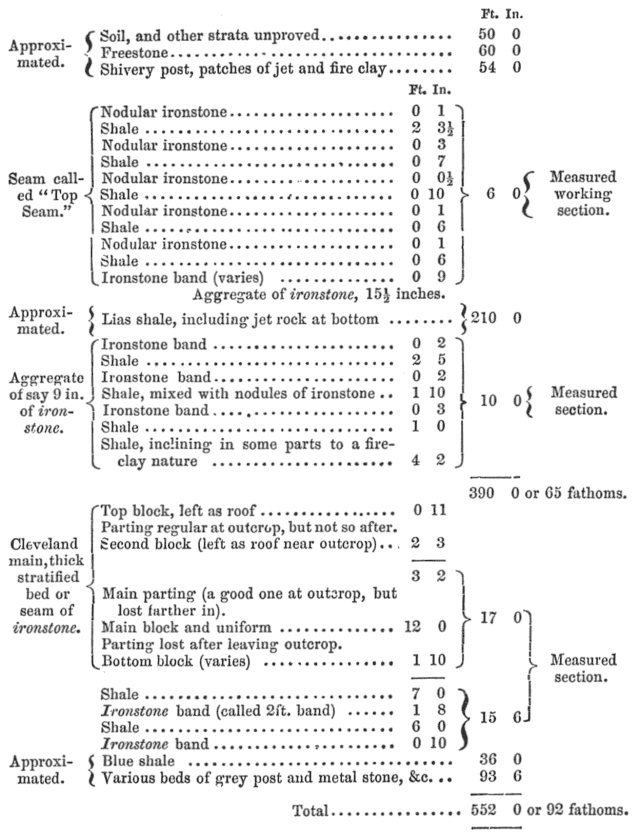
Before entering on the latter part of this paper, I may here observe that the existence of this ironstone having now become a public matter, numberless have been the accounts of its previous discovery, amongst others, Mr. S. Blackwell, in a lecture12 before the Society of Arts in London, in 1852, says, "the iron ore in this formation was first known and worked at its northern extremity, in the neighbourhood of Middlesbro'. A workman noticed a considerable deposit of iron, which took place from a spring, issuing at the base of one of its beds. Upon calcining a piece of the rock, its character was at once evident. He communicated his discovery to the proprietors of the extensive iron-works of Witton Park and Middlesbro', who immediately recognised its importance." This account will be seen to be far from correct. The real merits of the case are, that the existence of this stone has been long and well known, though not its value. For instance, Sir J. H. Lowther's carriage roads at Wilton Castle are made of it, and have been for years. It may and does seem strange that it should have lain over so long ; although, even after it was opened out, we have many instances of even ironmasters, on inspection, throwing it away as no better than a sandstone, as it is stated in the Geological Survey for 1856,13 "It would easily pass muster for an ordinary sandstone with only its external surfaces, more or less rusted by the peroxidation of iron." The application of this discovery was speedy; competition for royalties arose on all sides, notwithstanding which, I am glad to be able to state, that the Eston tract, secured by Messrs. Bolckow & Vaughan, (after their persevering efforts, they being the first parties to open out the north part of Cleveland), will bear comparison with any in Cleveland. At the same time, to show that it is not free from its "troubles," I append Plan No. 3 to this paper, being a cross section of the Eston range of hills. I next give a section of the strata as shewn under the Eston Nab, in S. Stapylton, Esq.'s royalty, as follows :—
At these mines there is no sulphur or pyrites band on the north side of the hill, except at a small point to the extreme west.
11 — An error hereon appears in Mr. Waddington's speech, printed along with a lecture on Gold and Iron, and Iron-ore, by George Merryweather, M.D., 1853, wherein this report is put as having been made in 1837.
12 — Quoted in the afore-mentioned "Lecture on Gold and Iron," by Dr. Merryweather, 1853.
13 — Memoirs of the Geological Survey of Great Britain, and of the Museum of Practical Geology. Part I: The Iron Ores of the North and North-Midland Counties of England, 1856.





 Contains public sector information licensed under the

