


 |

|

|

|
|
 |
 |
|||
Volume 5 (V), 1856-1857, published 1857
In May, 1828, the year previous to that in which Professor Phillips work was published, Mr. Charles Attwood, ironmaster, now managing partner in the Tow-Law Iron-works, was by accident detained in Northamptonshire, and while so, discovered part of a wall, built of ironstone, of a somewhat similar kind to this, in a ploughed field, but after search in proximity thereto, he could not discover any quarry or hole, whence it could have come. He observed that the stone was oolitic, and although his other pursuits at the time drew his attention from the Northampton stone, in the summer of the following year, viz., 1829, when on his way to the Hambleton Hills, and not far from Sutton, under Whitestone Cliff; his attention was again attracted by seeing what he conceived to be a similar ironstone to that seen in Northamptonshire, and at the same time recollected seeing somewhat similar pieces at Lemington Iron-works, amongst the stone collected from the coast. In August or September of the following year, viz., 1830, lie, in company with his brother-in-law, Mr. William Matthews, a Staffordshire ironmaster, was again in this district, proceeded past the limestone quarries to near Boltby, and in that neighbourhood found a similar ironstone (now known as the top seam) samples of which Mr. Matthews kept and labelled, with the prognostication that when the railroad system became developed, then Cleveland would become a great iron district, and thus this subject was allowed by both to rest until the winter of 1841, or spring of 1842, when Mr. Attwood's attention being again directed to the iron trade, he procured one of the original Geological Maps of the late W. Smith,4 and from it, and from the sections of the coast in Professor Phillips' work already mentioned, had hand sections and maps made ready for a tour of discovery, with a view of finding the same ironstone as near to the railway at Stockton-upon-Tees as possible. These maps Mr. Attwood has kindly allowed me to examine, which maps, of course, from their sources, contain sufficient materials to have led Mr. Attwood to the right places, if his tour had been followed up, as the geological formation at Eston and at Roseberry are prominently and correctly marked thereon. However, although, the time was arranged for this visit, the tour was abandoned, in consequence of a Mr. Walton, from Weardale, calling on him with specimens of the "vein" or "rider" ironstone, and pointing out the advantages as then appeared, of Stanhope furnaces being partly erected, and actual existing railway communication; and hence, on the 23rd day of July, 1842, he turned his back on Cleveland, and made his first visit into Weardale; and thus, as far as he was concerned, lost sight of the subject until Mr. Vaughan, of the firm of Messrs. Bolckow and Vaughan, waited on him in 1850, for the purpose of selling part of this ironstone. When told of the quantity and prices, before knowing the locality, he produced the maps in question, and pointed out Roseberry and Eston, as, in his opinion, the locality from which it must come.
About the year 1832 or 1833, this ironstone is said to have been examined and reported on by one of our members, Mr. T. Y. Hall, and Mr. W. A. Brooks, C.E., (see Vol. II, pages 115 and 116, of this Institute's Transactions,5) and reference is there made to the "Nautical Magazine," of May, 1833. But on referring to this magazine, I find from one of the articles in it,6 that Mr. Brooks only is named, (although Mr. Hall was concerned with him,) and that lie, Mr. Brooks, had been reporting on the project of Docks and Harbour of Refuge at Redcar, and that the only allusion there made to ironstone is as follows: "The adjacent rocks contain large quantities of ironstone," and then, after alluding to "Upleatham freestone," "cement manufacturing," and to the "supply of coals by canal," &c., suggests the feasibility of a "cannon and anchor foundry," to supply these articles "30 per cent. cheaper than at other places." I presume it must be a mistaken reference by Mr. Hall, as only quotations are given, in the "Nautical Magazine," of May, 1833, otherwise from anything therein given, no wonder that so "little notice was taken" of this ironstone. I have not, as yet, been able to procure a copy of the report alluded to.
In a lecture7 delivered in March, 1853, Dr. Merryweather says, "It is now about twenty years since" he and his friend, the late Mr. Richard Moorsom, at that time President of the Whitby Literary and Philosophical Society, "took a geological walk," (which would thus be about the year 1833,) and their "object was to seek for minerals and mineral waters," as well as to get to the summit of the basaltic ridge which crosses the middle of Godeland, on their way up the Whitby and Pickering Railway, to Beckhole. They "also examined minutely the bed of Godeland Beck, near to the south side of the church that has since been erected there, and found it composed of a firm mass of marine fossil shells." He says, "I little thought at that time that this was to turn out the oolitic ironstone, which is at present causing such a sensation." In congratulating Mr. H. Belcher on account of having promoted the building of the above mentioned church at Grosmont, he says, "Mr. Belcher has not only unintentionally raised his own monument, to transmit his worthy name to future generations, but he has planted it on the very rock of iron from which the first modern workings of the oolitic ironstone in the north of England took place." Some exception ought to be taken to this, so far as the shipments from this bed of ironstone, along with the nodules taken off the coast, are concerned, as also the samples from Normanby, by the late W. W. Jackson, in 1811.
In 1845, Dr. Merryweather seems to have taken an active part in endeavouring to get a railway from Whitby to Stockton; and in 1846, as appears from the lecture above referred to, formed one of a deputation to the directors of the York and North Midland railway, to assist in getting what they called the "Whitby and Tees railway, with a branch from Stokesly to join the Great North of England at Cowton," and in setting forth its advantages, says, "there is one feature connected with the dales which is of the first importance, that is, the ironstone with which they abound." They succeeded in getting the Act for the railway from the Whitby and Pickering railway to Castleton; which railway, has not however been made. This ground is now occupied by the North Yorkshire and Cleveland railway, which is opened from Picton to Stokesly, the link between which and Grosmont still being incomplete.
About the year 1834, I understand one of the principal estates in the Rosedale Abbey district changed proprietors, (which district has lately caused no little interest in Cleveland, as well as out of it, and of which, more hereafter) the east side of Rosedale was purchased by Dr. Penfold, (now Captain Vardon's property) and on which occasion, an agent of Lord Ward's, from Dudley, was brought over to examine this estate for ironstone, but his report was, that it was limestone and not ironstone.
Coming next to Louis Hunton's paper,8 read before the London Geological Society, on 25th May, 1836, we find a complete section of the strata at Rockcliff; near to Lofthouse alum-works, from which I give the following extracts, viz:
"Section of the upper lias and marlstone at Rockcliff (Easington heights), local dip, S.W., one foot in ten feet." (See diagram on next page).
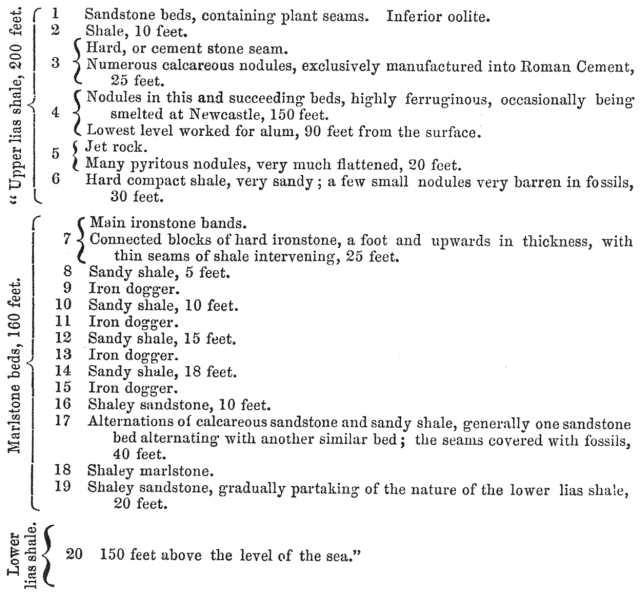
The main bed of ironstone is here definitely shown, and called 25 feet thick. The nodules are also alluded to as having been smelted at Newcastle.
The next subject worthy of notice, is the Whitby and Pickering Railway, which has played an important part in the development of this ironstone. The royal assent was given to this railway in May, 1833; and to the various examinations of the Esk Valley, with the view to the making and opening of this railway, may be traced the first practical application of the discovery of this ironstone in the south part of Cleveland. An account of the scenery on this railway, as well as a description of the railway itself, was written in the year 1836, by Henry Belcher,9 solicitor, Whitby, who was not only secretary to the railway company but also an earnest promoter of the railway, and to whose various excursions, occasionally accompanied by Dr. Hubbersty, of Cambridge, we owe this application of the discovery, they finding and directing the attention of the Whitby Stone Company to a portion of the main seam of ironstone, cropping out to the surface in the side of the Meck Branch of the Esk or Godeland Beck, in the Egton estate, belonging to the late Mr. Elwees, at Grosmont, six miles, (by railway,) southwest of Whitby, near to the church; and which six miles of this said railway were opened on the 8th day of June, 1835, the whole line not being publicly opened till the 26th day of May, 1836. About the same time we have a public company formed, fur the purpose of developing traffic for this railway, (and without any special view to this ironstone, but primarily for freestone and whinstone), called the Whitby Stone Company, consisting of twenty-four members, viz., Messrs. Robert and John Campion, Henry Simpson, John Chapman, and others, with the said Mr. Henry Belcher, as secretary, and it was by this company that, on the 18th day of May, 1836, (eight days prior to the public opening), the first small quantity of the fifty-five tons previously named were sent from Grosmont to Whitby, and shipped for the Birtley iron-works. With regard to this first shipment the experiment was anything but certain in its results. A second trial quantity was sent off in March and May, 1837, by the same company, to the Tyne Iron Company, who condemned the stone most strongly, saying "they were ashamed to see such refuse on the Quay!" Nothing daunted, however, they, got the Birtley Iron Company to try it again, and on 30th May, 1837, sent 128 tons (22½ cwts. each), of which they received, this time, a more favourable report, which said, "if we can get it at a payable rate we shall be induced to try it," and hence it was, that in January, 1838, the first contract was made for 30,000 tons, and they used it with their local ironstone and Cornish ore, first beginning in small quantities, then using 33 1/3 per cent., and next 95 per cent. of this ironstone. After using about 10,000 tons of this contract the Birtley Iron Company entered into further and permanent contracts. The Whitby Company had 10s. per ton (22½ cwt.), for the first cargo, and 9s. per ton for the second, delivered at Pelaw Staiths on the Tyne, for the Birtley Iron Company, the prices now being somewhere about 7s. to 8s. per ton, 22½ cwt. I subjoin a section of the ironstone strata in the Esk Valley, having reference principally to the mines, wrought by the said Whitby Stone Company, viz.:—
General Section of Strata in the Vale of the River Esk, from Cooper's Cut, via Grosmont, to Beckhole.10 Rise of strata 1 in 45, N. 78 E. —
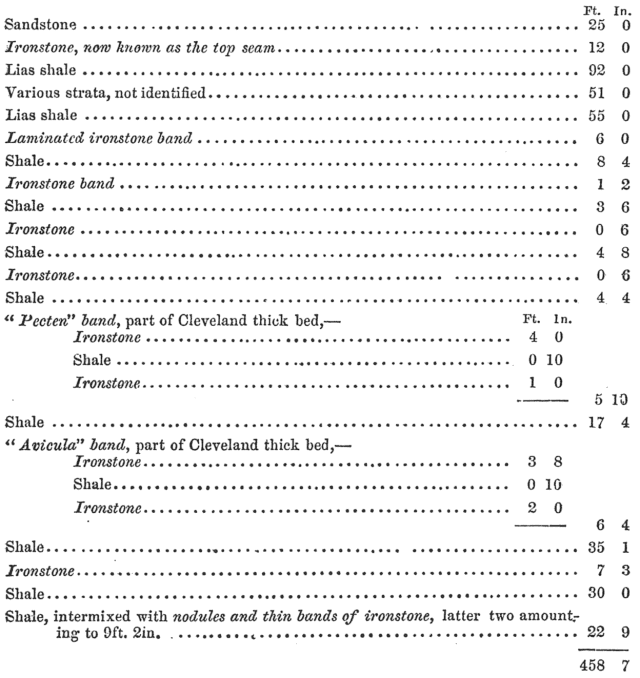
Thus showing the aggregate of the ironstone in the above section to be 47ft. 3m.
In 1838, Mr. Bewick, sen., began to work, and shipped the main bed of ironstone from the sea-beach, at Kettleness, for Wylam ironworks. This ironstone is now being wrought by Mr. John Watson, of Lythe Hall, near Whitby.
In 1839, Mr. Bewick, jun., commenced to work the main bed of ironstone on behalf of Mrs. Clark, near Grosmont, for Lemington iron-works, and for general sale, and it may be as well here to give another section of the Esk Valley district, having more especial reference to Mrs. Clark's mines, as follows :—
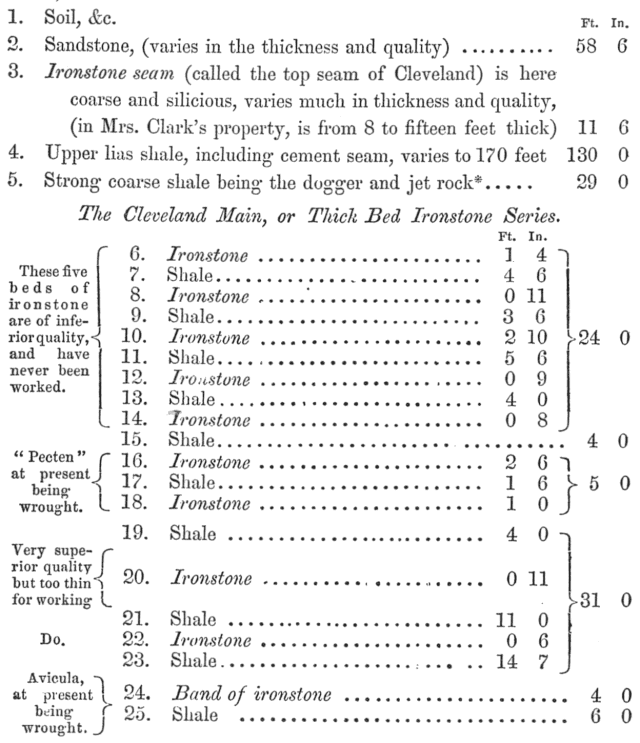
The Avicula bed is so called from the fossil shell avicula cygnipes (or young swan) being prevalent in it.
The Pecten bed is so called from the number of the pecten fossil, or common scallop therein contained.
The method of working in this district used to be, to get about one half in the first working, but of late they have adopted a mode similar to that of our northern coal mines, and so find it advantageous to take only about one-third in the first working.
The Pecten and Avicula seams together yield from 18 to 20 thousand tons (22½ cwts.) per acre.
The general vend from Mrs. Clark's mines has been about 30,000 tons per annum, but in 185(3 only about 20,000 tons.
The seam known as the top seam was opened in April, 1852, and about 200 tons vended, (i.e. from Mrs. Clark's property) and then. abandoned on account of being so very silicious.
04 — Geological Map of Yorkshire, W. Smith, Mineral Surveyor, 1821.
05 — The Extent and Probable Duration of the Northern Coal Field, &c., by T. Y. Hall, 1853.
06 — Observations on Port William, at Redcar, on the south aide of the Tees Bay, coast of Yorkshire, projected by W. A. Brooks, C.E., Stockton-on-Tees.
07 — A Lecture on Gold and Iron, and Iron-ore, with especial reference to the Ironstone of the vale of the Esk, of Staithes, and Cleveland, delivered before the Whitby Literary and Philosophical Society, by George Merryweather, M.D., on Tuesday, March 29th, 1853: with a report of the speeches.
08 — Remarks on a Section of the upper Lias and Marlstone of Yorkshire, shewing the limited vertical range of the species of ammonites and other testacea, with their value as Geological tests, by Louis Hunton, Esq., 1836. Also quoted from very largely, with section, in J. W. Ord's History and Antiquities of Cleveland, 1846.
09 — Illustrations of the Scenery on the line of the Whitby and Pickering Railway, with a short description of the district and undertaking, by Henry Belcher, 1836.
10 — Per Mr. J. Waddington, manager for the Whitby Stone Company, Whitby.





 Contains public sector information licensed under the

