


|

|

|

|
|
 |
 |
|||
CONDITION OF THE SHAFT, THE GUIDES, THE CAGE, CHAINS, DETACHING HOOK, WINDING ROPE AND CAGE SHOES AFTER THE ACCIDENT.
Shaft. — Examination of the shaft after the accident showed it to have been very little affected but that certain of its fittings had been displaced or broken. The damage done was confined to the East side of the shaft and, taken in descending order, was as follows :—
Fittings. — At bunton number 14, see Plate I, the Cast Iron girder, which at one time had been in use for supporting a column of pipes, was fractured near the middle of its span and marked on its under side;
At bunton 18 a double headed rail was fractured and bent downwards at its North end;
Between buntons 19 and 20 some wooden cleading was displaced;
At bunton 21 a double-headed rail was bent downwards at its North end;
Between buntons 21 and 26, the water pipes carrying water to the stables had been broken and dislodged;
At bunton 24, a double-headed rail similar to those at buntons 18 and 21 had been broken at each end and dislodged;
Between buntons 25 and 26, the North-East guide rail had been bent and broken; and
At bunton 27 the second Cast Iron girder was broken downwards at its North end.
Cage. — The most noticeable damage to the cage was that its bottom hoop at the South-East end was broken upwards, and the top hoop at the same end was bent downwards and had a deep indentation near the South-East corner. Generally, it had been severely shaken.
Chains. — The cage chains were strained but not broken, one of the four being elongated about five inches.
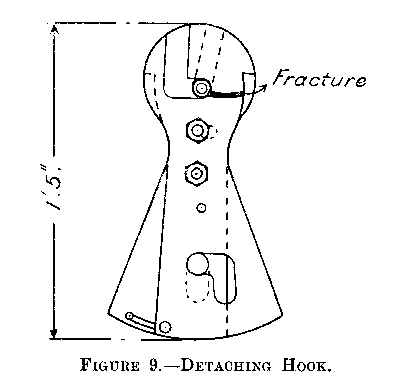
Detaching Hook. — The two outer plates of the detaching hook were broken across the jaws (see Figure 9). The breaking of these jaws set the cage free and so allowed it to fall down the shaft.
Winding Rope. — The rope had been drawn two inches out of the capel or socket.
Cage Shoes. — The Shoe A (the disposition of the cage shoes on the cage is shown in Figure 5, page 6) had been broken in half and one of the two bolts — the one on the West side of the North-East guide — by which it had been attached to the top hoop of the cage had come out, thus allowing the Western half of this shoe to fall free while leaving the other half in position on the hoop of the cage with its bolt and nut intact and in place.
When the cage was brought to the surface Shoe D was missing. It was found later, still on the guide, in the sump and undamaged. The two bolts by which it had been fastened to the bottom hoop of the cage were missing and were not recovered, although a thorough search for them was carried out.
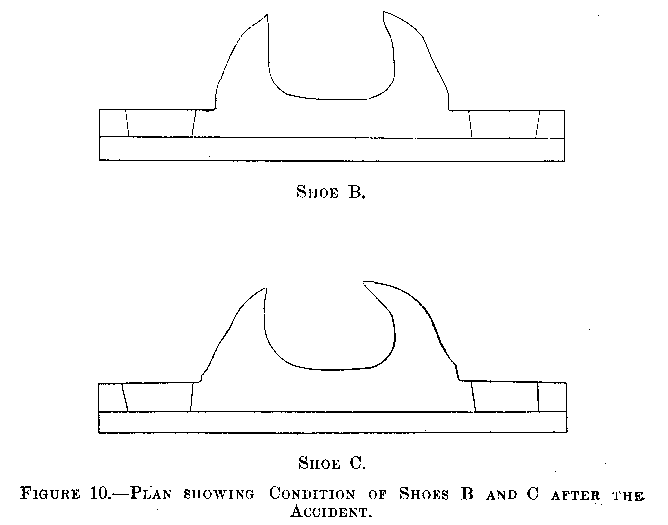
The Shoes B and C (see Figure 10) were still in their correct position on the top and bottom hoops of the cage respectively. The distance between the outer ends of the jaws of both these shoes was so great that the Enginewright, when asked what he thought about their condition, replied :— "I did not know what to think about them, I thought something very unusual and very extraordinary must have happened to them." The leading blacksmith, when examined on the same point, said :— "I did not know what had happened to them, I had never seen anything like it before. The jaws were straightened out instead of being curved in as they usually are."
He agreed that the condition of the Shoes B and C was consistent with wear but caused by something abnormal, and then later qualified his statement by saying that the condition was due partly to wear and partly to something else.
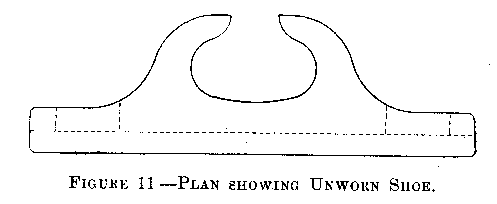
For purposes of comparison, a plan of an unworn shoe is given below :—
These four shoes A, B, C and D, together with two other shoes (marked X, X), which had previously been in use on the North-West guide, a piece of the North-East guide rail, and a new ¾-inch diameter bolt — the bolt being a sample of those used to attach the shoes to the cage — were examined at the National Physical Laboratory. These materials were submitted to mechanical tests and chemical and microscopical examination, and the results of those tests and examination formed the subject of a report by Dr. T. E. Stanton and Dr. Walter Rosenhain; Dr. Rosenhain produced the report at the Inquiry and gave evidence and was cross-examined upon it.
I quote from that report as follows :— "After the accident the slipper A was found to be fractured as shown in Figure 2, and there were signs of considerable abrasion having taken place between the broken portions and the rail after fracture of the slipper had occurred.
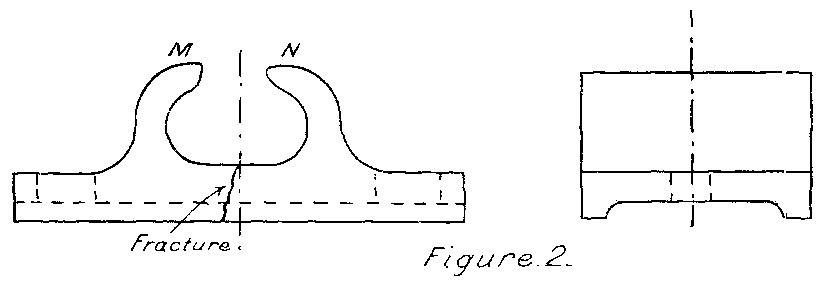
"In the case of slippers B and C, the lips M and N (Figure 2) were found to be worn away to such an extent that in the normal position of the cage relative to the rail, slipper B offered no constraint to the detachment of the cage from the rails, and Slipper C could be detached from the rails by a rotation about its axis of approximately 20°. Slipper D was intact and the extent of the wear on it was not appreciably different from that of the slippers X, X.
"The piece of steel rail was not taken from the section at which the accident occurred, but at some distance below it."
In fact, the piece of steel rail submitted was part of the North-East guide rail which had been broken during the accident whereas the Shoes B and C had been running on the North-West guide which, as has already been described, was made up of two different sections of rail. On investigation it was found that, at several places, the Shoe C, when in the same position relative to the guide as when fixed on the top hoop of the cage, could be pushed into place on the new section of rail.
The report continues: "The examination of the worn castings as received showed that parts of the 'lips' of Slippers B and C were worn completely away. This is illustrated in Figure 1 relating to Slipper C." (See Plate II.) "There is considerable evidence as to the manner in which this wear has taken place. In Slippers A and D the 'lips' were worn very thin at a considerable distance from the projecting edges, and in Slipper C the worn edge had the typical appearance of metal that has been fractured. It is therefore probable that Slippers B and C were worn so thin in places that the lips eventually broke off. The appearance of the fractured edge of Slipper C, viewed from above, is illustrated in Figure 2 at a slight magnification." (See Plate II.) "The smooth bright patches along the fractured edge show that some wear has taken place subsequent to the fracture. In the case of Slipper B there were no signs of fracture; if fracture has occurred in this case all signs of it have been worn away."
The conclusions arrived at by Dr. Stanton and Dr. Rosenhain are set out in their report as follows :—
"1. Quality of the Castings. — Chemical analysis, microscopic examination and mechanical tests all indicate that the material of the castings is of poor quality. The castings vary considerably but are very unsound, so that it was difficult to obtain even small test pieces free from defects, and the content of impurities (sulphur and phosphorus) is high."
The content of Sulphur varied from .052 to .077 and of Phosphorus from .065 to .085.
"2. Influence of the Quality of Slipper Castings on the Accident. — As far as conclusions can be drawn from the material available, the occurrence of the accident cannot be directly ascribed to the failure of one of the slipper castings owing to poor quality.
"In regard to the large amount of wear shown by Slippers C and B, as the castings are somewhat hard and brittle, their poor quality is not directly responsible for excessive wear. The edge of the lip of Slipper C, however, shows that this lip at some time broke off and that the fracture has subsequently undergone further wear. If this slipper was allowed to wear very thin at the shoulder, the weak and brittle nature of the material would allow fracture to occur. In this way, the poor quality of the casting may be regarded as having contributed indirectly to the accident.
"3. Examination of Slipper C shows that, when placed on a rail of the cross-section of that submitted for examination, it cannot be freed until turned through an angle of 20°. Such turning could not occur unless Slippers A and D were previously freed either from their rails or from the cage.
"Slipper A was found fractured after the accident, the position of the fracture being very similar to that produced in another slipper by a wrenching test in the Laboratory. Microscopic examination of Slipper A furnishes strong evidence that it was broken by a blow or shock. Unless such a shock could have occurred before the accident, the inference is that the fracture of Slipper A was a consequence and not a cause of the accident. If this inference is accepted, the freeing of Slipper C from the rail must be accounted for in some other way."





 Contains public sector information licensed under the

