


|

|

|

|
|
 |
 |
|||
CAUSE OF THE ACCIDENT.
The accident was due to the cage getting out of the guides. Different opinions as to the cause of this were expressed by different witnesses.
Mr. Sydney Arthur Main, Steel Metallurgist, employed by Messrs. Hadfields, Limited, called by Mr. Kirkup, stated that the analyses and tests, as disclosed by Dr. Rosenhain, showed the qualities he would expect from castings suitable for cage guide shoes and did in fact represent the quality of casting which Messrs. Hadfields had been supplying for years for that particular work at collieries.
"Mr. Kirkup: In other words, the strength of the castings is so very much greater than the strain that would be put on to them by normal working that you cannot suggest anything that would overcome that severe stress? — We can put in a harder quality of steel. There is no question about that at all. We could put in the highest quality steel which nowadays metallurgical science can produce, but it seems to me there is absolutely no call for it. The properties of manganese steel have been mentioned. That is a very hard wearing and an extremely tough steel. It seems at first sight to have just the qualities one wants for a thing like this. You would not have to submit the thing to such frequent or such rigid inspection, because you would know the wear was not taking place very rapidly. But as I reconstructed the circumstances of this accident (I formed my own theory about it, of course, otherwise I could not say) I could not see how the qualities of the castings have come into question in causing the accident; but I have considered what might have been the case had the castings been tougher. It seems to me that casting 'A' got loose in some way and jammed on the rail causing the cage to wedge and causing the arrest of the cage, and causing all sorts of further trouble. It seems to me had shoe 'A' been more brittle. something in the nature of cast iron, as soon as that seizing took place the thing would have fractured at once before the stress had reached any very large figure, and relieved the pressure and the cage might have gone on on three shoes in just as sweet a way as it could have gone on on four.
Then later . . . " I hold very strongly that one of these bolts (cage shoe bolts) has given way. . . ."
Professor Henry Louis, Professor of Mining at Armstrong College, Newcastle-on-Tyne, M.A., D.Sc., Past President of the Society of Chemical Industry, etc., etc., was called by Mr. Kirkup and gave his explanation of the cause of the accident as follows —
"My first idea was that Shoes B and C were unduly worn and would come off the rail. I tested them with a piece of rail supplied to me — this piece. I found that Shoe B would pull straight off. Therefore, if the other guides were not gripping, Shoe B could come away. Shoe C would only come away if it was turned through an angle. Dr. Stanton says about 20 degrees. I measured it as carefully as I could and I make it a turning angle of 25 degrees, but that is only if you turn it in one direction; if you turn it in the opposite direction, you have to turn it through 40 degrees before it will come off the rail. I am assuming they are fixed in their place on the cage.
"And that is top side up? — Yes. In any case, I say you have to turn it through 40 degrees. As long as A and D are on that piece of rail, you could only turn that cage through 15½ degrees. If my figures are doubted, it is easy to measure them. I did it with Shoe D.
"Which rail? — The top rail. I have sent for a piece of the bottom rail which I have not had a chance of examining. By turning it this way, I find the maximum turn it admitted of was 15½ degrees. This I am told is the piece of the bottom rail, it has been brought in just now at my request. When I found that it was impossible to turn that cage through a larger angle than 15½ degrees, I had to reject that theory altogether.
"I then put forward, quite tentatively, the view that occurred to me what might have happened, and it is this, that in Shoe A one of the bolts, probably the outer one, I will not say which for certain, has got over-strained or weak, or in some condition in which it is easily fractured. Assume any jar on the cage, assume your rope was a bit slack at starting or anything of that kind, to put a jerk on to that bolt, that bolt would snap and drop out. Shoe A could then easily, remembering this flange is a bare one-quarter of an inch deep, spring out that much. You have it on a long hoop which is only 3½ by ¾, and therefore in a 5-foot length a considerable spring, and I therefore consider it quite possible that the end of Shoe A may have sprung out and dropped down a bit. The result of that would be the rubbing action that you see on opposite angles of Shoe A. As you have the rubbing action on two opposite corners, I am inclined to think (and this is where I beg to differ from Dr. Rosenhain) that the rubbing was produced while the shoe was still on the guide, because two opposite angles have been rubbed in a way which could only occur if the shoe had been tilted on the guide while it was still moving on it. I imagine that to have happened and the guide to have worn hot until you got actual seizing, and there is evidence in the metal here that there has been actual seizing. The moment that happened, you have got an immense strain put on; you have a 2-ton cage moving at 18 feet a second, you have a tremendous strain on that cage, and, in my opinion, that is quite sufficient, given a momentary seizure of the shoe on the guide, to have snapped that shoe. That I think I speak with a good deal of doubt — could have been abrupt enough to have produced the ' Neumann bands.' "
It should be explained that under examination at the National Physical Laboratory, the material in the neighbourhood of the fracture in Shoe A showed a number of "Neumann bands" in the ferrite and the fact that these bands were present, as was set out in the report by Dr. Stanton and Dr. Rosenhain, is strong evidence that the fracture of Shoe A was the result of shock.
Dr. Rosenhain in the witness box amplified this by saying :— ". . . and it is an observation which I have confirmed on many occasions that they (Neumann bands) only occur in a steel which has been broken with very considerable rapidity, definitely a blow or a shock."
Professor Louis continued :
"I do not want to be dogmatic on that point because it is a difficult point, but I think that is plausible. If you admit that, that you have Shoe A broken by the snap, then half of it drops down into the sump. The cage up to then has been binding and has had a pull on it which has been resisted by great friction. The moment that shoe breaks, you have the effect as though the brake is taken off a motor car and you get a bound forward; the cage springs up and slacks the rope, and you therefore get a turning movement of the cage inclined to tilt forward about the bottom shoe. That puts an enormous strain on the bolts of Shoe D. I have calculated it, and I find that the strain put on certainly exceeded 100 tons. Now assume that to happen, worn guides I found experimentally allow a play of 9/16ths of an inch. I think it is possible with that amount of play, with that enormous strain (the strain I have calculated) to strain the top fibres of the bolts. and it is so great that, in my opinion, it would instantly fracture the two bolts in Shoe D by bending stress. If that is so, Shoe D would drop down the guide into the sump. You would then have your cage hanging on Shoes B and C, which are partially worn as we all know. Then a backing action, which we can understand, takes place. The weight of the cage tears the pieces off the lip of the shoe in the way which Dr. Rosenhain considers possible, and you have your two shoes left in that condition. If one of them goes, obviously you can get sufficient turning movement in the opposite direction to free Shoe C. You have your cage hanging free in the shaft and obviously the rest of the accident will happen. . ."
It will be noticed from these quotations from Professor Louis' evidence that his first theory of the accident was that Shoes B and C were unduly worn and came off the guide rail. He tested his theory by trying these two shoes on a piece of guide rail supplied to him by the owners. He found that, while Shoe B would pull straight off the guide, Shoe C would only come away if turned at an impossible angle, and on the information before him he had no option but to reject his first theory and seek another.
Unfortunately, the information before him seems to have been incomplete on a most vital point. The piece of guide rail supplied to him was a piece of the old section. He was not shown, until he appeared in the witness box, a portion of the new section; and he was not aware that at certain parts of the shaft it was possible to pull Shoe C as well as Shoe B straight off the new section of guide.
When all the facts were put before him, Professor Louis said :— "If B and C were unable to come off the new rail at the fatal wind, the theory I have put forward is, to my mind, the only feasible one that I can see. I think you have definitely to choose between those two alternatives; either B and C were in such a condition that they were able to come off by direct pull, or else something like what I have suggested, in my opinion must have happened. One or other of those is the alternative for us. At the present moment I see nothing else."
In answer to Colonel Blackett, Professor Louis said that he knew that the North side cage had a tendency to twist, due, he imagined to the twist in the winding rope, which resulted, he suggested, in the shoes on the North-West guide wearing more rapidly than the others — these shoes were always trying to get off the guide. He agreed that, if these shoes had become so worn in three weeks that they were approaching the end of their usefulness as shoes, and if as they went slowly up the shaft they suddenly met a wider section of guide, they could at that moment just open out, due to the wedge-like action consequent upon their encountering the wider guide.
Mr. Kirkup examined Professor Louis on this last point as follows :—
"With regard to Colonel Blackett's questions to you, I suppose you are aware that in the joint between the old and new sections in the shaft in actual working practice it cannot he noticed where the two join? — I have not seen the shaft. I have been told so.
"Really the difference which would be felt by the shoe in passing from one to the other could hardly be felt. When we remember that a new shoe has something more than a quarter of an inch of play, do you think the joint of those two sections would really have an appreciable effect on the wear of the shoe? — I still think Colonel Blackett's suggestion is not an impossible one, namely, that the shoes pressed hard against the lower guide, and then the gradual but very gentle tapering which would exert a wedging action would open those guides (shoes). I think I am interpreting Colonel Blackett correctly?
"Colonel Blackett: Yes, my question referred to wedging."
Later, Colonel Blackett put the same point to Mr. H. T. Foster in the following question :—
"I am not one that would attach very much importance to exactly how it got out, because at the best it will be guesswork, but supposing the inner chains were tighter than the outer ones and that the shoes were nearing the time when they were going to succeed in getting off, is it not possible for them to grip the lower section and then be wedged open when they reached the higher section." Mr. Foster replied :— "Yes, it is a very feasible suggestion, if you got to the point of just gripping the bulb, that is. Although there is such a small observable difference, there is enough difference actually to do it."
Professor Louis, in further answer to Colonel Blackett, said that assuming that the Shoes B and C were free from the North-West guide, it was possible for the cage to swing and break Shoe A and to sheer the bolts holding Shoe D, but that in any case, the point was not very material. If that was what actually happened, then he (Professor Louis) agreed that such a happening would account for the way the North-East guide rail was bent.
Mr. George Patrick Herron, Chief Mechanical Engineer for the Home Collieries of Messrs. the Consett Iron Co., Ltd., said he agreed with the theory put forward by Professor Louis. He had never seen shoes taken off any of the cages at any of the collieries owned by the Company in the condition that the Shoes B and C were in after the accident. He suggested that B and C had been worn fairly thin, and that the thin points had first been broken and then abraded by wedging in the bulb of the guide. He thought that the thin portion could be taken off and the shoes brought to their condition as produced in a few yards of a wind.
Mr. Percy Edmond Smallwood, B.Sc., Assistant Mining Agent of Messrs. the Consett Iron Co., Ltd., gave evidence, and in reply to Mr. Kirkup stated that, in his opinion, the initial cause of the accident was the bolt on the left hand side (Western side) of Shoe A becoming, by some means or other, displaced. Thereafter Shoe A became tilted and put a heavy drag, practically seizing, on the North-East guide, and set up a strong vibration at the bottom opposite corner of the cage which brought Shoe B off the North-West guide, and at the same time, only in less degree, Shoe D was subjected to similar vibratory movements. As soon as Shoe B came off the guide, the bolts holding Shoe D had to fail. Shoes C and D held on for a time but D coming off, the cage swung round to such an extent that Shoe C was freed from its guide rail; the whole cage was then free. The cage then swung in the contrary direction and caught the under side of the cast iron girder, the detaching hook broke, and the cage went back.
Mr. H. T. Foster, B.Eng., H.M. Inspector of Mines, stated that Shoe B could be put on to the North-West guide at any point but that Shoe C down to the new section of guide rail would not go on. Between Nos. 24 and 27 buntons Shoe C would pass over the guide (the new section began at No. 24 bunton) at the top of the shoe but not at the bottom. Below No. 27 bunton for a length of 4 feet, Shoe C could be put on to the guide with difficulty. Between Nos. 29 and 30 buntons, Shoe C could be put on " by giving it a bit of a push." At two fathoms below "meetings," it went on freely, and again at three fathoms above the new Townley Inset. Mr. Foster explained his theory of the cause of the accident at length and then gave it shortly as follows :— "The inner bolt of Shoe A broke; very rapidly afterwards that end of Shoe A got off the hoop, seized the guide, gave a fast hold, and broke; very rapidly after that, Shoes B and C were torn out of the North-West guide; the bolts of Shoe D were broken; Shoe D went down the shaft in front of the descending cage; the cage was free in the shaft; it struck the under side of the cast iron girder at No. 14 bunton; it broke the girder; it broke the detaching hook, letting the rope free, leaving the cage unsuspended; the cage fell down the shaft, doing very little damage indeed — it must have fallen almost vertical — to No. 24 bunton; it struck the cast iron girder on the East side, broke the cage floor up, tilted the cage westward; the top end of the West side of the cage struck the wooden girder, and the cage rested there: certainly some of the men were thrown out on the first impact. probably the remainder fell out during the following two or three seconds."
Mr. Peter Lee, Joint Committee Secretary of the Durham Miners' Association, referred to and explained the several inspections he had made in the shaft, and after criticising the theories of others gave his own theory, based upon what he had measured and observed, as follows :— "The theory is that these shoes on the North-West guide marked B and C were a great deal worn, and as the cage was ascending these two shoes were pulled from the guide about the 27 bunton and the cage travelled up with these free, but the two on the North-East side in order and still on the guide this enabled the cage to swing round until it came in contact with the under side of the metal stand-pipe girder which broke the detaching hook and caused the accident."
Mr. Lee went on to explain that he considered that Shoe A was broken when the cage struck the stand-pipe girder, and that the Western half of it was freed at the same moment and fell down the shaft; that Shoe D remained on the North-East guide until the cage fell on to the second cast-iron girder just above No, 27 bunton; that the bolts holding Shoe D to the bottom hoop of the cage were then broken and the shoe thus made free to slide down the guide to the shaft bottom, and that the Eastern half of Shoe A being during the fall of the cage against the North-East guide rail, when the cage struck the last mentioned cast-iron girder, this guide rail was in consequence bent and broken.
Mr. Peter Lee was supported in his theory by Mr, John George Longstaff, Engineer and General Secretary of the Amalgamated Managers' and Foremen's Association, who also criticised the theories put forward by other witnesses. Mr. Longstaff, although supporting the theory of Mr. Peter Lee that Shoes A and D remained intact and on the North-East guide until the top hoop of the cage collided with the cast-iron girder, nevertheless argued that, if Shoes A and D were on the North-East guide at the time of impact, then three of the cage chains would have been elongated and one remain normal. The evidence in regard to these chains was that one only was elongated.
That completes the recapitulation of the several theories of the cause of the accident. It will be noticed that they may be divided into two categories, the one, propounded by Mr. Main, Professor Louis, Mr. G. P. Herron, Mr. P. E. Smallwood and Mr. H. T. Foster, and the other, put forward by Mr. Peter Lee and Mr. Longstaff.
In the former theory, each adherent starts with the assumption that one of the bolts — the Western one — holding Shoe A broke and fell out, and then makes the further assumption that Shoe A itself became canted on the guide rail and eventually seized that guide so tightly that it (the shoe) was broken in two. It is also assumed that Shoes B and C, though worn, were in working order.
The assumption that this — a broken bolt — was the initial cause of the accident is contrary to all former experience, as testified to in evidence by the leading blacksmith, the Enginewright, and the Chief Mechanical Engineer, Mr. Herron, to the effect that they had never known a bolt to break during the many years they had known the shaft. This experience is what might be expected, for the duty of the bolts is simply to hold the shoes against the hoops of the cages and nothing else. They fit loosely in the holes in the shoes and any strain tending to twist the shoes is borne by the upper and lower flanges at the back, which overlap the hoops of the cage. It was suggested that the bolt in Shoe A failed because of fatigue or because of being strained either when being tightened or when the cage was being lifted from the "hanging on." Having regard to the duty it had to perform and the short time it had been in use (it was given in evidence that no bolt was used more than once), I cannot accept such a suggestion in respect of fatigue, and as the blacksmiths were provided with proper tools, that is to say, keys of such a length that they could not overstrain the bolts, and in evidence they said they did not so overstrain them, I am not able to accept the second suggestion either. Nor do I consider it possible, having regard to the fact that the hoop of the cage fitted into the recess on the back of the shoe, that the bolt could be strained at the moment of lifting the cage away from the pit bottom.
Further the assumption that Shoe A came off the hoop of the cage and canted, and thereafter seized the guide is contradicted by the evidence as to the condition of the half of this shoe which remained on the hoop of the cage after the accident. This part of the shoe was found in position with its bolt holding it tight against the hoop. If Shoe A had been canted on the guide as suggested, then the half remaining must thereafter have returned to its original and proper position on the hoop and the eastern bolt then have been tightened up by some fortuitous happening which in my opinion it is impossible to conceive.
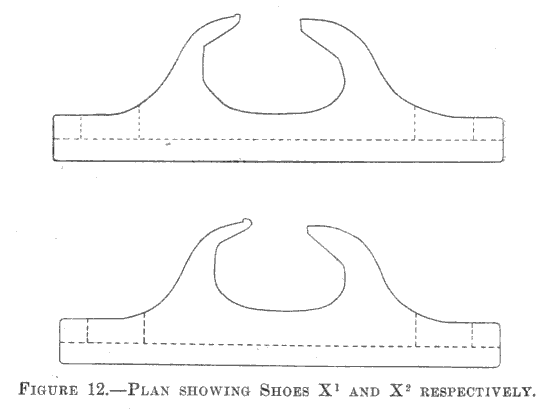
In regard to the assumption that Shoes B and C, though worn, were in working order immediately prior to the accident, it has to be pointed out that such an assumption implies that during the last wind these shoes, B and C, were altered from a state comparable with two worn shoes X1, X2 (see Figure 12) which were produced at the Inquiry and described as being the shoes for which B and C were substituted, to the state they now are and were in immediately following the occident. I am not able to make that assumption.
The theory necessarily involves also the assumption that Shoe A seized when the cage was ascending. In my opinion there was nothing in the condition of this shoe after the accident to support this assumption. On the contrary, the condition of the top of its Eastern lug, as shown in Plate III, and of the inside at the bottom of its Western lug, was such as to point to this having been brought about when the cage was descending.
This theory, then, involves at least four independent assumptions — each in my opinion most improbable in itself. The cumulative improbability of all four assumptions being correct is to me hardly distinguishable from the impossible.
I now take the second theory, that of Mr. Peter Lee and Mr. Longstaff, and up to the time of the collision between the ascending cage and the cast-iron girder, I agree with it in essentials. With the rest of their theory — as to the subsequent course of events — I do not entirely agree.
When the following facts, namely (1) that the shoes on the North-West guide, consequent upon that guide being made up of two entirely different sections of rail, had to he renewed at intervals, on occasion of three and always of four weeks; (2) that the Enginewright had found them to be in such a condition on the day prior to the accident as to require that they should be changed on the following day and had so instructed the blacksmith; and (3) that at times it had actually been necessary to change them during the week and prior to a Saturday, on which day it was customary to change them, are coupled with the result of the examination and tests made by Dr. Stanton and Dr. Rosenhain, and with the evidence of Dr. Rosenhain, Professor Louis and Mr. Herron, it appears to mc that the cause of the accident is made perfectly clear.
Dr. Rosenhain, Professor Louis, and Mr. Herron were in practical agreement as to the manner in which the final rupture of the lips of Shoes B and C was brought about. Dr. Rosenhain considered that a considerable amount of abrasion took place, then a part broke off and then there was further abrasion and some polishing. To these causes Professor Louis added slight compression. Mr. Herron said : "They (the Shoes B and C) have been worn fairly thin and the thin points have been first broken and then abraded by wedging in the bulb."
Cage shoes in the natural course of events become worn ; Shoes B and C under the unnatural conditions in which they were employed, namely, on a guide made up of two different sections of rail, became worn rapidly, and not only worn rapidly, but also worn in a peculiar fashion consequent upon the shape in cross section of the lower length of guide rail and the impossibility, because of the employment of the two different sections for the same guide, of having a shoe to fit that section.
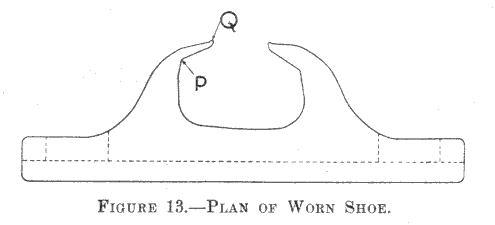
In Figure 8 the cross section of this last length of guide rail is shown, and Figure 13 is a plan of a worn shoe. Consequent upon the shape of this part of the guide rail, the shoes running on it became worn in such a manner as to form an angle as at "P" in Figure 13, and it follows that, if these shoes were allowed to remain in use too long, there was the risk of a fracture arising in the angle and resulting in the loss of the lip of the lug from "P" to "Q" for the full depth of the shoe. Further running of the shoes on the guide would result in a wearing away and polishing of the rough edge left by the fracture.





 Contains public sector information licensed under the

