


|

|

|

|
|
 |
 |
|||
CONDITION OF THE SHAFT AND ITS FITTINGS PRIOR TO THE ACCIDENT.
The last examination of the shaft and its fittings prior to the occurrence of the accident was made by the shaftman (Timothy Collinson), between the hours of 12.30 and 1.30 in the morning of Saturday, 24th February, that is within seven hours prior to the occurrence of the accident. At that time he found everything in normal running order. He saw the two top shoes of each of the cages and was satisfied they were all right. It was not his duty to examine the shoes but it was his custom when examining the shaft "to cast his eyes on them every morning." He recorded a report of this examination in the report book as follows :— "All in working order."
The last examination of the cages, shoes, chains, detaching hooks, winding ropes and their capels or sockets prior to the accident was made by the Enginewright, J. Simpson and the blacksmith, J. Wilson, between the hours of 8 and 8.30 in the morning of Friday, 23rd February, that is within 24 hours of the occurrence of the accident. During this examination, the various appliances were found to be in good order with the exception of the two cage shoes on the North-West guide, which were found to be worn, and Simpson told Wilson that they would have to be changed on the Saturday.
A report of this examination was recorded by Simpson in the report book as follows :— "In good order."
At the Inquiry the Enginewright gave evidence in regard to the condition of these cage shoes as found by him on the morning of 23rd February as follows :—
"When you examined those shoes what was your opinion of them "that morning ? — They were all in good order except the two North-West guide shoes, and I told the blacksmith they must be changed on the Saturday.
"They were in good order ? — Yes. What I mean by 'good order' is, they were worn but in good shape and fit to go another week, which I always kept in hand. I always kept that in hand. If they would go a month, I used to take them up in three weeks; if they were running to five weeks, I would take them up at the end of a month. That is what I acted on, those two shoes only on the North-West guide. The others did not require it at all. There was no anxiety about any of them, but those two North West shoes.
"You acknowledge they were worn ? — Yes, they were worn."
Then, being asked to say how much the shoes were worn, the Enginewright demonstrated by reference to a shoe marked "XX" which was in evidence, and explained that the condition of those on the North-West guide when he last examined them was similar. This shoe "XX" is shown in Plan in Figure 6.
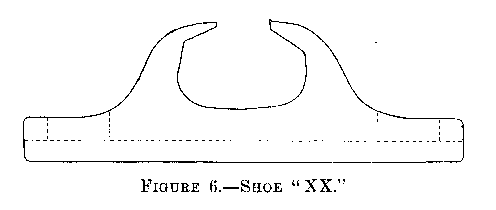
To quote further from the Enginewright's evidence :—
"How long does it take to change a pair of shoes ? — Not very long; half-an-hour to three-quarters of an hour.
"It would not have been a big job to have done it that night if you had wanted to do it ? — Not if I had wanted to.
"You are confident they were not worn enough to necessitate that? — Quite positive."
No record was kept of the dates when the shoes on the various guides were changed, but the Enginewright stated in evidence that those on the South-East and South-West guides, i.e., those on the South cage, wore very evenly and lasted from 8 to 10 weeks; that those on the North-East guide of the North cage lasted almost as long as those on the South cage, but that those on the North-West guide of the North cage only lasted a month. He further said that the shoes on the North-West guide at the time of the accident had been put on new on the 3rd February, that is exactly three weeks prior to the occurrence of the accident.
METHOD OF MAKING EXAMINATION OF CAGE SHOES.
The Enginewright explained in evidence, and later demonstrated to me on the spot, the manner in which he made his examination of the cage shoes. This consisted of passing his hand over them and judging their condition by the feel of them. Although he could to a certain extent see the shoes, he preferred to base his examination on "touch" rather than "sight."
CAUSE OF WEAR OF CAGE SHOES, PARTICULARLY OF THOSE ON THE NORTH-WEST GUIDE.
As has already been stated, three of the four rail guides in the shaft had been in use for many years but a portion of the fourth — the North-West guide — for a distance of 312 feet measured from the bottom of the shaft was taken out in January, 1921, and replaced by rails of a somewhat different section from those which had been in previously. That is to say, the North-West guide, subsequent to January, 1921, consisted of two lengths, measuring respectively 312 feet and 171 feet to the banking-out level, of different section, as shown in Figures 7 and 8.
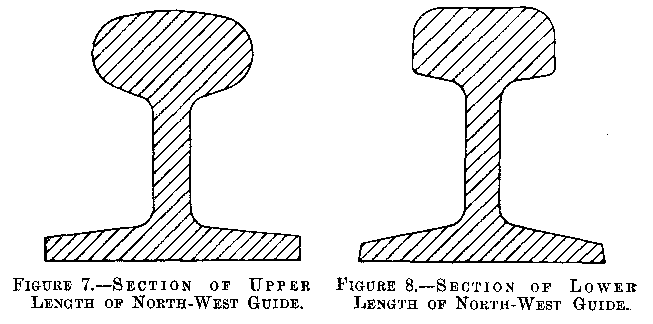
The joint between the two portions was carefully tapered and in course of time became so even that the point where the change in section occurred was not easy to discover. Nevertheless, all the witnesses to whom the question was put gave it as their opinion that the greater wear of the shoes on the North-West guide, as compared with the shoes on the remaining three guides, was due, in the first place, to this change of section in the guide. There were other contributory causes, namely, the fact that the North-West was in its lower length the wet part of the shaft and as a consequence it was difficult to lubricate this guide, and the fact that the winding rope in its natural tendency to uncoil caused the inside of the West side lugs of the West side shoes to bear more hardly on the North-West guide.





 Contains public sector information licensed under the

