


| Newspaper Articles |

|
Newspaper Articles |
 |
 |
19th October 1940, Page: 113, Column: 1
Spray And Mist Projector Tests
Investigation in South Wales Coalfield
Problem of Allaying Coal Dust Clouds.
In recent issues of this journal (No. 2 and No. 3 Volume 51) extracts were presented from the first report of the Coal Dust Research Committee of the Monmouthshire and South Wales Coal Owners' Association, of which Mr. M. H. Llewellyn is the chairman, and Dr. T. David Jones is the director of research.
The Second Report of the Committee has now been issued and deals with sprays. The introduction informs that in carrying out the work included in the First Report a compressed air and water spray was used. During this work, it was felt that little reliable information was available as to the behaviour of these sprays and as to the amount of compressed air and water consumed by them in use. The committee felt that it was most desirable to carry out extensive laboratory tests on sprays in order to obtain, if possible, some indication as to their efficiencies. The second report records a summary of the results obtained with (i) water sprays, and (ii) water and compressed air.
With reference to the water sprays the committee felt that, since the fire-fighting requirements in collieries had rendered available water at high pressure underground almost up to the coal face, advantage should be taken of this fact and that an attempt be made to design a satisfactory water spray. It will be realised that the efficiency of the water spray only will not be as high as that of the compressed air and water spray. The effect of the compressed air in atomising the water is most marked. The figures for water and compressed air consumption included in the second report should serve as a useful guide to the mining engineers of the coalfield. The committee do not claim that the report should be regarded in any way as having reached finality, but suggest that their publication would be of great help to industry in dealing with the important problem of coal dust in mines. The sprays referred to in the report may be successfully applied to dust problems on the surface and in particular at colliery screens. The work has been carried out almost entirely by Mr. J. Howard Griffiths and Mr. W. L. Gyles in the laboratories of the Mining Department, University College, Cardiff.
The report deals with the effectiveness of water sprays and compressed air and water sprays, and ends with the presentation of the conclusions arrived at by the investigators. Extracts are appended.
Method of Measuring Water Particles.
Sprays and mist projectors differ greatly in design and in water and compressed air consumption, but the factor which would influence most, their effectiveness in allaying dust clouds, would be probably the size of the water particles ejected from them. It soon became obvious that a method should be found which would allow the size of these particles to be measured, because opinions as to the fineness of the spray varied greatly with the individual observers. The first method to be tried was to catch a sample of the mist on a glass slide, and then photograph it. The second method was to catch a sample of the mist on a sieve of standard size and then photo-micrograph it, using a magnification of about 100. The third method consisted of catching a sample of mist in a cell containing a liquid which was immiscible with water, e.g., paraffin, and then taking a photo-micrograph. Finally, it was found that successful photographs could be taken if the sample of the mist was caught in a liquid, immiscible with water, contained in a cavity slide, and after experimenting with kerosene, liquid paraffin, benzine, toluene, xylol, lubricating oil, and carbon tetra-chloride, it was decided that the best results were obtained when using castor oil.
Water Sprays.
Method of Testing. — Water was run into a compressed air receiver until it was about one-third full. The air-compressor was then run so as to compress the air above the water to the required pressure, and the governor on the compressor was then adjusted to maintain this pressure. The spray to be tested was connected to one end of a hose, the other end of which was connected to the drain-cock of the air-receiver. A five-gallon drum about one-third full of water was then weighed to the nearest 10 grms. The drain-cock was then opened and the spray adjusted where possible to give the finest mist. A stop-watch was started and the spray was placed inside the five-gallon drum so that it was about an inch from the surface of the water. In this way any loss due to splashing was avoided. When the drum was about three-quarters full the watch was stopped and the spray removed from the drum, which Was then re-weighed. The increase in weight of the drum gave the weight of the water used by the spray in a given time, and from these figures the water consumption in gallons per hour was calculated. Altogether about fifteen water sprays of different designs were tested, but only the ten most efficient sprays are included. The pressure of the water in all the tests on water sprays Was 100 lb. per square inch.
1. — Garden Spray. — The garden spray consists of an annular jet fitting over a cone. The fineness of the spray can be controlled by screwing the outer nozzle along the cone and thereby increasing or decreasing the aperture through which the water is ejected.
2. — Lawn Spray. — The lawn spray is very similar to the garden spray, but is designed to give a slightly finer mist.
3. — Shower Spray. — In this spray the water is forced through a restricted orifice. The restriction, placed concentrically, is grooved spirally so as to impart a swirling motion to the water as it passes through the spray.
4.— Horticultural Spray. — The horticultural spray consists of a small circular chamber, into which the water enters tangentially, and after swirling around the chamber is forced out through a small hole situated at the centre.
5. — Pithead Bath Spray (Patent No. 888/14). — In this spray the water is forced out of four very small holes, drilled at an angle.
6. — Sirocco Large Spray. — In this spray the water has to pass through a single helix cut in a brass diaphragm, which imparts a swirling motion, and then ejected through a single hole at the centre.
7. — Sirocco Small Spray. — This is similar to the large Sirocco, only made to a smaller scale.
8. — The South Wales Water Spray No. 1. — In this spray the water passes through four small holes drilled axially at an angle, and then passes between an inner and outer cone before being ejected at the centre. Only clean water must be used with this spray, because the holes are so fine that they are easily clogged.
9. — The South Wales Water Spray No. 2. — The water in this spray enters by three channels in the periphery and is given a rotary motion by passing along tangential slots cut on the face, finally passing out through a hole at the centre.
10. — A.R.P. Spray. — In this spray the water is ejected through a hole at the centre. This is the simplest type of spray obtainable.
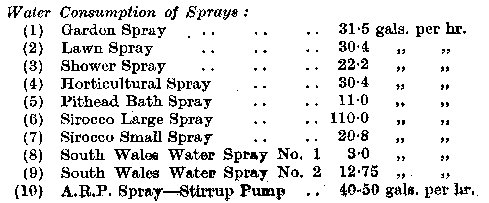
Examination of a number of water sprays showed that they employed one or both of two principles for atomising the water. These were : (i) by forcing the water through a small orifice and (ii) by imparting a swirling or rotary motion to the water. Photographs of the mists produced by the sprays show that the most effective atomisation is produced by those which employ both these principles, and that the South Wales (S.W.2) Water Spray is the best, with the small Sirocco a good second. The remainder of the sprays tested are far from satisfactory for coal dust work.
Measurement of the size of the water particles comprising the mist produced from a water spray show that there are few particles as far as 40 microns (one micron equals one thousandth of a millimetre), whilst the average size of the particles produced by a good spray is about 250 microns. As the size of the bulk of air-borne dust is below 25 microns it was thought, and later proved, that water sprays would not be very effective in destroying dust clouds. They are, however, ideal for wetting the surface of the coal in trams, on conveyors and in the roadways, etc., and so preventing the formation of dust clouds.
Compressed Air and Water Sprays.
Method of Testing. — All the compressed air and water sprays Were fitted with two connections, one for the air, and one for the water. The water was measured and supplied at constant head from a large tank fixed 7' 6" from the floor. The air was supplied at constant pressure from a compressed air receiver, and if less than 10 cubic feet per minute were being used it was measured by means of an inclined differential gauge connected across an orifice placed in the air-line. If the volume was more than 10 cubic feet per minute, a gate type meter was used.
The spray was connected up and the water was turned on so that it spouted a certain number of inches, measured horizontally from a point situated 7½" vertically below the jet. If there Were more than one jet, the distance was measured from the centre one. The compressed air was then turned on and carefully adjusted to give the best mist. The water level in the tank was then noted, and a stop-watch started. The pressure and volume of the air used were recorded, and after sufficient water had been consumed so as to alter the level in the tank by about 3" the spray was shut off and the watch stopped. The level in the tank was then carefully ascertained, and from the figures obtained the volume of water used in a given time was calculated. In all these tests the compressed air was at 65 lb. per square inch.
1. — The Air/Oil Spray. — In this spray the water flowed out through a hole placed in the centre of the spray. The volume of water was controlled by means of a small valve attached to it. The air blew out at an angle from two holes situated one each side of the water outlet.
2. — The Single Point Spray. — This spray consisted of a brass block machined out to take two concentric nozzles adapted from British Oxygen Co. standard fittings. The air passed through the centre nozzle and the water through the outer nozzle. Only a very limited volume of air could be used as the hole in the centre nozzle was only 1/32" diameter. The water had therefore to be throttled right down, and the volume of mist produced was very small.
3. — Walker-Whitfield Spray. — The Walker-Whitfield spray is made up of two circular reservoirs separated by a division plate. The mist is projected from seven Standard British Oxygen Co. "H" type cutter nozzles. The inner nozzles are connected with the rear compartment, which in turn is connected to the compressed air supply. The outer nozzles are connected with the front chamber which is connected to the water supply. The spray is held together by six bolts which pass through the division plate and the two chambers. The air and water are controlled by valves in the respective connection pipes.
4. — The South Wales Seven Point Circular Mist Projector. — In the design of the new spray, the water and air connections were interchanged so that water spouted through the inner jet and was surrounded by compressed air issuing from the outer jet. In this way all the water had to pass through the air stream and become atomised. This spray is of robust construction, and can be made in any colliery workshop. It was so successful that a number of other sprays were made by modifying the design.
5. — The South Wales Five Point Circular Mist Projector. — This spray is somewhat similar to (4), and was designed for use in places where it is essential not to obstruct the air-current too much. The diameter of the spray is therefore cut down to a minimum consistent with keeping the spacing of the jets at about four inches. This was done by doing away with the flanges and passing the bolts through bosses cast in the reservoirs. In this way leakage from one reservoir to another was still avoided.
6. — The South Wales Five Point Rectangular Mist Projector. — The South Wales Five Point Rectangular Mist Projector is designed to give a horizontal belt of mist which would probably be more effective in some places, for example, on a screen tippler, than the cylinder of mist projected by the circular sprays.
7. — The South Wales Single Point Mist Projector. — The Single Point Spray was designed for use at places where only a small volume of mist is required.
8. — The South Wales Single Unit Mist Projector Assembled from Standard B.O.C. Fittings. — This spray is not fitted with a reservoir, and therefore should only be used where the air and water pressures remain fairly constant. The outer nozzle is not adjustable and therefore cannot be used for controlling the volume of compressed air, and the air consumption is therefore slightly higher than that for the Single Point Spray.
9. — The "Hay" Mist Projector. — The "Hay" Mist Projector is already well-known and extensively used in mines for allaying dust and fumes produced by shot-firing in headings. It can be made at any colliery workshop from a few short lengths of piping and an old five gallon oil drum. To operate, the drum is filled with five gallons of water to which 4 ounces of powdered washing soda has been added. Compressed air is turned on which ejects the water in the form of a coarse mist. The water consumption of this projector is five gallons in eight or ten minutes, depending on the pressure of the air. The air consumption is about 140 cubic feet per minute, free air.
Dust Experiments with Sprays.
To determine the effect of certain variables which might affect dust suppression, experiments were carried out in the laboratory on both a horizontal and a vertical wind tunnel in which dust clouds of uniform concentrations could be formed. Two 12" tubes, each 6 feet long, were spigotted together to form a tunnel twelve feet in length. A compressed air nozzle was fitted at one end of the tunnel, so as to induce a current of air to flow through it. The dust cloud apparatus was a modification of that used by H. H. Schrenk of the U.S. Bureau of Mines, and consisted of a compressed air injector, the suction leg of which dipped into a tall cylindrical dust reservoir, which was slowly raised at a uniform rate, by means of a synchronous motor.
The coal dust used in these tests was such that it all passed through 300 mesh, and it represented a more severe test on the sprays than is likely to be met with underground.
A size frequency test on the dust deposited by the South Wales Mist Projector showed that a substantial percentage of the dust below 2 microns is deposited.
Before a particle of dust is brought down by the mist, two things must occur : (i) The particle of dust must collide with a particle of water, and (ii) the collision must occur in such a manner that the dust particle becomes attached to, or surrounded by, the particle of water. The probability of the first condition being fulfilled obviously depends on the number of water particles present per unit volume ; that is, the smaller the particle size of the mist, the greater the effectiveness of a given quantity of water. The second condition depends on the surface tension of the water, the angle at which the water and dust particles collide, and the relative velocity of the mist to the dust cloud.
In places where the velocity is very low, a mist projector blowing in opposition to the air-current might seriously affect, and in some cases actually reverse, the direction in which the air is flowing. An attempt was made to overcome this difficulty by placing a gauze about two inches in front of the jets. This assisted the atomisation of the water, and at the same time reduced the velocity at which the mist was projected against the air-current; that is, the relative velocity of the mist to the dust cloud was reduced, with a corresponding reduction in the number of collisions between the water and the dust particles.
Further experiments were carried out on the wind tunnel to determine the effect of adding certain chemical re-agents which would alter the surface tension of the water. The substances tried included washing soda, water glass, "Perininal," and "Agral." The effect of adding these chemical re-agents is very small. The change in efficiency is not appreciable, and is not worth the trouble and complications entailed in introducing the re-agents into the water going to the mist projectors.
The two sprays which gave the finest mist were tested out against a dust cloud produced in the wind tunnel, and as was expected from consideration of the particle size of the mist they did not prove very successful.
Further experiments were carried out to determine the effect of adding certain re-agents to the water to lower the surface tension. The results show that by decreasing the surface tension the size of the particles is reduced, with a corresponding increase in the effectiveness of the spray produced.
Conclusions.
The following conclusions are drawn from the results of the experiments carried out by the investigators as described in the Second Report of the Committee :—
Water Sprays :
1. The most effective atomisation is obtained by those sprays in which the water is forced out through a small orifice and given a swirling motion. Of the sprays tested the South Wales Water Spray No. 2, and the Sirocco Small Spray, gave the best atomisation, the average size of the particles being about 250 microns.
2. Water sprays are not very effective against air-borne dust, but are ideally suited for wetting the surface of the coal and so preventing dust-cloud formation. It is suggested that these sprays may prove effective in wetting roadways, thereby trapping the dust which has already been deposited.
3. The addition of certain chemicals to the water to reduce the surface tension increases the effectiveness of water sprays against air-borne dust by decreasing the size of the particles comprising the mist. The increase in effectiveness, however, is only about 10 per cent. even when using relatively strong solutions of the chemicals, and does not warrant the additional cost and trouble entailed.
Compressed Air and Water Sprays :
1. The most efficient atomisation is obtained by passing water through the inner nozzle and compressed air through the outer nozzle. The average size of the particles of mist produced by a South Wales Mist Projector is about 60 microns.
2. In general, the greater the air to water ratio the finer the mist, but there is a critical figure beyond which very little advantage is gained by further increasing the air consumption.
3. The finer the mist the more effective it is against air-borne dust. If, however, it is too fine, the water evaporates before it wets the dust. In practice it is best to adjust the mist so that the air feels damp, but not wet, at a distance about four feet from the mist projector.
4. The greater the relative velocity of the mist to the dust cloud the greater the effectiveness of the mist, and therefore it is recommended that the mist should be projected in the opposite direction to which the dust cloud is moving.
5. The South Wales Mist Projectors are capable of suppressing 80-90 per cent. of air-borne dust when used under favourable conditions. None of the other sprays tested in this investigation approach this efficiency.
6. With the South Wales Mist Projector, although the average particle size is 60 microns, it is interesting to note that the mist is effective in dealing with air-borne dust containing particles below 2 microns.
7. In practice it has been found that the South Wales Mist Projectors have given an efficiency far in excess of that obtained for steam in dealing with coal dust suppression.
 |
 |
| Names mentioned in this article | |
 |
 |
| Name | Age | Occupation | Notes |
|---|---|---|---|
| Griffiths, J. Howard | |||
| Gyles, W. L. | |||
| Jones, T. David, Dr. | Director of Research | ||
| Llewellyn, Morton Howell | Chairman | Whos Who Page | |
| Schrenk, H. H. |
 |
 |
| Related Articles | |
|
|
| Pub. Date | Article (Newspaper) |
|---|---|
| 27 Jul 1940 | Loading-Point Dust, South Wales Committee's Report (The Science and Art of Mining) |
| 10 Aug 1940 | Loading-Point Dust, South Wales Committee's Report (The Science and Art of Mining) |
| 19 Oct 1940 | Spray And Mist Projector Tests, Investigation in South Wales Coalfield (The Science and Art of Mining) |



 Contains public sector information licensed under the

