


| Newspaper Articles |

|
Newspaper Articles |
 |
 |
10th August 1940, Page: 42, Column: 1
Loading-Point Dust
South Wales Committee's Report
Concluded from page 27.
In the last issue of this journal extracts were given from the Report of the Coal Dust Research Committee of the Monmouthshire and South Wales Coal Owners' Association. Further notes are presented herewith.
Efficiency of Dust Extractor.
Throughout the whole length of the conveyor belt from the loader to the face a certain amount of dust is being raised into the air-current due to the working of the belt, abrasion against the side-plates, and from spillage of coal. The amount of dust raised into the air in this way varies from place to place along the belt, and also varies with different times, but as the dust concentration curves flatten out considerably beyond the point 80 feet from the loader, this flat part of the curves may be a measure of the amount of dust produced in this way from the working of the belt, the dust raised at the loader having largely settled out in this distance. The efficiency of the dust extractor in reducing the amount of dust present in the air-current between the loader and the point 80 feet from the loader was 70 per cent.
The amount of dust still present in the air-current between the loader and the point 80 feet inbye is by no means all due to inefficiency of the dust extractor, since on account of spillage at various points on the loader beyond the inlet to the dust extractor, the hypothetical line has been taken at a rather lower value than is actually the case in practice.
There is a considerable amount of coarse dry dust collected in the throat of the inlet tube, and at the baffles in the dust trap, as well as the sludge near to the mist projector at the inlet end of the dust extractor.
When the improved dust extractor was first installed sampling tests made to determine its efficiency gave the following results :—
1. 72 per cent. of the dust made in the tram, when loading, was being drawn into the inlet tube of the dust extractor.
2. There was a 70 per cent. reduction in the amount of dust in the air-current between the loader and a point 80 feet inbye.
With the object of increasing this efficiency certain improvements were made to the dust extractor, and particularly on the loading chute. The most important of these improvements were :—
(a) To increase the efficiency at the throat of the dust extractor, large strips of old conveyor belting were fixed to the sides of the inlet so as to prevent the escape of dust around the sides of the throat.
(b) One of the dust extractor tubes, 9 feet long and fitted with baffle plates, was removed so as to increase the suction at the expanded inlet.
(c) The spillage hopper below the loading chute was made larger so as to embrace the first roller of the underbelt, as this was formerly producing a great deal of dust.
(d) Two new strips of belting were hinged to the roof of the loading chute above the conveyor belt to act as screens and prevent the air-current from passing up the chute and raising dust from the coal leaving the belt.
When these improvements had been completed, a further series of sampling tests were made to determine the new efficiency. In the table herewith the results are compared with those previously obtained without the dust extractor working.
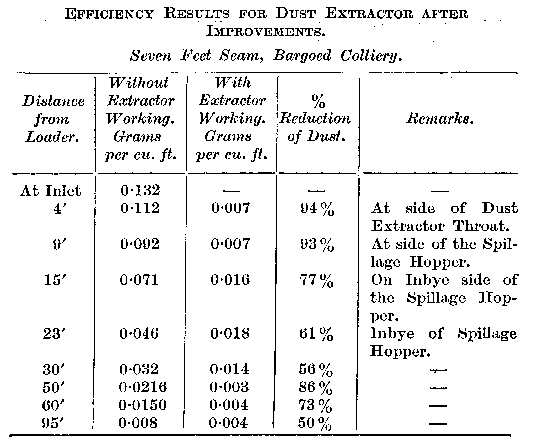
Tests were made to determine the amount of dust collected by the dust extractor per ton of coal being filled at the conveyor loader, and they reveal that approximately 12 ounces of dust per ton of coal loaded are being collected.
Water Condensing from Mist.
Some of the mist from the dust extractor is carried forward by the air-current for some distance beyond the end of the dust trap tubes, while the remainder condenses on the inside surface of the tubes. The tubes slope downwards from the fan so that the water of condensation in the tubes runs off at the outlet end of the dust trap. In some seams this water is liable to produce heaving of the floor, and to eliminate this a 20-gallon galvanised iron tank was placed under the outlet end of the tubes to collect the water.
The effect of the mist produced in the dust collector on the ventilating current has been carefully watched. It is both interesting and satisfactory to note that the conditions of temperature and humidity have remained unaltered at the coal face.
Consideration has been given to certain cases where the water formed by the use of a mist projector On the dust extractor would cause so much heaving of the floor that its use becomes impracticable. In such a case, it is probable that the dust might be allayed without the use of a mist projector by a method of dry filtration in the waste workings.
Procedure for Dust Reduction.
At most of the conveyor loading points in the South Wales pits a small open type of loading chute is used. The disadvantage of such a chute, from the point of view of the amount of dust raised, is that all the moving coal in the chute and around the conveyor head is exposed to the air-current and there are large dust clouds raised from all around the chute. These dust clouds rapidly become dispersed throughout the whole area of the roadway near the loader. In such a case it is extremely difficult for any kind of dust extractor to be applied to the loading point with any degree of success. The types of dust extractors so far tried out in South Wales have employed some form of hood or cowl arrangement over the tram at the loading point. This is necessary on account of the rapid dispersion of the dust clouds raised in the tram and from the movement of the coal in the chute itself.
In every case investigated the hood or canopy has proved a failure, and so far as South Wales is concerned it should not be adopted.
Experience gained at numerous South Wales pits indicate that the dust at a conveyor loading point can be reduced most efficiently by :—
1. Improvement in the type of loading chute by incorporating the dust suppression devices used with the Bargoed loading chute.
2. The installation of an improved type of dust extractor.
Great interest has been taken by the Powell Duffryn Colliery Company in the general suppression of dust produced by conveyors, and especially in regard to improvements in the general design of the loading chute. The one in the Seven Feet Seam at Bargoed Colliery is particularly well designed when considered from the point of view of dust suppression, and it is the best type of loading chute so far observed in South Wales during the investigations concerning dust problems. The loader is capable of dealing with a large output per conveyor head with the production of a minimum amount of dust. The outstanding feature is the quickness of action of the large compressed air operated door for closing the chute at the lower end. This enables the man operating the loader to have complete control over the coal passing into the tram ; there is very little rolling or tumbling of the coal in the chute, as it is allowed to slide or flow gently forward into the tram.
Several arrangements are incorporated for reducing dust, all very effective and simple in design and operation. The whole of the top of the chute is covered over completely by means of plates ; strips of flexible belting are hung by means of hinges from the roof of the chute so as to prevent, as far as possible, the air-current from raising dust from the coal in the chute and around the conveyor head. A spillage hopper is fixed below the belt roller and the point forming the angle of construction of the chute, and this collects the small coal and dust carried back by the underbelt.
The general effect of such an enclosed chute is to concentrate the dust in a small dense cloud just above the top of the tram standing at the loader. This dust cloud is carried forward by the intake air-current, but it can now bo more readily dealt with effectively by a dust collecting apparatus with its inlet placed in the line of the dust cloud and just above the top of the empty tram ; i.e., it can be dealt with before it has the chance of becoming dispersed into the general body of the air-current. It was only after the installation of the dust extractor at the loader at Bargoed Colliery that some very big leakages in the chute became apparent, and a considerable amount of work was done to stop them. With the introduction of such an enclosed chute the dust problems at many of the South Wales loading points would be very greatly reduced.
An Improved Type of Dust Extractor.
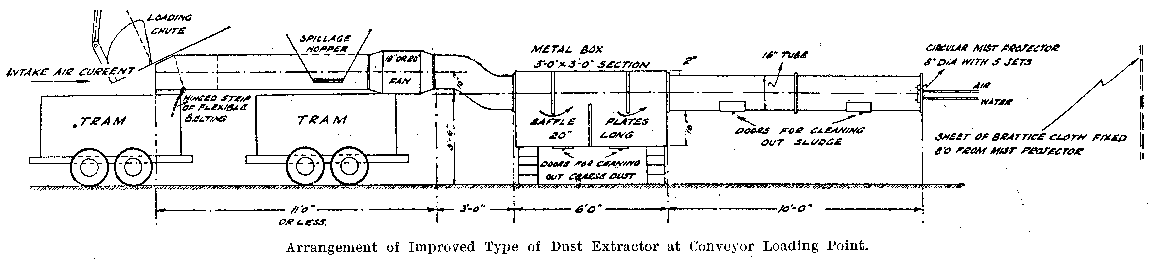
The dust extractor made in the mine workshop at Bargoed Colliery and applied to the conveyor loading point in the Seven Feet Seam, has been working for over six months and is still giving highly satisfactory results. Evidence that it is capable of arresting the large dust clouds raised during loading operations is afforded by the accumulations of dry dust in the throat of the expanded inlet tube, and also by the thick deposit of coal dust sludge at the outlet end of the dust extractor tubes.
The dust extractor achieves the important objective of causing all the dust made in the tram when loading to be concentrated in a tube of small area, where it can be more effectively dealt with than if it were dispersed throughout the roadway. At the same time it must be realised that this dust extractor was the first to be made, and was essentially an experimental one, and as the result of experience gained in making and testing it certain improvements could be made, and these can be embodied in new installations wherever the dust extractor is intended to be installed; the same general principles in the design can be adopted for allaying the dust, but the size and shape of the apparatus can be modified to suit the new conditions. The improvement would chiefly concern the overall size of the apparatus, as this is the chief disadvantage of the experimental one tried out at Bargoed Colliery.
Equally as efficient results might be attained with an all-round reduction in the size of the dust trap, as the mist projector has proved capable of allaying dust when the mist is projected against the direction of the dust-laden air. As the dust extractor is to be a component part of the conveyor loader a reduction in size would be much appreciated in practice, as it would greatly facilitate the work of moving it forward with the loading chute. A detailed drawing of this smaller and improved type of dust extractor is reproduced herewith. The expanded throat or inlet tube must be wider than that of the tram at the loader, to ensure that all the dust is drawn in. The portion of the apparatus up to the position of the suction fan must be the same as before, but in the improved type of dust extractor there is a considerable reduction in the size and length of the tubing which forms the actual dust trap, the overall length of tubing beyond the fan being now only 19 feet. The box, 6 feet long, and of section 3 feet by 3 feet, gives a big drop in the velocity of the air, so that the coarse dust will settle out in it. The resistance to the passage of the dust-laden air will be considerably reduced in this improved type, so that a smaller size fan can be used.
The circular mist projector, 8 inches in diameter with five jets, is suitable for use in the reduced size of tubes.
 |
 |
| Related Articles | |
|
|
| Pub. Date | Article (Newspaper) |
|---|---|
| 27 Jul 1940 | Loading-Point Dust, South Wales Committee's Report (The Science and Art of Mining) |
| 10 Aug 1940 | Loading-Point Dust, South Wales Committee's Report (The Science and Art of Mining) |
| 19 Oct 1940 | Spray And Mist Projector Tests, Investigation in South Wales Coalfield (The Science and Art of Mining) |



 Contains public sector information licensed under the

