


| Newspaper Articles |

|
Newspaper Articles |
 |
 |
23rd March 1929, Page: 274, Column: 1
Roof Control In A Machine Worked Mine
By Alan Hill.
From paper read before the Past and Present Mining Student's Association in the Wigan Mining and Technical College. Mr. Hill is Manager of the Parsonage pits at West Leigh, Lancashire. Continued from page 261.
Seam Development.
In considering the particular case with which we are at present concerned, at the Parsonage Collieries, the points already referred to have been closely considered, and have had a certain amount of bearing on the decision as to what particular method of working muBt be adopted. The shafts at Parsonage are sunk to the Arley Mine, which lies at a depth of 998 yards. The seam is 3 ft. 4 ins. thick with an average gradient of 1 in 5, dipping approximately S.S.E. The roof is fairly strong, consisting of 15 ft. of metal, overlain by a very strong sandstone 39 ft. in thickness. The floor is a strong warrant or clunch which, as might be expected, gives a certain amount of trouble with creep due to lateral compressive stresses. The area to be worked is intersected by faults varying in size and running approximately parallel with the dip. The largest of these split up the area into three definite belts.
Narrow Main Headings.
The original method of developing the seam was as follows :— The main roads were driven east and west on a more or less level course, each road being in the centre of a 20-yard heading. The intake and return being 60 yards apart, a pillar of coal was thus left between them 40 yards wide. Those on the east side were driven forward to a 38-yard down fault, and after tunnelling through this the headings were joined up to form a face 80 yards long. The same procedure was adopted in the west side, the heading being joined up 170 yards from the shaft after passing through a 10 ft. 6 ins. up step. The 80-yard face thus formed continued to advance through what we term the No. 1 West Belt, until at a certain distance beyond the shaft pillar a 20-yard heading was set out to the rise to develop the higher side area of the belt. Forty yards further to the west a similar heading was set out to open out the dip workings ; meanwhile the main 80-yard heading advanced to a 28-yard down fault, and after tunnelling through this the roads were continued forward as 25-yard headings. The main level road was lined out in the centre of the heading 13 ft. wide, the roof was ripped as shown in Figure 5, and supported by double cockering. A space was left at each side of the heading between the pack and the coal to aid the ventilation, and for a time the conditions were fairly good.
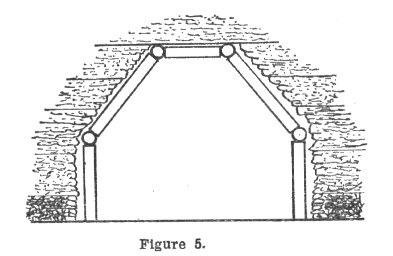
The continual pressure, however, soon closed up the temporary roads along the fast sides, and with a strata temperature of 103°F., the heat became too excessive for comfortable working. As soon as possible, therefore, the two headings were joined up to make one 80-yard conveyor face with an engine level at the centre. The rest of the face was packed solid, as was necessary between the main intake and return. The effect of this working, and leaving the coal to the dip, soon revealed itself in the bottom level, which is the main return. The whole of the higher side of the level from roof to floor was slowly squeezed inwards, gradually diminishing the area of the road, which was originally 13 ft. wide by 10 ft. 6 ins. high, to a bare 7 ft. wide and often less than 6 ft. high. This may be best explained by the fact that the face being packed solid, there was no chance for the nether roof to break off and relieve the strain, with the result that the forces liberated in the upper roof caused the nether roof to slide downwards to the dip over the packs — towards the point of least resistance, namely, the bottom level. This squeezing and sliding continued over a far longer period than it usually takes for strata to settle down, and from examination of a small portion of the level which is being redressed, it appears incredible that the side which once was straight is now leaning over at an angle of 45°, and each lamination has been pushed a little further than the one beneath it. Obviously, supports of any kind during this period have been more or less useless, and the natural arch, so formed by the side thrust, has materially assisted in keeping the roof temporarily safe. The two 20-yard headings driven respectively to the rise and dip were being taken forward in a similar manner, mainly for the purpose of speed of development, but the condition of these roads varied from the latter since the coal was extracted from each side of the roads almost immediately it was formed.
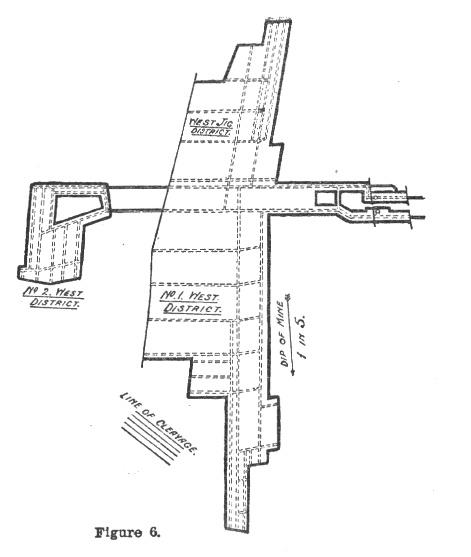
The brow in each case was driven in the centre of the heading, and the ripping of the roof eased the strain and allowed it to settle quickly on the packs at either side. These headings were continued forward for a distance of 150 yards, sufficiently far enough to allow one 95-yard face on each side to be opened out, but immediately these started the pull on the main brows was tremendous. So great were the forces liberated that the roads were in danger of being squeezed out of existence. The downbrow had been supported by steel arches of 14 ft. span, lined with dressed timber and well packed behind. The arches were in two portions, fish-plated together at the top, but when the weight was thought to be over, and it was considered advisable to re-dress the road, it was found that each half-arch had been straightened out by the pressure, and the fish-plated ends had been thrust up into the roof like a wedge. A short length of the road that had been supported with ordinary bar timber constantly required re-timbering, and the period that elapsed before the area could be said to be anything like settled was approximately 2½ years.
Wide Main Headings.
Two very good reasons were thus quickly demonstrated why these narrow headings should not be persisted in a mine at this depth. Having in mind the various theories already referred to, it was decided to make the development headings 60 yards wide with three roads being formed to provide dirt for solid packing, the right-hand road being a temporary intake airway, the centre the permanent intake and main haulage brow, and the left-hand road a temporary delivery brow. The roads were made 12 ft. wide, and spaced at 20-yard centres with solid packs between. This arrangement certainly proved more satisfactory, but later experience showed that there was still room for improvement. In the rise heading it was found that though the conditions at the face were excellent, after each break-off of the nether roof the weight transferred itself downbrow, and subjected the lower lengths of the brows to continual squeeze, until the main return was reduced in size to about 4 ft. square.
A reference to Figure 6 will show how the main return was formed out. As each side face reached the requisite distance from the main brow, i.e., 60 yards, the main return was set out and road-side stacks lined along the whole face length of the brow (105 yards), and in order to overcome any possible roof trouble, due to the extensive excavation so formed, the lower end of the face was pushed well in advance of the top end. This system worked well with the side faces off the rise brow, but in the down-brow area it was not so successful, owing to the fact that if the top end of the face was advanced far too much weight was thrown on the centre of the face, and if the bottom end was advanced it put the face parallel with the main cleavage. Each case, so far as the formation of the main return was concerned, was equally bad.
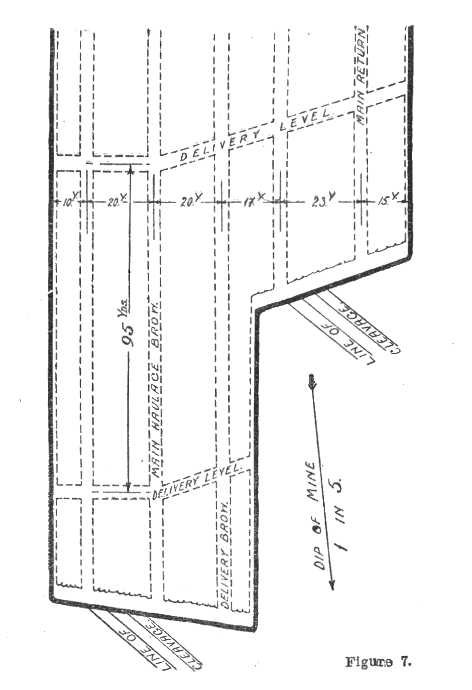
The method finally adopted was to form out a face 45 yards long to advance to the dip (Figure 7) and in a line parallel with the main brow face. Two brows were taken down with the face, the left-hand brow being the main return, and the other a temporary direct haulage brow, the latter being cut off at each 95 yards by a new level which was previously left formed out by the main brow face. The downbrow face was kept about 250 yards in advance of the return brow face, which was also solidly packed. On these two downbrow faces there was seldom any evidence of any serious weights, only a gradual settling down of the roof onto the packs which resulted occasionally in a portion of the immediate roof gradually yielding to the strain and showing slight fractures.
It will be understood that with a face advancing to the dip, the compressive stresses set up in the nether roof at the face would be increased by the weight of the disturbed strata behind, and we have found that by ensuring that every stick of timber is withdrawn from the goaf, before solid packing proceeds, the weight can be controlled and a too severe crush on the coal prevented. At about 20 yards back from the face the roof appears to have settled on the packs, and even with this short space of time, the packs are compressed to about 12 to 18 inches in height.
I might mention here that the only supports used at the face are pointed props with lids. Split bars are only used where the roof shows a local weakness such as a slip or pothole. The props are systematically set in rows 4 ft. apart and 4 ft. between each row. The packs are kept well up and are seldom more than 3 yards from the face. When a new delivery level is being set out across the face, special care is taken to support the roof, in and adjoining the line of the level, and if there is any doubt as to the possibility of preventing the roof breaking down, the level is partially packed with stud-packs composed of ordinary roof dirt, and left until the face has advanced a short distance beyond the point, and the roof more or less settled. There is no doubt that the rapid advance of the face plays an important part in the success of roof control since the line of the pack usually occupies the position of the face of two days previous, whilst the men are always under new or green roof.
After the experience with steel arches previously referred to, no further attempt was made to use them in a new road, and double cockering was put to test in the downbrow. The road was lined out 14 ft. wide, and the roof ripped to a height of 11 ft. with the sides leaning over to simulate a naturally formed arch. The roof runners used were in 12 ft. lengths put up in pairs, with 3 ft. sprags between them, set at intervals of 2 ft. The side sprags average about 6 ft. in length, and are set to spurn into the side about 5 ft. from the floor. Where the side is not sufficiently solid to allow this, side runners are used, either supported on props from the floor or ledged on the side. This class of timbering follows immediately behind the advancing face, and the whole of the dirt is packed in the waste, and it is interesting to note that although a certain amount of subsidence has taken place, there is to-day a length of over 350 yards of this cockering which looks practically as well as it did when it was first erected. As previously quoted the width of this downbrow heading was 60 yards and the partial success of the project is no doubt due to this width. However, it must not be suggested that, although the above system of timbering has been of some advantage, the roof troubles are entirely overcome. Unfortunately the back brow face following on behind soon begins to disturb the whole of the main brow area, and repair work is constantly required in the road for at least 12 months afterwards. As the side faces are worked on the right-hand side of the brow there is also evidence that some damage to the main brow is caused by these faces, and although the waste of the first 40 yards of each side face is packed solid, the movement of the strata is continuous until the faces have advanced about 120 yards from the main brow. After this the roof in the latter becomes quiescent and the brow may then be made permanently secure. This is done by taking out the remains of the broken cockering and other temporary timbers and getting roof down to the sandstone, which by this time is within 12 ft. of the floor level. Some of the dirt is utilised in burying the packs in the main brow to reduce the height to about 10 ft., and so assist in further supporting the side, and the remainder is packed in old roads.
It is, of course, not possible to say with certainty that the sandstone does not break when settling down, but so far as may be seen in the roof of the downbrow, there are no visible signs of fracture. Profiting by the experience gained by the working of these two faces, and noting the effect of the strata in the goaf and all adjoining roads, the subsidence theories already referred to in the first paragraphs were brought out in practical form, and it was these main points that suggested that the headings must be taken forward together and their width if possible increased.
 |
 |
| Names mentioned in this article | |
 |
 |
| Name | Age | Occupation | Notes |
|---|---|---|---|
| Hill, Alan | Colliery Manager | Whos Who Page |
 |
 |
| Related Articles | |
|
|
| Pub. Date | Article (Newspaper) |
|---|---|
| 09 Mar 1929 | Roof Control In A Machine-Worked Mine (The Science and Art of Mining) |
| 23 Mar 1929 | Roof Control In A Machine Worked Mine (The Science and Art of Mining) |
| 06 Apr 1929 | Roof Control In A Machine-Worked Mine (The Science and Art of Mining) |



 Contains public sector information licensed under the

