


| Newspaper Articles |

|
Newspaper Articles |
 |
 |
6th April 1929, Page: 290, Column: 2
Roof Control In A Machine-Worked Mine
By Alan Hill.
From paper read before the Past and Present Mining Students" Association in the Wigan Mining and Technical College. Mr. Hill is Manager of the Parsonage Pits at West Leigh, Lancashire. Concluded from page 275.
Wide Main Headings.
The opening out of a new district beyond the 28-yard downfault already mentioned, allowed a new system to be commenced immediately. Prior to coupling up with the main return, the main brow face in this area was at first taken 60 yards wide, with three roads, and as in the previous case with the main brow in the centre. After advancing 60 yards the back brow face was opened out to a width of 80 yards, and the main brow face increased a further 20 yards to make it 80 yards also, thus giving a total length of 160 yards of face, which was intended to be worked on the double unit system. It will be obvious that this length of face on a very slight gradient would be too cumbersome to operate with a single face conveyor. Again the output from a face of this size would not be less than 200 tons per cut, which was beyond the capacity of an air-driven direct haulage, although it could be handled easily enough when it was received at the delivery level. The scheme finally evolved was that shown in Figure 8. The face of this 160-yard heading is driven in the form of a flat "V" with the necessary roads arranged symetrically in it. The centre road acts as the common delivery for the two 80-yard faces, and a 24-inch belt conveyor is now delivering the coal into the tubs on the delivery level. This belt was installed to replace two auxiliary direct haulages which would be required to deal with the output in the time at our disposal. The belt has a maximum intermittent capacity of 50 tons per hour, and is easily capable of delivering 200 tons per shift of 7½ hours, 150 yards up an incline of 1 in 5.
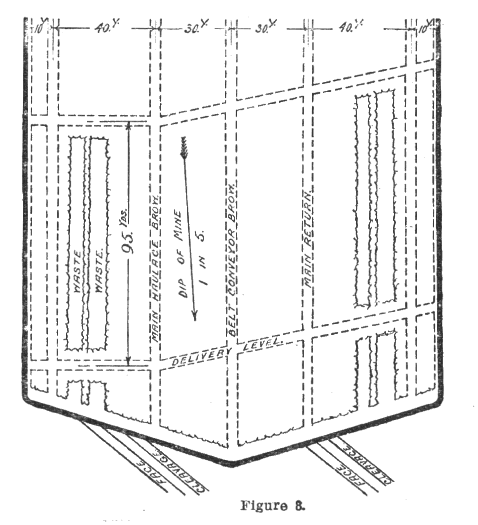
The main intake and return brows are each driven 30 yards to the right and left respectively of the belt conveyor brow. They are lined out 14 ft. and 12 ft. wide respectively, and the roof ripping is done in a similar manner to that already described for No. 1 downbrow. Double cockering is used in both brows as a support for both roof and sides. At a point 10 yards from each fast side a temporary airway is made, and between these and the main brows two temporary pipe roads are driven. These four brows and the belt conveyor brow are cut off every 95 yards by a new delivery level, which in time will serve the side faces.
It will be noticed that four 6-yard wastes are indicated on the plan, and these are provided not so much with any idea of effecting immediate roof settlement, but with a view to making provision for the disposal of any surplus dirt obtained from the formation of the delivery levels. Of course the temporary brows when not required for any purpose are also packed with this dirt, and it can be said that when sufficient material is available the whole of the full width of the heading is packed solid. The system has now been in operation a sufficient period for me to say that it has fully come up to our expectations. There has so far been no evidence of any actual breaking up of the strata, such as would be given by a severe and irregular weight. The strata appear to be sinking gradually and quietly without any fracture. On going through the space left for a delivery level after the face had advanced 45 yards beyond it, and no ripping had been started, I found that although the roof was only 15 inches from the floor it appeared as solid as when it was first exposed. No side faces have as yet been worked in this area, so that I am not suggesting that when this time arrives we shall have no further trouble with the roof supports in the main brow, but I do confidently feel that our former troubles with crush will be less, and that we shall be free from the heavy maintenance cost and annoyance by small falls occurring in the brow during a working shift. Due to the width of the heading in the first working, the natural conditions of the Strata will allow the subsidence to be still more complete and regular, and any disturbance due to the working of the side faces will be kept some distance from the main brow area, and such resultant crush will be allowed to settle itself in the goaf.
Side Faces.
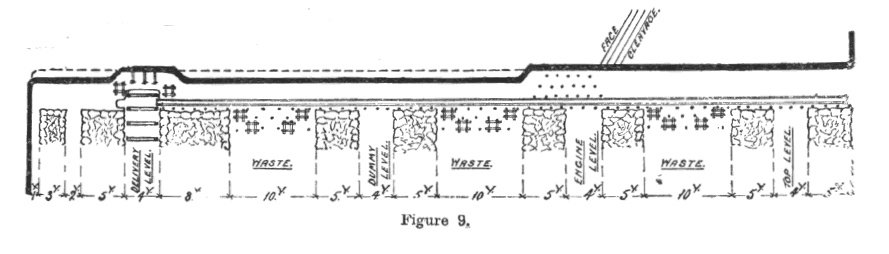
Referring now to the working of the side faces. These were originally intended to be formed out to give a length of 105 yards, but it was found later that a 95-yard face was sufficiently long to ensure it being filled off in the time allotted. For the purpose of roof control on the face and in the delivery levels, two systems of packing and spacing of the auxiliary roads have been tried, the first being that shown by Figure 9. The bottom level, termed the delivery level, was taken forward with a floor ripping in order to get the tubs underneath the end of the conveyor, the top level served as the timber road and airway, and the intermediate roads as compressed air pipe tracks. The roads provided the material for the formation of the packs on each side as indicated, and it will be noticed that there are only three 10-yard wastes left on the face. As this system continued beyond the first 40 yards, which, as previously mentioned, was solidly packed, we had continual trouble with the roof breaking at the face, the weight riding over and making the delivery level difficult to maintain, and, moreover, the ventilation was made difficult due to the waste not settling down quick enough. When a weight did occur it was lengthy and very severe, and often resulted in breaking down on some portion of the face. From what I have already mentioned, I think the cause of this will be easily appreciated, which can be briefly attributed to the system not being such as would allow the roof to break down in the goaf and so take the weight off the face and adjoining roads.
A new system was introduced as shown by Figure 10. One of the levels was knocked off and the packs were re-arranged to give four 10-yard wastes. Shots are fired in the wastes to provide dirt for two 3-yard stud packs separating each pair of 10-yard wastes. This method has proved very satisfactory. We find that the weight has been relieved from the face and delivery level, the waste is now settling down at regular intervals of about 21 ft. from the face, and trouble with serious breaks on the face is practically negligible.
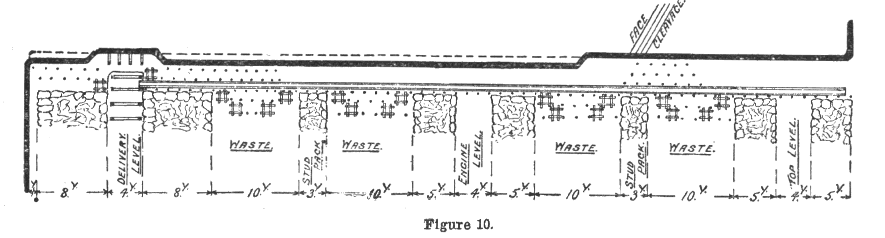
As can be expected the velocity of the ventilating current is far greater and easier to control than that in the former system, and at a depth of over 1,100 yards this in itself is an important factor.
A general summary of the chief points dealt with in this case of successful roof control, may be taken as follows :—
Rise and Dip Main Headings. — (1) Headings to be of such a width as proved practical to meet the natural conditions of the seam and overlying strata.
(2) Regular and rapid advance of the faces.
(3) The face should be straight to permit regular lines of break-off in the waste, and should be worked in such a direction, so that if possible the main line of cleavage is avoided.
(4) Solid packing on all faces working to the dip in which main roads are being driven and maintained, but a systematic arrangement of packs and wastes should be adopted for side faces.
(5) All timbers must be withdrawn from the goaf so as to ensure an even and uniform yielding to the strata; all packs should be kept close to the face.
 |
 |
| Names mentioned in this article | |
 |
 |
| Name | Age | Occupation | Notes |
|---|---|---|---|
| Hill, Alan | Colliery Manager | Whos Who Page |
 |
 |
| Related Articles | |
|
|
| Pub. Date | Article (Newspaper) |
|---|---|
| 09 Mar 1929 | Roof Control In A Machine-Worked Mine (The Science and Art of Mining) |
| 23 Mar 1929 | Roof Control In A Machine Worked Mine (The Science and Art of Mining) |
| 06 Apr 1929 | Roof Control In A Machine-Worked Mine (The Science and Art of Mining) |



 Contains public sector information licensed under the

