


|

|

|

|
|
 |
 |
|||
Safety Lamps
|
Evan-Thomas Lamp. – The Evan-Thomas is similar to a shielded Clanny, but the brass ring covering the glass is carried up some distance outside the gauze, and has a flange at the top. This lamp will resist a very great velocity; the only objection to it is that the flame is rather dull.
|
|
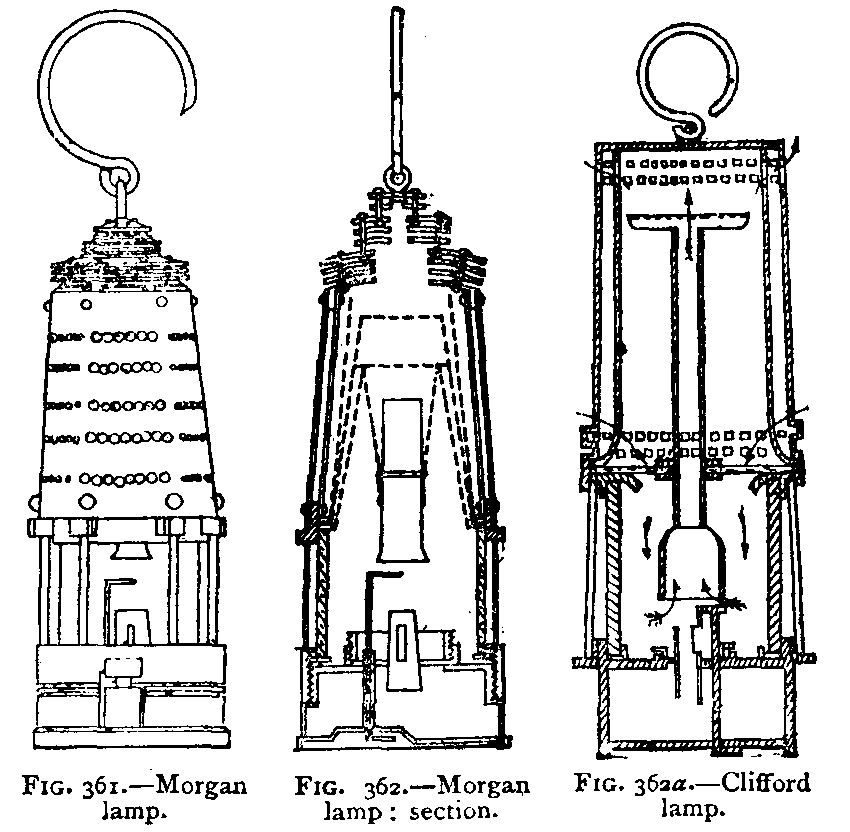
Morgan Lamp. – The Morgan lamp (see Figs. 361, 362) metal chimney to improve the draught, and the flame gives a good light. The inlet air enters through three gauzes, and the outlet air passes up the chimney and through two gauzes. There is a double iron shield, so that the air cannot blow straight through the orifice against the gauze, but is deflected in into passage. This lamp successfully resisted tests up to a velocity of 53 feet a second, and is sufficiently safe for every practical purpose.
|
|
|
Clifford Lamp. – The Clifford lamp (Fig. 362a) has a metal chimney terminating with a glass bell over the flame ; it also has a double shield, the air-current being so deflected in passing through as to produce an equal pressure all round the lamp. The air passes through a perforated compound plate of copper and fusible metal, made so that if the lamp gets hot, the melting of the fusible metal should close up the air-holes. This lamp has successfully resisted every effort to explode it up to a velocity of more than 100 feet a second.
|





 Contains public sector information licensed under the

