


|

|

|

|
|
 |
 |
|||
Safety Lamps
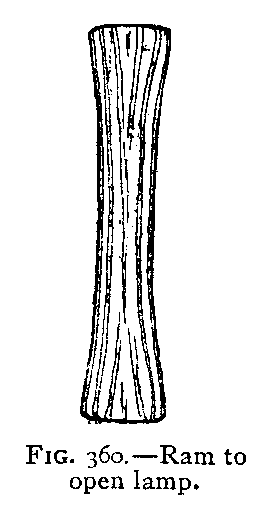
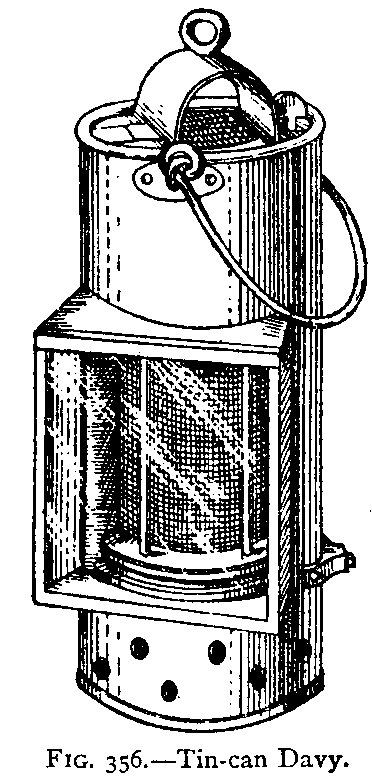 Shielded Lamps. – Owing to the discovery that the Davy and other lamps were not safe in a rapid explosive current, it has been rendered obligatory by law to use a lamp which will resist a rapid current of explosive mixture without allowing the flame to pass. In the case of the Davy lamp, this has been achieved by placing it in a tin can (see Fig. 356). In the bottom of the can are perforations for the admission of air; in front is a piece of glass; the top is open, with a handle. A screw-lock keeps the lamp in its place. The Clanny, Mueseler, and Marsaut are shielded by an iron (tinned iron) covering, sometimes called a "shield," and sometimes a "bonnet" (see Figs. 357, 358). This protects the gauzes from the air-current. Well-made Mueseler or Marsaut lamps with this shield will resist a current of 30 feet a second. The shield is sometimes permanently fixed on the lamp. The objection to this is that the miner or deputy who examines the lamp in the pit cannot see if the gauze is in its place or. not. To meet this difficulty the cover is sometimes made movable so that it can be removed at will in order to inspect the gauze. In other cases the cover s put on after inspection of the gauze, and is then locked. Fig. 359 shows a shield of corrugated metal, which has a spring lock. After inspection by the collier arid deputy, the cover is placed over the lamp and cannot be withdrawn unless the lamp is unlocked and taken to pieces, and then, by means of a round wooden ram (Fig. 360), the spring is pushed back so that the cover can be removed. Many ingenious inventions have been made to increase the safety of lamps when exposed to rapid currents. 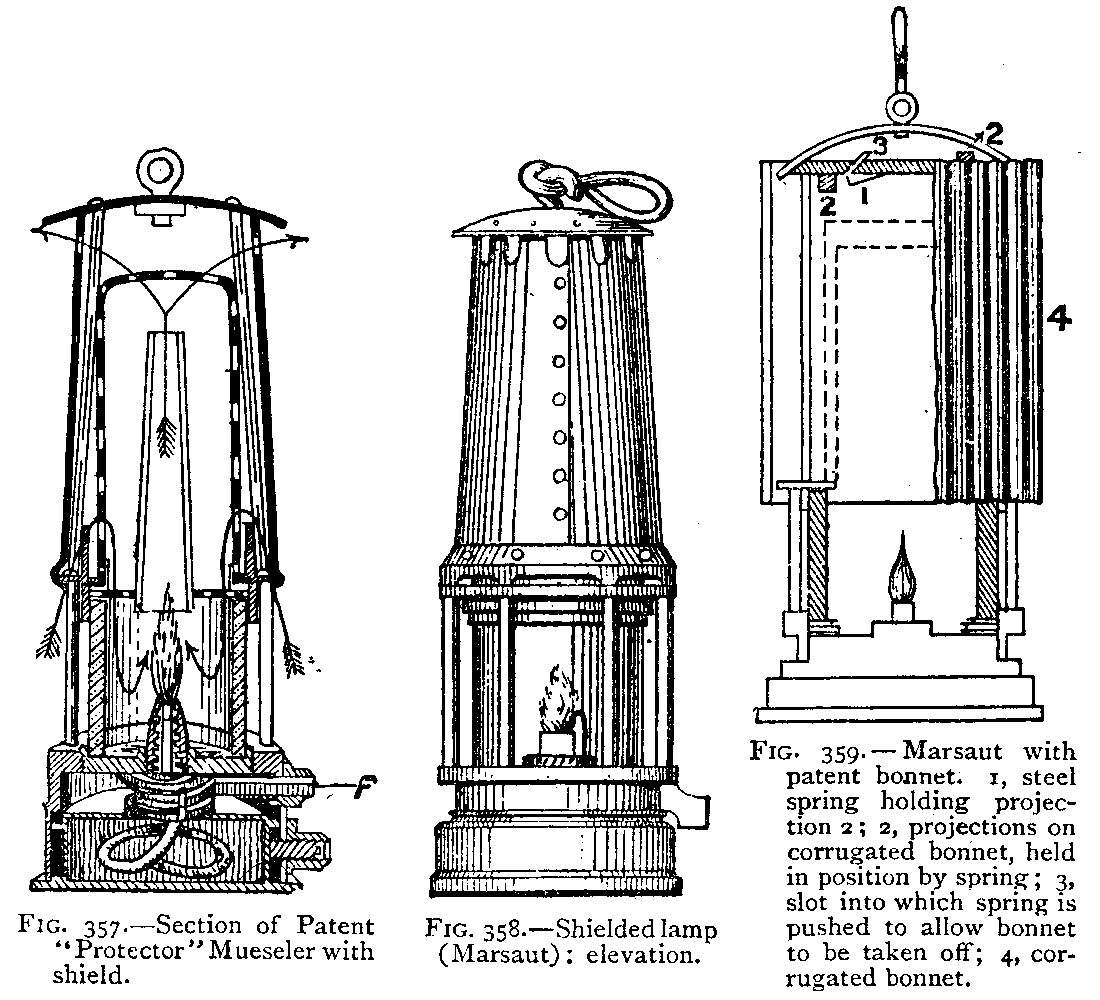
|





 Contains public sector information licensed under the

