


|

|

|

|
|
 |
 |
|||
Safety Lamps
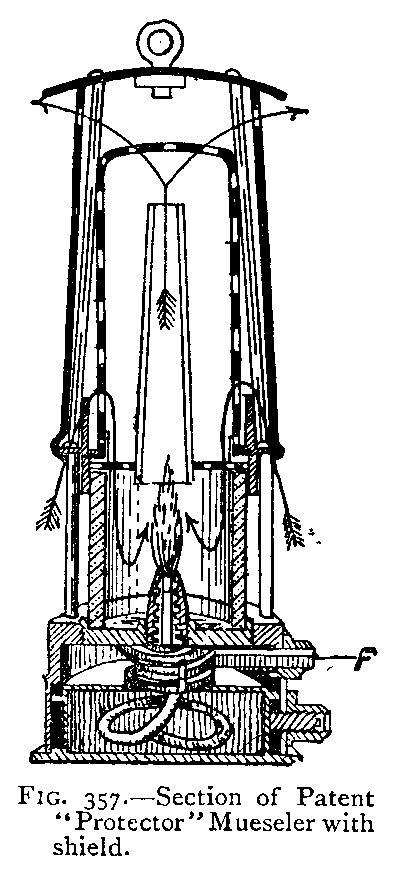 Protector Lamp (see Fig. 357). – This is a spirit-lamp burning a mineral spirit called colzalene, similar to benzoline. The oil-pot contains a sponge which absorbs the spirit, the loose liquid being poured back into the reservoir. The wick of cottonwool or asbestos does not burn. The protector construction of lamp is applied to the Davy, Clanny, Stephenson, Mueseler, and Marsaut lamps. The lamp is so constructed that it cannot be opened without being extinguished. To effect this, the wick-tube is surrounded with a brass tube, which is screwed into a brass plate which covers the bottom of the lamp below the glass. The oil-pot has a long wick-tube screwed inside the extinguisher tube. When the lamp has been lighted, a bolt F is pressed in; the fork at the end of it clasps the extinguisher tube and prevents it from turning; a spring on the bolt prevents its withdrawal until the lamp has been opened. The oil-pot can only be withdrawn by unscrewing. The wick-tube is in that way drawn down within the extinguisher tube, and the flame put out. The height of the flame can be regulated by unscrewing the oil-pot for a little way. Another lock prevents the lamp from being opened; this second lock is one of the usual kind, and is adopted as a second precaution. |





 Contains public sector information licensed under the

