


|

|

|

|
|
 |
 |
|||
Sinking
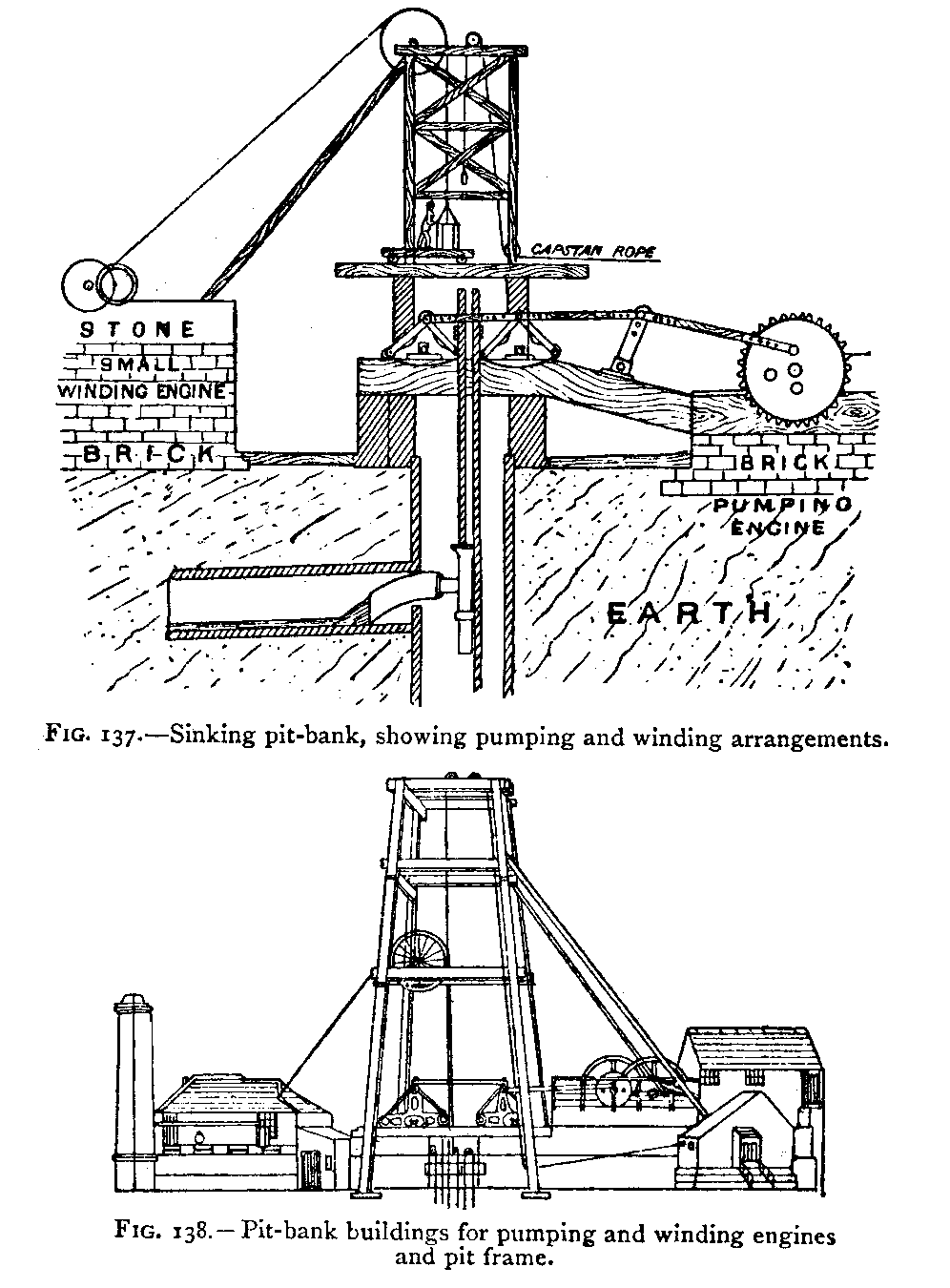 Pit-Top, and Winding-Engine. – Fig. 137 shows the general arrangement at the pit-top: winding-engine house and pulley-frame, pumping-engine house and pump, beams and movable bridge over the pit-top, etc. Fig. 138 shows a different arrangement. Fig. 139 shows a suitable pair of engines for winding the dirt out of the sinking pit. The larger the engines are the better, but small engines are generally employed, in order to avoid the delay consequent on the erection of large engines. A pair of engines with cylinders 18 inches in diameter, with a stroke of feet and a drum 6 feet in diameter, is a suitable size for sinking a pit for depths not exceeding 500 yards. A single rope only is used. At the end of this rope is a piece of heavy chain called a bull-chain, 3 or 4 yards in length, and at the end of that is attached the sinking-tub or hoppet. The heavy chain is required because, when the hoppet is detached, the weight of the rope on the other side of the pulley would overbalance the short length at the pit-side and draw the end back over the pulley; this is prevented by the weight of the bull-chain. Formerly a flat rope was used for sinking, because round ropes were so liable to twist round with the hoppet, and would spin round in the shaft like a teetotum; latterly round ropes have been manufactured which do not twist, and as round ropes are cheaper and lighter than flat ropes, they are therefore preferred. 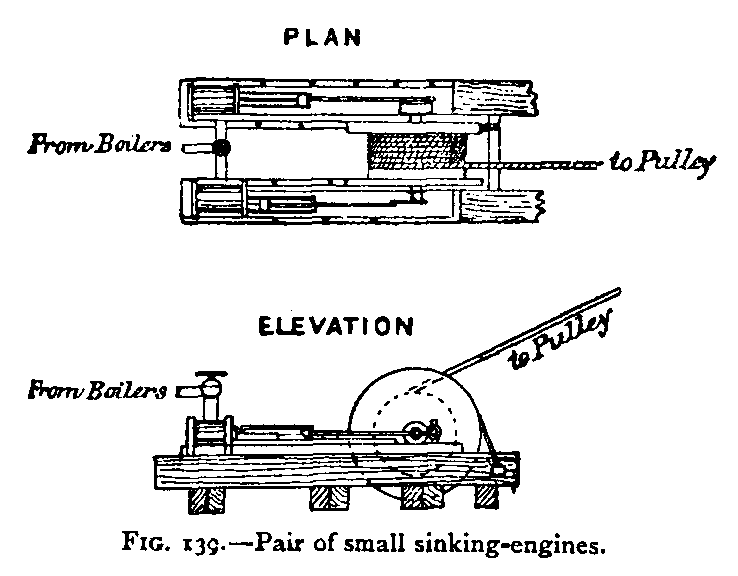
|
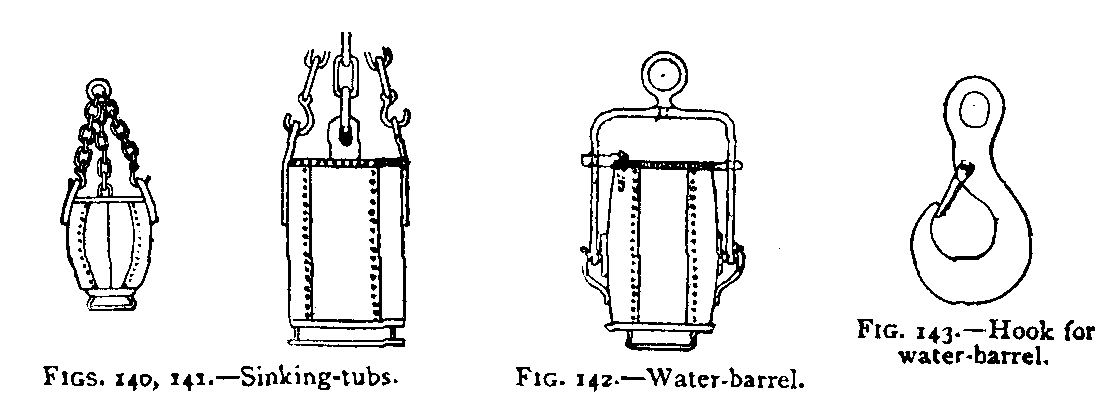 Hoppets. – The hoppets used are as follows: Fig. 140 is a good old-fashioned kind, and it is shown to be wider in the middle than at the top and bottom, like a barrel, and is attached by three chains to a ring at the end of the bull-chain; when the hoppet has to be detached, the three chains are each unhooked from the lugs on the hoppet. This barrel-shaped hoppet has the following advantages: When it is loaded with stone, the stone does not easily tumble out, being jammed in, owing to the upper parts being of less diameter than the middle. If when being wound up it should come in contact with the sides, it is the widest part that is most likely to touch, and there is nothing there to catch. Fig. 141 shows a hoppet with straight sides; this is also larger and holds a greater weight, and is more easily emptied by the banksmen at the surface. Fig. 142 shows a water-barrel; this is suspended from a snap-hook (Fig. 143) at the end of the bull-chain; the hook is fixed in a ring attached with a swivel-joint to a strong iron bow, which is fastened by two trunnions to the water-barrel just below the middle of its height, so that the barrel, when filled with water, can be very easily upset. To prevent it tipping up there is an upright pin on one side of the top edge, a collar sliding on the bow fits also over this pin; when the barrel is drawn to the surface, the banksman lifts the collar and thus tips the barrel. When dirt is being sent out of the pit, the hoppet is lowered down to the bottom, the chains are unhooked and sent up to the top, and a second hoppet sent down. As soon as the first hoppet is filled, it is sent up, and the sinkers proceed to fill the second hoppet; as it may take some time to empty the hoppet on the hank, especially if the dirt has to be taken some distance away from the pit-top, five or six hoppets may be necessary for each winding-engine. |





 Contains public sector information licensed under the

