


|

|

|

|
|
 |
 |
|||
Sinking
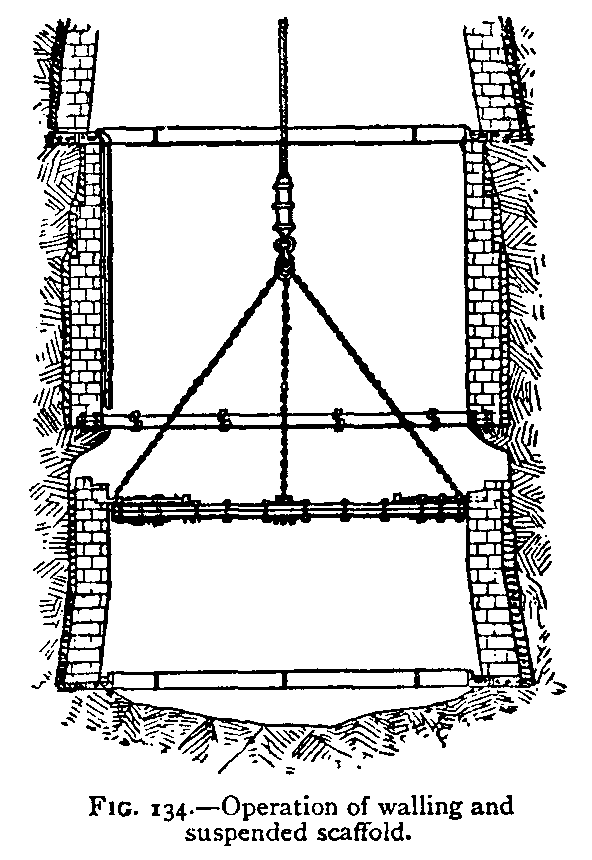 Scaffold. – A more expeditious and convenient plan, however, is to suspend a circular platform in the pit by means of a strong rope from the capstan at the surface. On this platform the masons stand, and upon it are laid the bricks and mortar. As the wall rises the platform is also raised (Figs. 171 and 134). In order to steady the platform, wedges are driven in at each side sometimes bolts fastened through staples in the platform are knocked into holes in the wall, and this prevents the platform upsetting in case of uneven loading. The platform is frequently made with hinges in the middle, so that it can be folded up into a half-"moon" and withdrawn from the shaft or suspended from a hook in one side when it is not in use. |
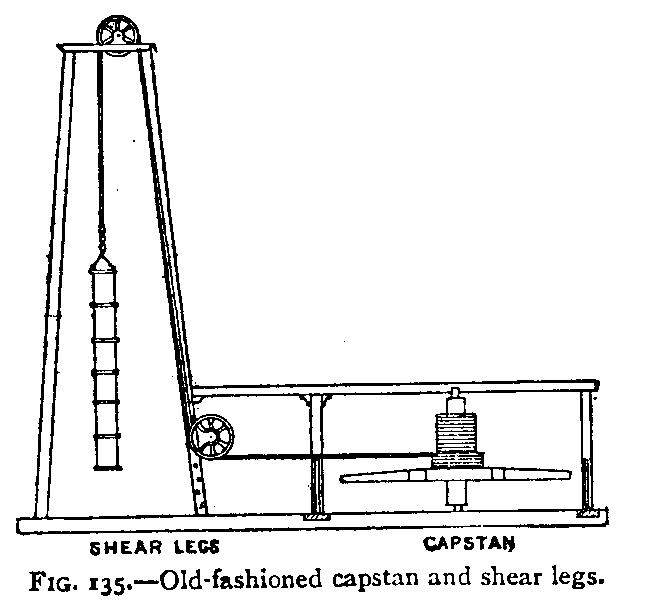 Capstans. – Fig. 135 shows a drawing of a capstan of the old-fashioned kind, with a vertical drum and six long wooden arms. This drum is usually worked by men, as many as twenty men could push at these arms at once; sometimes horses are used as well as men. Fig. 136 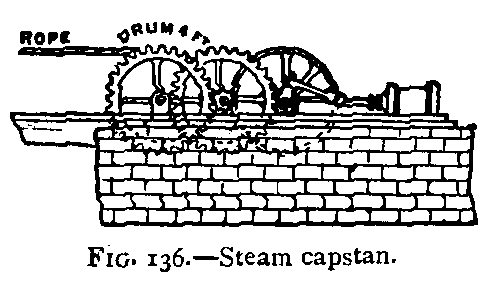 shows a crab capstan; in this case the drum is horizontal, and spur gearing is used to give the men at the handles a leverage. Instead of men, steam-engines are generally used, as shown in Fig. 136, in which a couple of small steam cylinders, operating through three sets of spur-wheels, give movement to the drum. The chief dimensions of such a machine are as follows: pair of steam cylinders, 10 inches in diameter, 18 inches stroke; horizontal rope-drum, 4 feet in diameter and feet wide; pinion on fly-wheel shaft, 15 inches in diameter, gearing into wheel on intermediate shaft 6 feet 3 inches in diameter pinion on intermediate shaft, 15 inches in diameter, gearing into wheel on drum-shaft 6 feet 3 inches in diameter; steel rope on drum of patent crucible steel, 5½ inches in circumference, galvanized, to lift say 10 tons. Such a capstan is stronger than required for a bricking platform; it is suitable for pumps and heavy machinery. |
|
This steam capstan is much superior to either of the other two; it is much quicker than any hand-crab, and much safer than the old-fashioned capstan, and in modern works is nearly always erected in preference to the old class of machinery. The capstan ropes were formerly made of hemp about from to 4 inches in diameter; they are now generally made of steel and galvanized to prevent them from rusting. The capstan rope, as shown in Fig. 135, goes underneath a pulley in the frame, which is fixed at about the level of the drum, and then goes straight up and over a pulley at the top of the frame, whence it descends into the pit. There should be a strong beam between the capstan and the pulleyframe, otherwise, when there is a heavy load in the shaft, there would be a tendency to pull the leg of the frame carrying the lower pulley towards the capstan, and this might lead to a serious catastrophe.
|





 Contains public sector information licensed under the

