


 |

|

|

|
|
 |
 |
|||
| Colliery Engineering | December, 1934 |
The Concordia Electric Safety Lamp Co. Ltd.
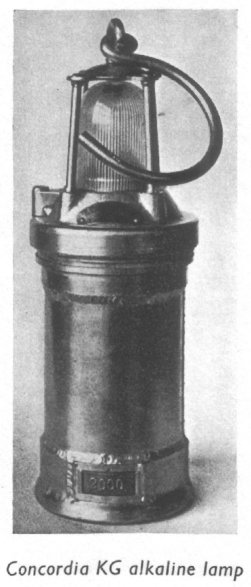
CONCORDIA TYPE KG ALKALINE LAMP. — An outstanding feature of the Concordia Type KG lamp is the tubular positive plate adopted for the alkaline battery. This design of plate was developed to prevent the loss of capacity to which alkaline accumulators are liable, and to provide a plate of ample strength to withstand the stresses induced during discharge. It is claimed that this accumulator will stand up to rough treatment, heavy discharge and even short-circuiting.
The tubes are constructed of perforated and electroplated steel tape wound spirally and secured by rings, and are filled under pressure with alternate layers of nickel hydroxide and flake nickel. Apart from the matter of strength this construction is stated to be both compact and light. The negative plate consists of flat nickel containers into which the active material, cadmium oxide, is pressed.
The battery terminals are rigid and arc concentric, making it impossible to put the battery on charge with reverse polarity, and the spring contacts are carried in the upper part of the lamp to avoid such troubles as weakening of the springs, corrosion, &c. The spring contacts have serrated faces so they exert a cleaning action as the upper part is screwed down, thus preventing flickering due to dirty contacts.
The case is a welded sheet-steel structure comprising a cylinder divided by a vertical partition into two battery compartments; each compartment has its own bottom, and an extra base is welded on to afford additional strength. The cover-plate is of sheet steel secured by a screwed ring, and the upper part is a drop stamping carrying the protector rods, hood, swivel eye and hook. The illustration on page 435 shows a normal type of hook, but a special hook has recently been designed which cannot break the wellglass and can be reversed either for carrying or for hanging up. The prismatic wellglass shown gives a diffused light in all directions, but a spherical wellglass has been designed in conjunction with Holophane Limited which diverts a certain amount of top and bottom light to the horizontal plane. By means of a special top the lamp can be converted into an officials' bull's eye.
We understand that some 30,000 of these lamps have been installed up and down the country, one colliery group alone having purchased just over 6,500 lamps.
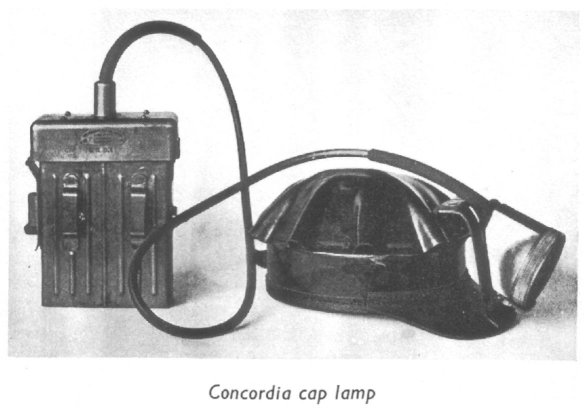
A camp lamp has also recently been put into production by this company, and is to be submitted for approval under Schedule A.
Drawings and Photographs accompanying the article


Article reproduced from a copy of the magazine held at National Mining Museum Scotland, Newtongrange, Midlothian.




 Contains public sector information licensed under the

