


 |

|

|

|
|
 |
 |
|||
| Colliery Engineering | December, 1934 |
John Davis & Son (Derby), Limited
ALKALINE LAMPS — As a firm of long standing (150 years) it is perhaps natural that John Davis & Son (Derby) Limited should have a large selection of lamps to offer their clients. The two alkaline hand lamps they have developed to meet the Schedule A conditions are the Sirius-Miner, type D.2.S.M., and the British Alkaline, type D. 1. The Sirius-Miner lamp (illustrated) is provided with a 20 amp. hour nickel-cadmium cell, and in general construction follows the two part principle which may now be regarded as standard practice. The unique feature of this lamp is the bulb holder, which forms an entity in itself and is constructed of resilient, alkali resisting rubber. Not only does the rubber sleeve and cushion act as a shock absorber for the bulb, thus tending to prolong the life of the filament, but also as an effective seal to prevent fumes from entering the upper portion of the lamp. A further advantage is that the bulb can be changed in a few seconds. The contacts are made solid and flush with the base and neither springs nor screws are used in the construction. In case it may be thought that the rubber would be liable to perish in these conditions an experiment involving the steeping of the rubber in strong alkaline solution for twelve months proved no deterioration to take place whatsoever. Either a screw or bayonet cap holder is provided. The lamp can be supplied with either a pillared headpiece or the pillarless headpiece illustrated. The latter offers certain attractions on occasions, and can be provided with or without a reflector. The weight of the lamp, fully charged, is 10 lb. 6 oz.
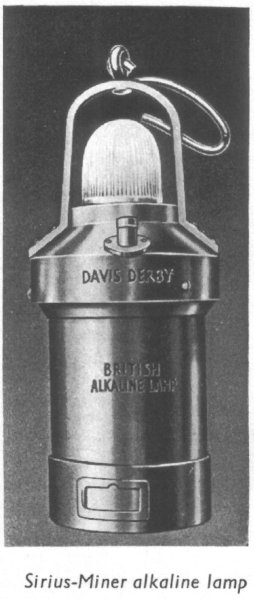
In the British Alkaline D.1 lamp essentially the same construction has been adopted, but in this case the lamp is provided with a battery of somewhat larger capacity.
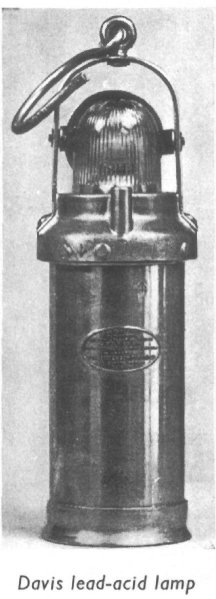
LEAD ACID LAMP. — The Davis-Derby 4-volt lamp, shown above, apart from its lead-acid battery, possesses the same special features as the two lamps just described. A 1-amp. bulb is fitted and, of course, the capacity of the battery is smaller than is the lower voltage alkaline lamp. The accompanying illustration is of interest in that it shows the reflector fitted to the pillarless type of headpiece.
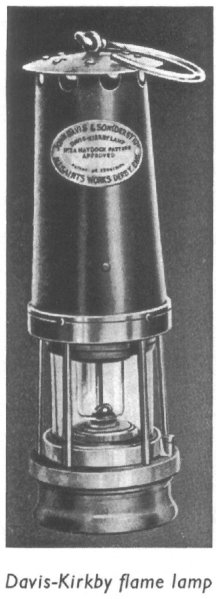
FLAME LAMPS. — In the Davis-Kirkby No. 2A (Haydock Pattern) lamp an oil burning unit has been produced which is stated to give over 4 candle-power. Several factors have contributed to the production of this amount of light, the most important being the provision of a combustion tube so suspended from above that it cannot vary its position under the action of heat. Another contributing cause is the special type of dome burner, which also acts as a reflector. An outer glass having a silvered flash is generally employed, affording nearly perfect reflection, but if required, of course, an ordinary glass can be employed to give an all round light. Sufficient oil can be carried to burn for about 14 hours, and the candlepower at the end of a nine-hour shift is stated not to fall below 3.56. An oil-filling valve and either a magnetic or lead rivet lock are fitted and a relighter pin can be included. The weight of the lamp is 4 lb. and the height to the top of the handle eye is rather less than 12 in.
This lamp is also supplied with certain modifications for the use of officials. In the officials' type a screw wick adjustment is fitted to the wick tube and at the back of the tube is a patented shield which rises or falls with the burner tube. The object of the shield is to eliminate all reflections from the silvered portion of the glass and enable the gas cap to be readily distinguished. An air shut-off ring is fitted to enable tests for gas to be made near the roof. If desired the bonnet is constructed of aluminium.
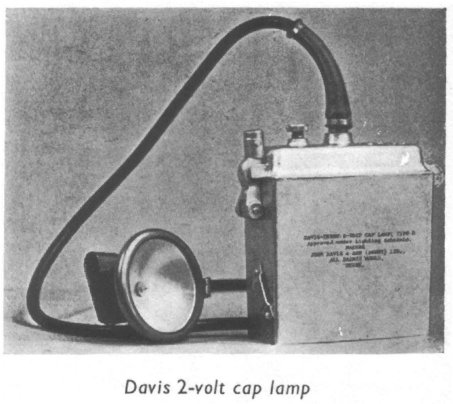
CAP LAMPS. — There are two Davis-Derby cap lamps-one having a lead cell and the other an alkaline cell. A view of the former, in which a solid electrolyte is used, is given in the accompanying illustration, the alkaline lamp having practically the same appearance. The overall measurements of the alkaline battery container are 7½ in. by 1.875 in. by 6½ in. high, while those of the 2 volt lead-acid container are 5 in. by 2 in. by 5.375 in. high. There is also about 1 lb. difference in weight, the alkaline unit weighing 5 lb. 15 oz. and the lead-acid 4 lb. 14 oz. The headpiece, which is of bakelite, is the same in either case, and either a matt reflector with clear glass or a highly polished reflector with prismatic glass is provided according to choice. The light is distributed over an arc of from 120-125°. The glass is secured by a lead-plug lock and either a lead plug or magnetic lock may be fitted to the accumulator case. A fuse is inserted in the accumulator case and operates in case of damage to the cable or any interference with the headpiece.
Drawings and Photographs accompanying the article


Article reproduced from a copy of the magazine held at National Mining Museum Scotland, Newtongrange, Midlothian.




 Contains public sector information licensed under the

