


 |

|

|

|
|
 |
 |
|||
| Colliery Engineering | December, 1934 |
Ceag Limited
FOUR VOLT LEAD-JELLAC LAMP, TYPE C4. — Reckoned on the "candle power per pound weight" basis the 4-volt lead-acid lamp is the most efficient of the various hand lamps. Great care is needed in the design, however, particularly as regards inter-cell leakage, which would quickly destroy the plates. In this respect the Ceag 4-volt lamp owes its immunity to the special construction of the celluloid case-in which the middle partition has been superseded by a serpentine arrangement- and to the use of jellac in the cells. The electrodes are arranged concentrically and are of the Ceag locked-grid type; they are kept apart by perforated ebonite separators. Inter-cell connection is effected by a bridge of pure lead and no screws or nuts are used whatsoever. The lamp itself is of the standard Ceag construction having solid drawn steel components and a pressed steel bayonet joint between the lamp top and case. A patented quick-action bayonet-type bulb release is provided and a safety fuse, which operates in the event of the well glass breaking, is fitted as standard. The 4-volt bulb is rated at 3 watts, and may have a pearl finish, for use with clear glass, or of the ordinary clear type if used with a Lumax primatic well glass. The weight of the complete lamp is 7¼ lb.
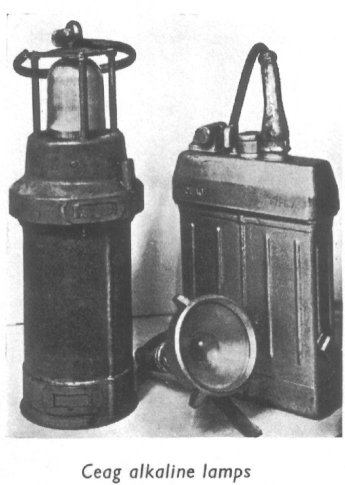
ALKALINE LAMP, TYPE C18. — This lamp has a nickel cadmium battery, the electrodes consisting of flat type perforated pockets, with rod separators between the plates, the whole being encased in a rigid steel sheath. The double-cell container has a welded bottom with a renewable false bottom to take any wear. A pressed steel lid, held in position by a screwed ring, carries the electrodes. Solid steel terminals are provided arranged for hanging from the fool-proof connection on the charging rack. As regards general construction the lamp follows much the same design as the 4-volt unit just described. The casing is entirely of steel, with a forged steel machined joint ring and the same quick-action bayonet-type bulb release is fitted. A floating self-centring contact plate affords continuous contact from bulb to battery. The standard 2.5 volt 1.5 amp. gas-filled bulb is used in this lamp. The hook is designed for ease of carrying and is fitted with a stop so that the handle is always presented in a handy position. The weight of the complete lamp is 10 lb.
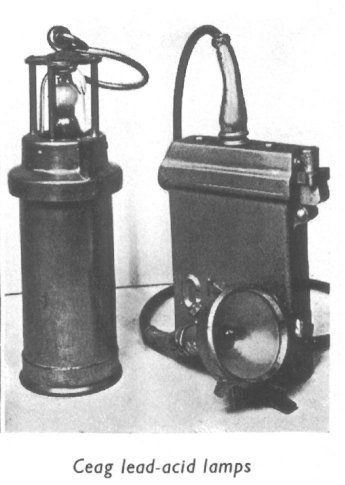
2-VOLT CAP LAMP. — This lamp comprises a strong, light battery container of aluminium, a 2-volt jellac cell, a length of specially made flexible twin cable and a lantern of simple construction with a straight-through connection from battery to bulb. The battery is of the flat plate type with a twin negative electrode and perforated ebonite separators. A celluloid container is provided and the solid acid, which is quite unspillable, acquires a special significance on a battery that is strapped to the body. A floating, self-aligning contact plate is provided. together with a unit-type fuse which can be readily replaced. The moulded bulb holder is fitted with a matt aluminium reflector which affords an angle of distribution of 1200. A 2-volt 0.9 amp. vacuum-type bulb is standard. The weight of the battery container and cable is 4 lb. 13 oz. and of the headpiece 7 oz., making the total weight 5¼ lb. It is claimed by this firm that 90 per cent. of the cap lamps in use in this country are of their manufacture.
ALKALINE CAP LAMP, TYPE A2. — In this lamp a flat-plate nickel-cadmium battery is housed in a cadmium-plated pressed steel container. Reinforced by raised ribs the container is provided with a welded double bottom, the additional false bottom being designed to take wear. The electrodes are held in a monel metal lid, secured by a central bolt. Solid steel nuts, with different diameter pole pieces, are used to suspend the battery when on charge and to connect with the tempered steel contacts in the lid. The switch is fitted to the headpiece, and is convenient to handle away from battery fumes. A renewable fuse unit is incorporated. A patented form of construction enables the action of locking the lamp to seal the lid and case; this makes an effective leak proof joint which prevents any excess electrolyte from reaching the wearer. The headpiece is of the same well-tried design as that used with the lead-acid cap lamp; it is fitted with a matt surface aluminium reflector and a 2.5 volt, 1 amp. gas-filled bulb having a frosted top. The weight of the battery and cable is 6 lb. 3 oz., and of the headpiece 7 oz., making the total weight of the complete outfit 6 lb. 10 oz.
Drawings and Photographs accompanying the article


Article reproduced from a copy of the magazine held at National Mining Museum Scotland, Newtongrange, Midlothian.




 Contains public sector information licensed under the

