


 |

|

|

|
|
 |
 |
|||
| Colliery Engineering | December, 1934 |
Batteries Limited
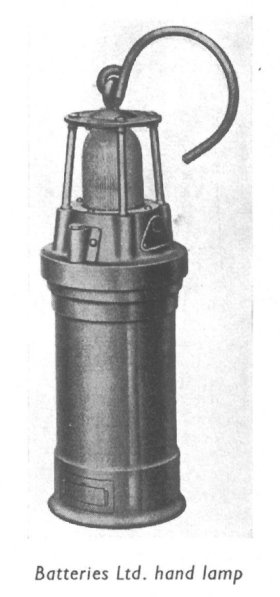
ALKALINE HAND LAMP. — The Schedule A hand lamp manufactured by this firm, the "Nife" N.20, is designed on the two-piece principle and a 2.5 volt 1.5 amp. bulb is fitted. The upper piece consists of an accurately machined drop forging, into which are screwed the pillars carrying the crown and hook. This forging carries a heavy square thread for attachment to the battery casing and a finer thread to take the screwed ring which holds the contact and bulb assembly in position. It is claimed that the use of the drop forging eliminates any possibility of distortion, and as the machining can be done to the closest of limits no difficulty arises with replacements. The hook is of the usual round shape but is so designed that it cannot in any circumstances come into contact with the well glass. A solid ebonite moulding forms the basis of the contact assembly, which is leak proof and carries a spring loaded contact disc on the underside. As the contact disc floats on two substantial flat springs it is claimed that even pressure is ensured on the terminals at all times and that this feature, combined with the self-cleaning action, eliminates all possibility of flickering.
The accumulator is the well-known Nife" nickel-cadmium alkaline unit, in which the active material of the positive plates is nickel hydroxide enclosed in perforated steel tubes, of flattened section, which are interlocked and pressed into a steel frame. It is claimed that this type of construction, which is an exclusive feature of the Nife cell, results in the battery having a very low internal resistance. For the negative plates cadmium is used as the active material. The positive and negative plates are bolted to the respective terminals and two such groups are attached to the steel cover plate in such a way that it acts as the electrical connection between the groups. The plates themselves are insulated from each other by means of ebonite rods which fit into grooves. Around each group of plates a steel sleeve is fitted.
The ebonite rod separators and the steel sleeves are exclusive to the "Nife" accumulator, and it is claimed that the former results in lower internal resistance than when ebonite plates are used, while the sleeves enable the complete assembly to form a compact unit which can be withdrawn and handled without any danger of falling to pieces. The outer case is built of heavy steel plates with welded joints, the whole being rendered corrosion proof by a plating of cadmium. Solid steel terminals are provided and have pointed contacts to engage with the floating contact plates in the lamp top. The gas release plugs are fitted with a rubber sleeve valve and do not require to be removed during charging. To facilitate "topping up" a specially designed equipment is provided, an electrical circuit being completed as soon as the electrolyte reaches the right level. The opening magnet is designed so that it can be mounted either on a wall, bench or on the charging rack, a spring loaded turntable being provided so that a few revolutions of the table open the lamp. The magnet is controlled by a foot operated flameproof switch, a fuse being provided for the protection of the coil.
The charging racks are designed to accommodate 150 batteries, and each cell is completely insulated from its neighbour. The batteries have four slotted grooves and steel springs ensure perfect contact. To ensure that the batteries cannot be inserted in wrong polarity, the positive and negative grooves differ in size to correspond with the positive and negative terminals. Each rack is of double sided construction and is divided into six panels, all of which are provided with a knife switch, a fuse, a moving coil ammeter and a variable resistance. On five of the panels the resistances are so rated that any number of batteries from 15 to 25 can be accommodated, while the final panel has two resistances enabling from one to 25 batteries to be charged. The supply for each panel is taken from steel busbars mounted on the top of the rack, and the branch connections, which are constructed of substantial strip metal, have the advantage that they are always under observation and are very accessible. A view of the "Nife" "topping up" equipment is reproduced in Fig. 10 on page 431, which shows the filling tanks, the first-aid cabinet and the electrolyte level indicator.
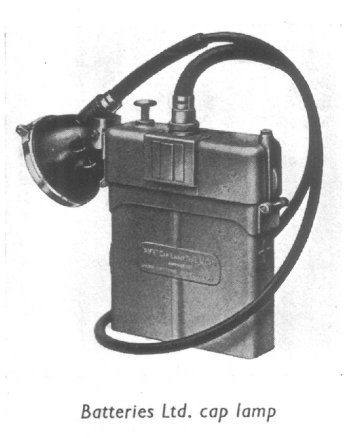
CAP LAMP. — The alkaline cap lamp designed by Batteries Limited to meet the requirements of Schedule A is illustrated above. This possesses a battery of 12 amp. hour capacity, which is housed in a welded steel case measuring 6 in. by 6¾ in. A magnetic lock is provided and is praiseworthy in that, being neatly recessed into the body, it offers no projection to catch clothing, timber and the like. As regards construction the battery and case follow much the same general principle of the "Nife" N.20 lamp, the gas vents, electrolyte level indicators, &c., being the same in every respect. The battery is held down in the case by an ingenious cantilever arrangement, to which any degree of rigidity can be given by means of an adjusting bolt. For the lamp casing a synthetic moulding is provided weighing a few ounces only. This is fitted with a 2.5 volt 1 amp. bulb and plain or armoured glass as desired. This armoured glass, when we inspected the lamp, was hurled across the room for our edification, without suffering the slightest damage. It is held in continuous rubber ring and secured by a metal band passing round a flange in the moulding. The bulb holder is spring mounted, the spring being depressed by the glass pressing against the bulb. A short-circuiting device is incorporated so that should either the bulb or the glass fracture all current is cut off from casing. The fuse is also blown, of course, in the event of a short circuit in the cable to the lantern. A matt-surface reflector, giving a soft yellow tone to the light, can be supplied if required.
Drawings and Photographs accompanying the article


Article reproduced from a copy of the magazine held at National Mining Museum Scotland, Newtongrange, Midlothian.




 Contains public sector information licensed under the

