


|

|

|

|
|
 |
 |
|||
Pemberton Main Colliery
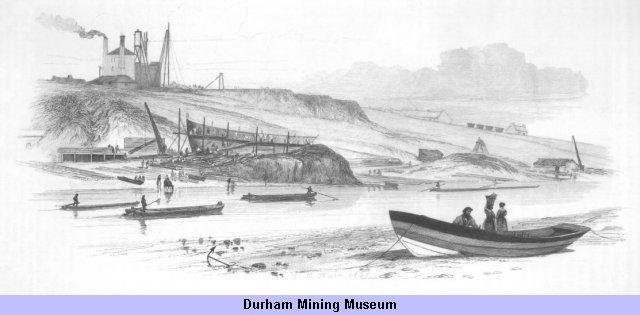
Pemberton Main Colliery
 This interesting colliery is situated on the north bank of the Wear, about half a mile from the Iron Bridge. It was commenced in May, 1826.01 In sinking it, 31 seams of coal were passed through, varying in thickness from 1½ inch to 6 feet 2½ inches, and forming an aggregate of 47 feet 2 inches of coal, including the foreign substances with which the several seams are interstratified. Only one of them, however, has been found of workable thickness and merchantable quality. "The peculiarities of this pit," says Mr. Elliott, in his evidence before a committee of the House of Commons, "are the extraordinary depth, namely, 265 fathoms to the Bensham seam, 15 fathoms lower being sunk for ' standage,' or for a reservoir of water. The ordinary time consumed in going down and coming up the shaft is about from two to three minutes respectively. The tub for drawing coals, and also men and boys, is 7 feet high. It holds 105 pecks of coals [Newcastle pecks]. The weight of these 105 pecks of coals by themselves is 30 cwt. [The weight of the rope itself is nearly five tons.] The shaft produces always, or nearly so, a sensible weight on the drum of his ears when he descends and ascends the upcast shaft, which is always the case; the other division of the brat tice being that for the pumping apparatus, and only descended by the engineer, and sometimes the viewer-in-chief." The average temperature in this pit (more than four times as deep as the height of St. Paul's church, London) ranges from 78° to 80°; and in some parts of the mine it occasionally rises to 89°. W. J. Dodd, Esq., surgeon to the colliery, in his evidence, describes a species of boil, caused by the extraordinary heat of the workings, and the irritating nature of the water in the pit, to which fresh workmen are liable for the first two or three months.
The following fatal accidents are recorded as having occurred here :— June 15, 1832, a fall of stone, one man killed; December following, another man lost his life by a similar accident; April, 1837, breaking of a chain, three men killed; November 4, 1838, a fall of stone, two men killed; March 5, 1842, one man killed by falling down the pit. On August 31, 1843, whilst two workmen were cleaning the pumping apparatus in that part of the shaft appropriated to it, one of the spears by some accident fell upon them, and precipitated them both down the shaft. One of them fell to the bottom; but the other fell across some beams of wood. Some time elapsed before their mangled bodies could be come at.
The coals are passed over ¾-inch screens, through which about one-fourth of the quantity drawn passes. The small coal consumed by the engines has been estimated at 3445 tons per annum. The waggons are transferred from the pit's mouth to the Wear by means of an inclined plane. In 1836, 51 ships, with 13,707 tons of coals from this colliery, arrived in the Thames; and in 1837, 61 ships, with 16,768 tons; the average shipping price in both years, being 11s. 6d. per ton. The total vend of the colliery in 1842 was 20,854 chaldrons.
01 The following account of this remarkable mining adventure is given in the "History and Description of Fossil Fuel," p. 187:— "The shaft at present sinking at Monkwearmouth Colliery, near Sunderland, has attained a considerably greater depth than any mine in Great Britain, (or estimating its depth from the level of the sea, than any mine in the world.) The upper part of the pit is sunk through the lower magnesian limestone strata, which overlap the south-eastern district of the great Newcastle Coal-field, and which, including a stratum of 'freestone sand' at the bottom of the limestone, extended at Monkwearmouth to the thickness of 330 feet, and discharged towards the bottom of the strata the prodigious quantity of 3000 gallons of water per minute — for the raising of which into an off-take drift, a double-acting steam-engine, working with a power of from 180 to 200 horses, was found necessary. The first unequivocal stratum of the coal formation, viz., a bed of coal 1½ inches thick, was not reached till August, 1831, (being about 344 feet below the surface,) after which the tremendous influx of water, which had so long impeded the sinking operations, was 'stopped back' by the metal tubbing, which extended from the above bed of coal to within 26 yards of the surface. The sinking now proceeded with spirit — still, no valuable bed of coal was reached, although the shaft had passed considerably above 600 feet into the coal measures, and much deeper than had hitherto been found requisite for reaching some of the known seams. It became evident that the miners were in unknown ground. A new 'feeder' of water was encountered at the great depth of 1000 feet, requiring fresh pumps and a fresh outlay of money. The prospects of the owners became unpromising in the eyes of most men, and were denounced as hopeless by many of the coal-viewers! Coalviewing, however, had as yet been limited to some 200 or 220 fathoms; and the views of the Messrs. Pemberton (the enterprising owners of the colliery) were not to be hounded by such ordinary depths; they considered that the thickness of the coal formation might be vastly greater where protected by the superincumbent limestone, than where exposed to those denudations which, in the neighbourhood of the 'rise' collieries, had probably swept away the strata through which their own shaft had hitherto been sunk; that they were, therefore, justified in anticipating the larger and known seams at greater depths; and that, in case those larger seams had (as was intimated) been split into smaller strata, the same causes which in other places had produced their subdivision, might, at Monkwearmouth, have effected their junction. They continued, therefore, their sinking, and in October, 1834, reached a seam of considerable value and thickness, at the depth of 1578 feet below the surface; and presuming that this newly-discovered seam was identified with the Bensham seam of the Tyne, (or Maudlin seam of the Wear,) they are rapidly deepening their shaft, in anticipation of reaching the Hutton, or most valuable seam, at no distant period, but which (if their anticipations are well founded) will be found at a depth approaching 800 fathoms from the surface!! [This was written in 1835] The outlay of capital in this spirited undertaking has been immense — it is said not less than between £80,000 and £100,000."
It is said that an unsuccessful attempt was made many years ago to bore for coals at Pallion, on the south side of the Wear, near Bishopwearmouth. [Return]





 Contains public sector information licensed under the

