


|

|

|

|
|
 |
 |
|||
Drops at Sunderland
Drops at Sunderland
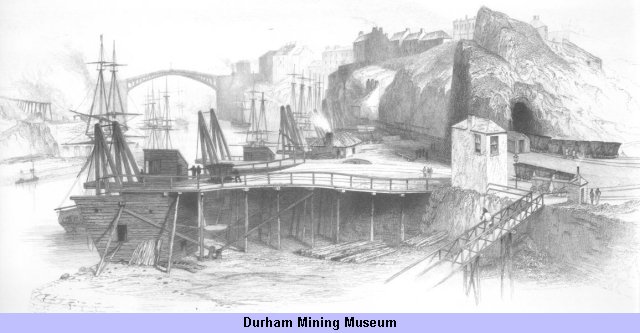
 The first staiths for the shipment of coals on the Wear were erected on the site displayed in our View01 in 1812, when three spouts were opened, The railways were brought to the western brink of a deep ravine, called "Galley's Gill," where an extensive depot was erected; and a strong bridge of timber, at a considerable inclination, was laid across the Gill, forming an inclined plane, down which the waggon-way was passed, and through a tunnel in a projecting rock02 (see View), to the spouts. The erection of these works caused a considerable sensation amongst the keelmen and casters of the Wear, then, for the first time, forced into competition with shipping staiths; and, several similar establishments having been talked about, on the afternoon of March 20, 1815, a great number of persons, chiefly belonging to the above professions, assembled in a riotous manner, and proceeded to pull down the wooden bridge, which they effected by means of ropes. They also set fire to the depot and machinery for lowering the waggons down the inclined plane; and one house in the neigh bourhood was pulled down, and several others unroofed. Many persons were injured by the falling timbers, and one man was killed. At a late hour in the night, a party of dragoons arrived from Newcastle, and dispersed the mob. The injury was estimated at £6000.
Since that period, the depot has been restored,03 and the bridge superseded by an earthen mound; the road beneath being kept open by an arch of brick. The projecting rock, which formerly stretched out much further towards the river than at present, was cut away, to admit of the gears being extended in that quarter; and, about 1820, drops were introduced instead of the spouts. There are now eight drops extending from the lower or eastern side of the Gill, and three on the western side (not seen in our View), to which the coals arc brought by another branch of the railway. The coals at present shipped here are those from the Earl of Durham's collieries, and those of Henry Stobart, Esq., at Lumley. The export of the Marquis of Londonderry's coals from hence is now discontinued; but those from Framwellgate Moor Colliery are expected to be brought hither. The drops here are capable of shipping 150 keels per day.04 They are differently constructed from those on the Tyne, the waggon being suspended from the extremity of a strong framing of beams, which turns on a central axle, and lowers its load to the deck of the vessel.
01 The scenery on this part of the Wear is peculiar and striking, and has often excited the attention of tourists. The lofty and precipitous crags of limestone rock which impend on each side of the river, indented by quarries, and interspersed with limekilns, bottle-houses, and loading gears; the number of ships, keels, and other craft, passing and repassing in the deep and comparatively narrow bed of the river; and that splendid monument of public spirit, science, and taste, the Iron Bridge, built under the auspices of the late Rowland Burdon, Esq.. of Castle-Eden, in the years 1793-6, — combine to form one of the most animating and impressive pictures to be found in this part of the country. For the amusement of our readers, we quote the following passage from the "Northern Tour" of the celebrated bibliomaniac, Dr. Dibdin, vol. i., p. 314 :— "On approaching the bridge, of only one prodigiously elevated arch — beneath which the moderate-sized collier sails without lowering her topmast — my daughter and myself quitted our chaise, for a leisurely survey of this new world of wonders upon which it seemed that we were about to enter. It was decisive enough that we were now in the region of COAL. Houses, windows, walls, pillars, posts, and posterns, were all more or less veiled in what may be delicately designated as black crape. Even the human countenance seemed to partake of it; and for one pure intermingling of the lily and the rose, you shall see a score of carbonated physiognomies" ! ! ! Twenty dirty faces to a clean one! What will the people of Sunderland, particularly its well dressed ladies, say to this? [Return]
02 A short time previous to the erection of the staiths, the late Mr. Thomas Ross, of Southwick Boat-house, having missed his way in the dark, fell from the highest point of this rock down to the quarry below, a height of about 60 feet, at ten o'clock in the evening, and was not discovered till six o'clock in the following morning, when some ship-carpenters, hearing groans, were attracted to the spot. Though severely bruised, none of his bones were broken; and he ultimately recovered. A few years afterwards, however, his eldest son, a boy returning from school, fell from a hanging staircase reaching from the staith to the bank, and was killed on the spot, not many ards from the p lace where his father had been so wonderfully preserved. [Return]
03 On August 16, 1819, John King was executed at the new drop, in front of the courts at Durham, for the wilful murder of James Hamilton, on the night of Sunday, the 16th of the preceding May, in a cabin attached to this building. [Return]
04 At page 5 we have given a brief sketch of the progress of the coal trade on the Wear. It may be interesting to add here, that the total vend from the port, from December 31, 1841, to June 30, 1842, was 229,598½ chaldrons shipped, and chargeable with duty; and 13,240 chaldrons for glass-houses, lime kilns, &c., exempt from duty. The corresponding quantities from the latter date to December 31, 1842, were 239,100, and 10,629 chaldrons. It was in Sunderland, in 1813, that a society was formed, from whose communications with Sir H. Davy, &c., the various safety-lamps at present in use were originated. Though the utility of this invention was at first greatly exaggerated, and a more scientific system of ventilation seems still to be necessary, yet the improvement effected by this species of light may be inferred from the fact, that formerly in Murton colliery, then considered the most fiery on the Wear, many yards of headways and drifts were wrought by the faint but secure light of fish skins. It is said that the first steel-mills were brought from Whitehaven to North Biddick in 1763. [Return]





 Contains public sector information licensed under the

