


|

|

|

|
|
 |
 |
|||
South Hetton Colliery
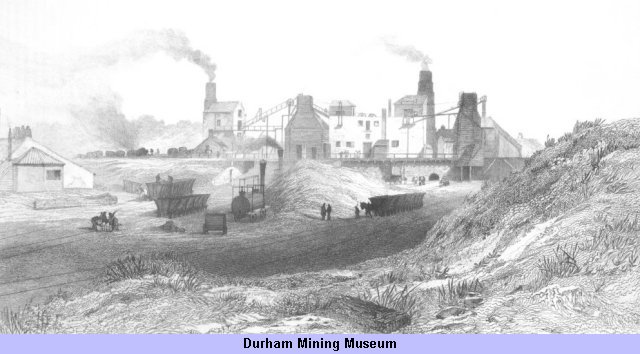
Hetton Colliery
 It was supposed, till of late years, that the magnesian limestone, extending over the greater part of the eastern district of the county of Durham, cut off the coal measures; or that, if coal existed beneath it, such coal must be deteriorated both in quality and thickness. The winning of this colliery, however, by Colonel Braddyll, and more recently that at Monkwearmouth by the Messrs. Pemberton (above described), have completely refuted this opinion, and have given an impulse to mining speculation in this hitherto unexplored field.
Hetton Colliery is situated in the vale of Houghton, about 5½ miles east-north-east from the city of Durham. Before its commencement, there was not a house within a mile of the spot, which now teems with a numerous population. Considerable attention was excited during the sinking of the pit, the shaft of which is 180 fathoms deep; and the following is a list of the beds of stratum, in the order they were sunk through :—
Outset soil. Sand gravel. Limestone marl. Yellow limestone. Blue limestone. Blue metal. Sandstone. White metal. Grey skamy metal. Strong brown limestone. Blue grey metal. Coal. Grey metal stone. Blue metal. Coal. Grey metal. Coal. Grey metal stone. Strong white post. Coal. Grey metal stone. White post. Grey metal. White post. Grey metal stone. Coal. Thill. White post. Grey metal. Coal. White post. Grey metal stone. Black and blue metal. Coal. Grey metal stone. White post. Grey and white post. Whin. White post. Strong white post. Strong white post with water. Grey and white post. Grey metal stone, Coal, Three-quarters. Thill. Grey metal stone. Strong grey metal stone. Black metal. Black grey metal. Grey metal stone. Strong ditto. Grey metal. Coal. Black metal. Coal. Five quarter. Grey metal. Grey post. Blue and grey metal. Ditto, with girdles. Main Coal. White post. Grey and white post. Black metal stone. Blue metal. Grey metal stone, Coal. Strong grey metal stone. Grey and white post. Grey metal. Coal, Maudlin. Grey metal. Blue metal. Grey metal. Blue metal Strong grey post. Whin Soft grey metal. Low Main Coal. White post. Whin. Grey metal. Black and blue metal stone. Splint Coal. re metal. Coal. Thill. Strong grey metal. Grey post. Black metal. Blue metal. Strong white post. Grey metal. Hutton seam, 2 yards thick.01
The temperature at the bottom of the shaft has been found to be 66°, and 70° in the workings. The coal is of excellent quality. The shaft is 15 feet in diameter, and divided into three equal parts at the centre, thus forming angles of 1200. The pumping-engine, of 300 horse power, is placed in a strong stone building, and is supplied by four large boilers. There are two winding engines, each of 90 horse power, and each supplied by two boilers. Two supernumerary boilers are also kept in case of accident, &c. The rope for drawing the coals is 220 fathoms long; its weight being nearly two tons, and its value about £100. Two cages come up at a time, each containing a tub, of which some contain 20, and others 30 pecks, being 6 or 9 cwt.; and the weight of cage, tubs, and coal has been estimated at 35 cwt. It has been stated that, on some occasions, as much coal has been brought up in 18 hours as would fill 30 Thames barges, or above 600 tons. The coals are passed over a screen of half an inch between the bars; and from one-fourth to one-third of small coal is separated by the process.
The waggon-way from this colliery to the staiths on the Wear was opened on November 18, 1822. It extends over a space of 8 miles, and in its course crosses Warden Law, one of the highest hills in the county of Durham. Five of Mr. George Stephenson's patent travelling engines, two 60 horse power fixed reciprocating engines, and five self-acting inclined planes, were the means of transit. On the formation of Seaham Harbour,02 however, a railway was constructed thither from this colliery, a distance of about 6 miles, along which the waggons are passed by means of standing engines and inclined planes. In 1836, 674 ships, containg 201,737 tons of Hetton coals, arrived in the Thames; and in 1837, 669 ships, with 204,668 tons; the average shipping price being 11s. 6d. The following account shews the price at market on the first sales in each month, from January, 1836, to December, 1837; also the average price per year :—
| 1836 | Jan. 23s. 6d. | Feb. 22s. 6d. | Mar. 22s. 0d. | Apr. 23s. 0d. | May 22s. 0d. | June 21s. 0d. | Average 22s. 11d. |
| July 22s. 0d. | Aug. 22s. 0d. | Sep. 22s. 0d. | Oct. 24s. 9d. | Nov. 25s. 3d. | Dec. 25s. 0d. | ||
| 1837 | Jan. 25s. 6d. | Feb. 24s. 3d. | Mar. 25s. 3d. | Apr. 25s. 0d. | May 23s. 3d. | June 22s. 9d. | Average 23s. 11½d. |
| July 23s. 0d. | Aug. 23s. 9d. | Sep. 24s. 6d. | Oct. 23s. 9d. | Nov. 23s. 9d. | Dec. 23s. 9d. |
The total vend of this colliery in 1842 was 83,769½ chaldrons.03
01 In the First Report of Children's Employment Commissioners, page 56, are the following remarks :— "The seams of coal in this district vary in thickness from two feet to seven feet. According to Mr. Edward Potter, coal-viewer and manager of the South Hetton Colliery, 'the principal vein, which runs over the whole of the eastern part of the county of Durham, called the Hutton Vein, is from four to four feet and a half, and there is frequently two feet of coarse coal unfit for market, which is taken up to make horse-roads. The workings are very rarely, if any where, under three feet in this county, and by far the greater part of from three to four feet and a half. No seam from below two and a half to three feet in thickness, would pay for working in this or the next county.' In most pits the top and bottom of the coal consist of shale, or indurated clay, so that a portion of the top or bottom may, without heavy expense, be taken away, if deemed desirable, and sufficient space obtained for the convenient working of the pit. This state of the mines is the most complete security that young children are never employed, nor can be profitably employed, to bring the coals from the workings to the horseways, because such heavy work can be done far cheaper by strong boys and young men." [Return]
02 This artificial harbour is situated 6 miles south from Sunderland, and was commenced in September, 1828. It was formed by enlarging some of the inlets of the coast, and by erecting piers to shelter the whole from the sea. It consists of an inner and an outer harbour; the water in the former being kept up to a certain level by means of a falling gate across the entrance, which is 32 feet wide. Each harbour contains an area of 2½ acres. The limestone excavated in the work was partly converted into lime on the spot, and used for the filling of the piers, and the formation of a foreshore on the north, which is defended by a sloping pavement and a parapet, The first vessel loaded here, the Lord Seaham, proceeded to sea on the 25th July, 1831. A town has also been constructed on the lofty cliffs above the harbour; and a market was established in November, 1843. [Return]
03 During the excitement of a stick in 1832, a pitman named Errington, who had consented to be bound, was found dead on the morning of Sunday the 22nd April, having been shot in the course of the night. Such was the savage feeling of the pitmen at this time, that the funeral of the murdered man, on passing their doors, was assailed with yells and execrations. [Return]





 Contains public sector information licensed under the

