


|

|

|

|
|
 |
 |
|||
Hartley Colliery
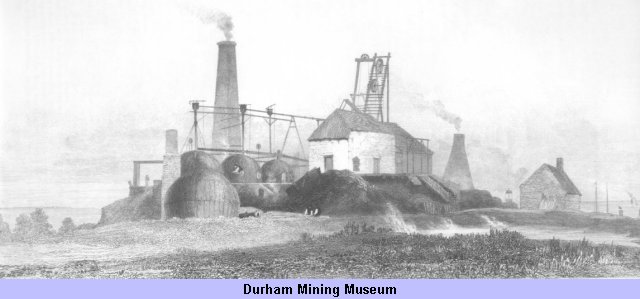
Hartley Colliery
 Before we proceed to describe a few of the collieries on the Wear, it may not be uninteresting to notice that at Hartley, situated about 6 miles north from North Shields. It is worked by John Jopling, Esq., and Partners. The present shaft, 53 fathoms deep to the Low Main seam, was sunk in 1830; a previous shaft, 80 fathoms deep, having been abandoned. The seam is here 4 feet 6 inches in thickness.01 The engine is of 40 horse power. The waggons are drawn to the staiths at Seaton Sluice,02 which is about a quarter of a mile distant, by horses. The following are the arrivals in the Thames :—
| Ships. | Tons. | Shipping Prices. | Market Price. | ||
| In 1836, | 111 | 35,660 | 8s. | ||
| In 1837, | 112 | 36,711 | 8s. | 22s. 6d. |
It is stated, in a MS. written by an old pitman now dead, that an attempt was made at Hartley Colliery, during the last century, to build a stone boiler for the engine! and that the same viewer endeavoured to stop a creep by introducing a ship's cargo of strong wooden balks, cut into lengths ; "but they did not stop the creep."
01 An instance of death which occurred here, from the effects of sulphuretted hydrogen gas, is narrated by Nicholas Wood, Esq., in his evidence before a committee of the House of Commons, June 24, 1835: An old waste had been drowned. "The men were approaching the waste, and boring to ascertain its existence; they met with the water, and the water and this air issuing through this hole, suffocated the person that was working; and the other men that went to his assistance found the candle burning chose to where he was lying dead, and they had very great difficulty to get the body out of the place until it was properly ventilated. I have no doubt that this case proved fatal from the circumstance of the candle continuing burning, and the man knowing that the other gases shewed some indication upon the candle before it was fatal to human life, that he thought he was quite safe as long as the candle burned." [Return]
02 This singular harbour is situated at the mouth of Seaton burn, which, running down from the west, formerly discharged itself into the sea by a sudden turn due north. Sir Ralph Delaval endeavoured to improve the haven by the erection of a pier; and, by the construction of a strong sluice and flood-gates, to scour the channel at low water, it having been found liable to be choked up by sand. The late Lord Delaval, at great expense, cut a passage through the solid rock in a direct line from the rivulet to the sea, and thus provided another entrance to the harbour, by which ships may enter and depart, This new passage, which is crossed by a draw-bridge, is 52 feet deep, 30 feet broad, and 900 feet long. Indeed, this haven, which is capable of accommodating from 12 to 1.5 vessels of 200 or 300 tons burthen, is a natural and artificial curiosity — "Worth gaun a mile to see!" [Return]





 Contains public sector information licensed under the

