


|

|

|

|
|
 |
 |
|||
Ellison Main Colliery
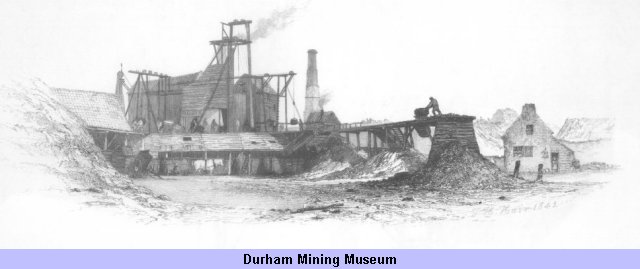
The Isabella Pit, Ellison Main
 Ellison Main, or Sheriff Hill01 Colliery, is situated on the summit of Gateshead Fell,02 and about 2¾ miles south from Newcastle. It is at present leased by Messrs. Lamb and Hutchinson under Cuthbert Ellison, Esq., of Hebburn Hall. The Isabella Pit was sunk between 50 and 60 years ago,03 and is 125 fathoms deep to the Hutton seam,04 which is here 5 feet thick. According to a table in Forster's "Section of the Strata," it appears that fifteen seams of coal, of various thicknesses, have been passed through here. The High Main occurs at the depth of about 60 fathoms, and crops out to the day in a quarry at the Low Fell.05 The following accidents are recorded to have occurred here
On the morning of June 27, 1815, an explosion took place, whilst Mr. William Foggett, the viewer, and his two brothers, were down, all of whom were killed by the blast, and eight of the workmen were also suffocated by the after-damp.
On December 11, in the same year, the brattice, separating the upcast from the downcast, took fire from the lamp at the foot of the shaft. Every exertion was used to get both men and horses out of the pit, as the destruction of the partition necessarily prevented the circulation of air in the workings. Five wastemen, however, unhappily perished.
On July 21, 1817, one man was killed by an explosion.
On July 19, 1819, after the hewers had left work, an explosion occurred, which proved fatal to two men and thirty-three boys who happened to be in that part of the mine. This event took place only half an hour before the pit was to have finished its day's work, otherwise the loss would, in all probability, have been more extensive. Upwards of twenty men and boys were in other parts of the mine, but fortunately escaped, a few only being slightly injured by the concussion and after-damp.
The coals are drawn at two shafts by an engine of about 30 horses' power, which raises three corves at once. Another engine, of the same power, is employed in pumping the water to a height of 30 fathoms from the bottom, where it is discharged into a drift of about 1¼ mile in length, and is finally drawn out by an engine at the Low Fell. The waggon-way from the Isabella Pit to the Tyne is about 3 miles in length, and the waggons are transmitted along it chiefly by means of inclined planes. The following are the arrivals in the London market :—
| Ships. | Tons. | Shipping Prices. | ||
| In 1836, | 64 | 16,549 | 8s. 9d. | |
| In 1837, | 35 | 10,374 | 8s. |
01 So called from being the place at which the sheriff of Northumberland was formerly accustomed to receive the judges of assize, on their way from Durham to Newcastle. In 1278, it appears to have been customary for the king of Scotland, the archbishop of York, the prior of Tynemouth, the bishop of Durham, and Gilbert do Umfreville (by their bailiffs), to meet the justices at a certain well, at the head of Gateshead, called the "Chillewelle." The usual halting-place of the sheriff and his followers was at the sign of" The Cannon ;" but, since the formation of a new and more level line of road, in 1825, by way of the Low Fell, "The New Cannon," at the latter place, has been the termination of the procession. [Return]
02 This lofty hill is described as having been formerly "a wide, spongy, dark moor," and, about 40 years ago, was studded with miserable mud cottages, inhabited by tinkers, cloggers, travelling potters, besom-makers, egglers, and others of that worthy race called Faws." In 1809, it was divided by act of parliament, and constituted a separate rectory; and a handsome church was erected in 1824 — 5. The whole is now highly cultivated and populous, and bedecked with handsome buildings and pleasant villages, so that a mud cottage is a rarity. [Return]
03 Roger de Fulthorpe and others, in 1368, worked the coal-mines in "Gateside Moore." At one time, there were "eight pittes on Gateside Low Fell," which accounts for the immense extent of pit-waste on this part of the Fell previous to the division. [Return]
04 This appellation is not used in the collieries on the north of the Tyne, but is applied to a very valuable seam on the Wear. Mr. Forster says, "The first eight small seams, and the High Main coal, on the river Tyne, are scarcely noticed on the river Wear. The next below, called the Metal coal on Tyne, makes part of the Five-quarters on Wear; then the next, called the Yard coal on Tyne, forms the High Main coal on Wear, six feet thick. A seam six inches thick, together with the Bensham seam on Tyne, three feet three inches thick, form the Maudlin seam on Wear, four feet thick. The next below is a coal called the Six-quarter coal on Tyne, three feet six inches thick, which unites with the Five-quarter coal on Tyne, three feet two inches thick, to form the Low Main coal on Wear. Underneath is a small seam, nine inches thick, below which we find the Low Main coal on Tyne, six feet six inches thick, which forms the Hutton seam on Wear, four feet three inches thick. We then find five small scams, when we come to the Hervey seam, three feet thick on Wear, identical with the Whickham stone coal on Tyne, six feet thick. The lowest seam which occurs is the Brockwell seam. It has not been much worked on the river Tyne, and is totally unknown on the river Wear, where it has never yet been sunk to." It has been stated that a band in the Tyne Low Main, which is first perceptible in the Spital Tongues Colliery, near Newcastle Town Leazes, and which is more apparently developed in the North Elswick Colliery, being there about three inches thick, gradually increases in a southerly direction until it becomes the division between the Low Main and the Hutton seams in the county of Durham. [Return]
05 The Low Fell is situated on the eastern bank of the wide valley through which the Team runs to the Tyne. This valley affords a remarkable instance of the effects of what geologists have called denudation, or the action of vast floods carrying off the surface to a great depth. The High Main coal appears in the sides of the hills on both sides of the valley, and seems to have been originally continuous; but the whole of the strata have been excavated and carried bodily away, not only to the level of the bed of the Team, but to the amount of sometimes more than 180 feet beneath it. [Return]





 Contains public sector information licensed under the

