


|

|

|

|
|
 |
 |
|||
Team Colliery
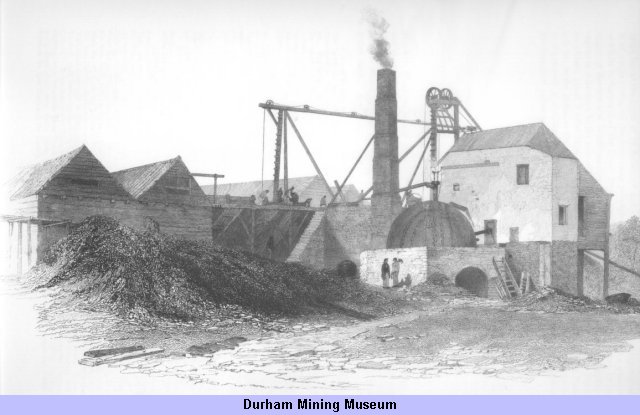
The Street Pit, Team Colliery
 Coal appears to have been wrought in the Team and Ravensworth districts for several centuries.01 The Team colliery is held under lease from the Right Hon. Lord Ravensworth by William Wharton Burdon, Esq., of Hartford House, co. Durham, whose ancestors have held it since the year 1796. The Street Pit (represented in our engraving, and so called from its contiguity to the site of the Roman road) is situated about 4 miles south from the borough of Gateshead. The seams at present working are the Five-quarter and the Low Main. The first is at the depth of 64 fathoms, and is 3 feet 2 inches thick; and the Low Main lies at the depth of 72 fathoms,02 and is 4 feet 8 inches thick. The drawing-engine is of single power, on the condensing principle, and of 18 horses' power, About a quarter of a mile to the north of the Street Pit is the Betty Pit, where the coals are drawn by an engine of Boulton and Watt's construction, of 26 horses' power; and there is a pumpingengine at Allerdean, in the vale of the Team. The coals are shipped on the Tyne, at Poulter's Close, about 5 miles from the colliery; and there is also a waggon-way leading from this pit, to the staiths at Dunston, about 2 miles west from Gateshead. The coasting trade in these coals is considerable. The following are the arrivals in the Thames, as stated in the document before quoted
| Ships. | Tons. | Shipping Prices. | ||
| In 1836, | 2 | 767 | 8s. | |
| In 1837, | 13 | 3,158 | 8s. |
01 A grant of way-leave from a colliery at Ravensworth occurs from Bishop Ruthall in 1530. The first waggon-ways, and the second steam-engine used in the north, belonged to the Liddells; and Colonel Liddell and the lion. Charles Montague were the founders of the partnership vulgarly called the Grand Allies. — Hist. of Durh. [Return]
02 About 26 years ago, a pitman named Byne, with his son, were being drawn up the shaft by the engine. The father was in a corfe, and the boy standing on its bow, and holding on by the rope. When within two fathoms of the top, by a sudden jerk of the pulleys, the boy was thrown off, and fell perpendicularly down the pit. The father, on arriving at bank, exclaimed, "The is gyen — he was always a hemp !" Meanwhile the onsetter, at the bottom of the shaft, seeing something fall into a deep "sump" beside him, pulled it out with a hook, and found it to be the boy; who, in an hour or two, was able to be sent to bank, and in a few days returned to his work. It is remarkable that a brother of this boy, a short time afterwards, was caught by the thumb while hooking on a corfe at the bottom of the shaft, and was in that manner drawn to the top without injury. [Return]





 Contains public sector information licensed under the

