


|

|

|

|
|
 |
 |
|||
Pumping Engine at Friar's Goose01
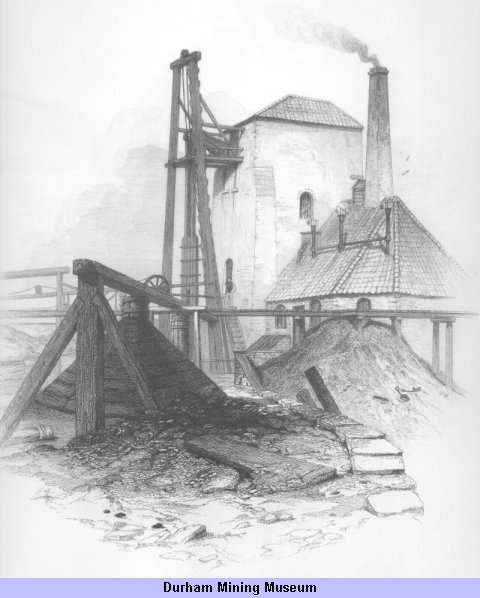
Friars Goose Pumping Engine
 This engine, the most powerful on the Tyne, is situated about 1½ mile east from the town of Gateshead. It was erected about 20 years ago, for the purpose of drawing off the water in the High Main seam of Tyne Main colliery; and it was by means of it that the colliery at St. Lawrence, on the north side of the Tyne, has since been recovered. (See page 20.) The depth of the shaft is 55 fathoms, and there are three sets of pumps, each of 16½ inches diameter. The cylinder is 6 feet in diameter, in which the stroke is 9 feet, and in the pit 7 feet 2 inches. At each stroke, about 195 gallons of water are delivered at bank; and, as the average is 6 strokes per minute, 1170 gallons are delivered in that space of time, or 1,444,800 gallons per day. The power is estimated at 180 horses.02
Another engine, of 70 horse power, was erected here in 1841-2; and an engine for draining the Low Main seam, at the depth of 100 fathoms, has also been erected at Gateshead.
During the night of November 14, 1841, a fire occurred at the screens contiguous to the Friar's Goose engines, which, from the combustible nature of the erections, and the coals which they contained, threatened the destruction of the valuable machinery. The flames were seen shooting to the sky at many miles' distance; but at length, by the most energetic efforts, the fire was subdued before it reached the engine-houses. The damage amounted to about £800.
A beautiful and extensive prospect may be had from the upper rooms of those erections, the interest of which is not a little heightened by the fact, that a considerable portion of the foreground, on both sides of the Tyne, is excavated by the workings of the colliery to which these engines belong.
01 The origin of the singular name of this place is involved in obscurity. It is of high antiquity; for, in Bishop Hatfield's Survey, it is stated that the Master of the Hospital of St. Edmund the King (in Gateshead) holds one plot of ground pro quodam chamino habendo, or way-leave from the Hospital to Freregose, through the lord's meadows there, and pays 4d. [Return]
02 The sight of the houses containing engines similar to that above described, struck Mr. Howitt, in his late visit to the north, as very remarkable. "Wherever reared themselves those tall engine-houses," says he, "there also towered aloft two vapoury columns, one of black smoke, and one near it of white steam. These neighbouring columns, like the ghosts of Ossian, slanted themselves in the wind, and wavered spectre-like in the air, each like some black demon with a pale spirit in his keeping, whom he was compelling to enormous labours; and such noises filled them as seemed to confirm the belief ofit. Some of these engines were groaning, some puffing, some making the most unearthly sighings and yawnings, as if the very Gouls and Afrits of the Eastern stories were set to stupendous labours, and were doing them in despair." — "You now see from the upper part of the engine- house a huge beam, protruding itself like a giant's arm, alternately lifting itself up, and then falling again. To this beam is attached the rod and bucket of a pump, which probably at some hundred yards deep, is lifting out the water from the mine, and enabling the miners to work where otherwise it would be all drowned in subterranean floods." What would Mr. H. have thought of the common occurrence of a boy advancing to the extremity of this beam, whilst it is in motion, and calmly and deliberately oiling the hinges from which the pump-rods are suspended? His height from the ground, the depth of the gulph beneath him, and the irresistible nature of the power by which he is alternately raised and lowered in the air, are circumstances calculated to impress the stranger with breathless awe, if not with terror. [Return]





 Contains public sector information licensed under the

