


|

|

|

|
|
 |
 |
|||
The St. Hilda Colliery, South Shields
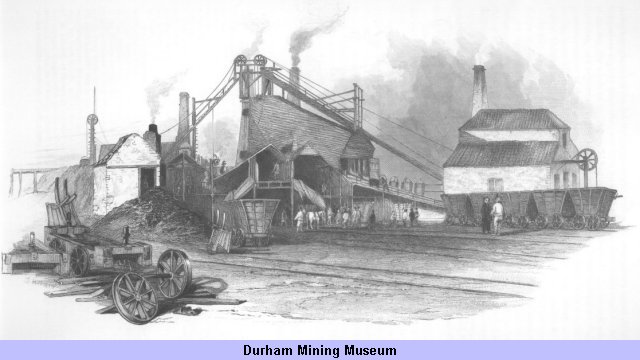
St. Hilda's Wallsend
 The enterprising Simon Temple, Esq., first won a colliery here on the ground of the dean and chapter of Durham, which was hence called Chapter Main Colliery. The first coals were conveyed to the spout, amidst great rejoicings, on April 23, 1810. The great expense of the undertaking, however, compelled that gentleman to stop payment; when the concern fell into the hands of Messrs. Brown, of London, proprietors of Jarrow Colliery, and who sold the lease to Messrs. Devey. The present colliery belongs to Robert, William, and John Brandling, Esqrs. The pit was bottomed at the Bensham Seam in July, 1825; the shaft being about 143 fathoms deep. The average thickness of the seam is about 6 feet; and the workings extend to the south of the shaft, which is situated at a short distance from St. Hilda's church, South Shields. The strata rise towards the sea. The pumping engine is of 90 horse power; and there are two drawing engines, each of 30 horse power. There is also a steam-engine of 20 horse power in the mine. The shaft is divided into an upcast and downcast, by means of a brattice.
This colliery was always considered as peculiarly safe; but, on the morning of Friday, June 28, 1889, about 9 o'clock, the banksman observed the smoke of the furnace, mixed with small coals, ascending the downcast portion of the shaft, announcing the fatal certainty of an explosion. From the situation of the colliery, in the heart, as it were, of a populous town, the alarm spread with fearful rapidity; and multitudes rushed to the spot to ascertain the extent of the catastrophe. The mute despair, or frantic grief of the assembled parents, wives, children, and friends, were intensely agonizing; and as the bodies of the sufferers were one by one brought to bank, and conveyed in carts to their recent homes, the scene became almost too painful for contemplation. William Anderson, Esq., the viewer, descended the shaft soon after the explosion, and remained in the mine till two o'clock in the afternoon, when he was brought up, suffering much from exhaustion. Mr. Mather, wine merchant, of South Shields, also descended at an early period, and exerted himself with indefatigable assiduity in extricating and administering restoratives to all such of the sufferers as exhibited the least sign of animation. The medical gentlemen of the town were likewise prompt in their attendance, and unremitting in their efforts; whilst every exertion which the most consummate bravery and self-devotion could dictate, was made by the men who had gone down to the assistance of their fellow-workmen. Frequently, when they were themselves brought out of the deleterious gas almost suffocated, they merely rested till they thought themselves slightly recovered, and then returned again to their noble work.01 In the course of the day, the whole of the bodies, 51 in number, were exhumed. An inquest was opened on Saturday, and adjourned to the Monday following, when it was ascertained that by far the greatest number of those in the mine had perished by after-damp, only a small proportion having been killed by the explosion. From the nature of the coal, which in working required blasting with gunpowder, it had been found necessary to use candles in many parts of the pit; the Davy lamp being used only where the coal was of a softer nature than usual. Hence the catastrophe, which occurred in the western workings, was attributed to a current of gas, from some of the wastes, having encountered a lighted candle. The verdict was as follows :— "Accidental death; with a special recommendation from the jury that the practice of working coal-mines with candles be abandoned, and lamps be adopted in their stead; as, from the evidence taken upon this inquest, it evidently appears that the explosion, causing such fearful loss of life, has been caused by the incaution of one of the workmen in going with a lighted candle into what is called the tenth board of the mine, which had become foul." Nineteen widows and 44 orphan children were left, for whom a subscription was entered into, which in a few days amounted to above £400.02
On the night of the 14th of January, 1841, a fire, supposed to have originated at the furnace, occurred at this colliery. About midnight, flames were observed in or near the engine-house, when fire-engines were hurried to the spot, and it was found that the brattice in the shaft, dividing the upcast from the downcast, was on fire, and which had also communicated to the shed at the top. Much apprehension was felt lest the circulation of air in the mine should be stopped by the burning through of the brattice, as upwards of 20 men and boys were then at work below. Fortunately the stream of water poured down by the engines carried with it a sufficient current of air to prevent immediate danger; and when, after anxious and long-protracted efforts, the fire was at last extinguished, the workmen, who had till nearly that time been unconscious of the jeopardy in which they were placed, were all safely brought to bank.
The following are the arrivals in the Thames from this colliery in the respective years:
| Ships. | Tons. | Shipping Prices. | Market Price. | ||
| In 1836, | 136 | 52,046 | 9s. 9d. | ||
| In 1837, | 121 | 48,005 | 9s. 9d. | 21s. |
01 A writer who descended the mine says, "The deadly gas became stronger and stronger as we approached. We encountered in one place five dead bodies who had died from the effects of the gas, and had apparently died placidly, without one muscle of the face distorted. Then there were three more, that had been destroyed by the explosion — clothes burnt and torn — the hair singed off — the skin and flesh torn away in several places, with an expression as if the spirit had passed away in agony. — Going with a single guide, we encountered two men, one with a light, the other bearing something on his shoulders; it was a blackened mass — a poor, dead, burnt boy he was taking out. A little further on, we found waggons that had been loaded, overturned bottom upwards, scattered in different directions; a horse lying dead, directly in the passage, with his head turned over his shoulder, as if, in falling, he had made a last effort to escape; he was swollen in an extraordinary matter." One man, who had been attempting to extricate the bodies of the sufferers, was brought out in a fainting state; and, as he did not recover himself so quickly as some others had done, he was questioned as to how he felt. "I am not well, sir," said he; "I HAVE TWO SONS IN THERE." [Return]
02 In consequence of the above fearful calamity, a "Committee for the Investigation of Accidents in Mines" was formed in South Shields, under the presidency of Robert Ingham, Esq., of Westoe. It is expected that an elaborate Report of their proceedings will shortly be published; but, in the mean time, the multifarious nature of their enquiries may be inferred from the following extract of a letter from one of the secretaries to the editor of the Mining Journal, April 3, 1841 :— "The most intelligent and able viewers of the north, in the various visits of this committee to their mines, have received it with much courtesy, and facilitated its investigations personally and by eve7 means in their power. It has been in communication for more than eighteen months with many of the most scientific men in the kingdom, from whom several valuable suggestions have been received. Under its superintendence, the comparative security of the different safety lamps, as Davy's, Clanny's, Upton and Roberts's, &c., has been tested; and by the kind assistance of the Belgic Embassy, it will shortly be in possession of that of M. Lemiell, so favourably reported on by the commission of that country for a similar purpose. Ventilation has engaged the particular attention of the committee, and will form an important feature of its Report. The laws and regulations of foreign mines it has also examined, and has found a paramount attention paid by them to the scientific education of their mining officers." [Return]





 Contains public sector information licensed under the

