


|

|

|

|
|
 |
 |
|||
Hebburn Colliery
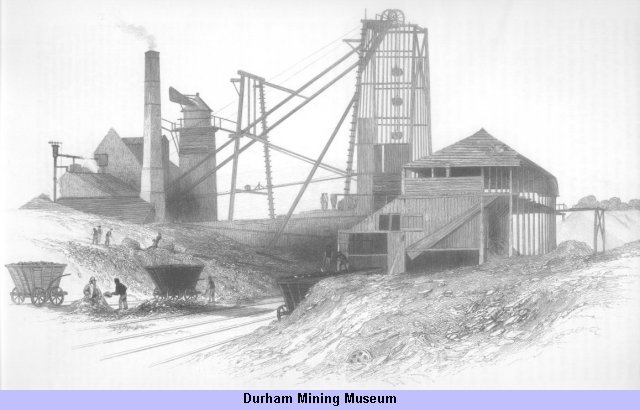
The C Pit, Hebburn Colliery
 Hebburn Colliery is situated about a mile west of that at Jarrow. Coals appear to have been worked here at an early period; and these mines probably formed part of the supposed passage alluded to in the following extract :— "In 1656, a mad design was entertained by — Clavering and Adam Sheppardson, to contrive a way from the cole-pitts, about two miles from the castle (of Newcastle), underground to the castle of Tynemouth, for to relieve the enemy with provisions if need required, and for that purpose there was a great store of provisions laid in, and to be laid in Hebburne-house, and eighty firelocks and a great number of stilettoes laid in Fellen-house."01
The present colliery was commenced in 1792. The winning was considered one of the most arduous and difficult that had up to that period been attempted, the quantity of water drained amounting to upwards of 3000 gallons per minute, until stopped back by the then infant art of wood tubbing.02 The strata here are identical with those at Jarrow. In "Forster's Section" is a table of the strata sunk through to the High Main, from whence it appears that the Monkton Seam, 3 feet thick, lies at the depth of 20 fathoms; that ten insignificant seams of coal, varying from 1½ inch to 1 foot 2 inches in thickness, occur between it and the High Main; and that the latter, 6 feet thick, is come to at the depth of 129 fathoms, 4 feet and 11½ inches. The Bensham Seam,03 as at Jarrow, is about 45 fathoms below the High Main. The Heworth Band also prevails in this colliery, where its thickness, in the line of Hebburn Hall, amounts to a preventative of working the seam as a whole; and the workings in that quarter are therefore carried on in the bottom part only, being about 3 feet thick. The Main Coal was always considered of excellent quality, bordering upon Wallsend colliery along the mid-stream of the river Tyne.
The difficulties to which the working of this colliery has been exposed, were singularly great and diversified, in the first place, the cost and risk of winning were considered enormous at that period. The quantity of inflammable gas also, evolved during many years of inexperienced practice, caused innumerable and heavy explosions; and the workmen, hardened by custom, frequently saw without alarm streams of blue flame emanating from the furnace. At that time, the business of the colliery was principally carried on by steelmills, upwards of 100 of which were in daily use; and the ventilating current, according to custom, was carried entire through all the ramifications of the mine, being stated to run a course of 30 miles between its entry and departure. About the year 1810, a general creep overtook the whole colliery, which suspended all coal-working for a considerable time. During its continuance, when the discharge of inflammable air was too great to admit of ventilating furnaces, the expedient of an air-pump was tried. It was 5 feet square, was wrought by one of the steam-engines, and produced a considerable current; but, from the nature of the application, was, of course, liable to irregularity and stoppage.
This was the first colliery visited by Sir Humphrey Davy, during a sojourn at Hebburn Hall, the seat of C. Ellison, Esq.; and it was from bottles of gas, taken from one of the blowers of the B. Pit dyke, that that celebrated chemist made his experiments and analysis. The first lamps, therefore, were sent down here to be tried by Mr. M. Dunn, the then resident viewer.
The following notices occur in Sykes :— On October 21, 1805, an explosion occurred here, by which 35 human beings lost their lives, leaving 25 widows and 81 children unprovided for. On August 12, 1814, Elias Mould, under-viewer, had descended one of the pits, with the deputies and overmen, to change the course of the air for ventilation, when the pit fired, and himself and two others were unfortunately burnt to death. On October 5, 1825, the gas exploded at a steel-mill which was employed while the Davy lamps were cooling, when four men were suffocated by the after-damp; and on November 27, 1830, two men met their death from a similar cause.
At the C Pit, represented in our engraving, the drawing engine is of 30 horses power. There are two other working shafts. The pumping engine at the B Pit was erected by Messrs. Bolton and Watt, and was considered at that time the most powerful engine in the north of England, raising the water from a depth of 180 fathoms. The coals are drawn from the pits to the inclined planes on the bank of the river by horses. The "Black Staith" is one of the oldest on the Tyne. The colliery is wrought by Messrs. Easton and Co.; and the coal is called in the market "Hebburn Main." The following are the arrivals in the Thames :—
| Ships. | Tons. | Shipping Prices. | ||
| In 1836, | 40 | 10,946 | 10s. 6d. | |
| In 1837, | 53 | 13,282 | 10s. 6d. |
01 Thurlow's State Papers, quoted by Surtees. The latter writer expresses his surprise that Hebburn should thus throw out plots and conspiracies, after it had become the property of a sober Protestant family; but the place seems to have got an ill name amongst the loyalists of that day, from its having recently belonged to a family professing the then proscribed Catholic religion. Surtees himself says that the Hodgsons of Hebburn were long objects of terror to their neighbours. During the northern rebellion in 1569, "of a Sonday last the Protestants and Papests withyn Newcastell made a fray; but Mr. Hodgson, a rank Papest, ys put forth of the town, and the matter payseffed, praised be God." (Sadler's Papers, vol. ii., p. 64.) Sir Robert Hodgson, the grandson of this dangerous Mr. Hodgson, strengthened his connexion with the old interest by marrying Frances Ingleby, grand-daughter of the attainted Earl of Westmoreland. Bishop Neill, in a letter to the Privy Council, denounces this Sir Robert Hodgson, with "John Davel his servant, and one Anthonye Berrye of Jarrow, three Popish recusants, men of ill note in that kinde, and dwellinge very dangerously nere ye river of Tyne for ye recevinge and conveyinge of Popish persons and their carriages." — "One Mrs. Lawson, of St. Anthonie's, over against them on ye North side," is also accused of being "reputed pragmaticall in ill offices of conveyinge, recevin e, and harboringe of all sorts ill affected to ye state." The common rights of hospitality to their persecuted fellow-believers were thus perverted into a crime. The mayor of Newcastle, however, informed the bishop that he and the aldermen, his brethren, hearing of the accusations alluded to, made enquiry, and "could finde noe matter thereof but idle reports." Nevertheless, prejudice was not to be so easily disarmed; for Master Colston, who married Sir Robert Hodgson's widow, is accused in a scurrilous pamphlet, called "Musgrave muzzled" published in 1650, of being a man disaffected to the existing government, and his wife a Popish recusant. [Return]
02 This was constructed as follows :— "A series of cribs, each 6 inches square, were placed at intervals around the interior of the shaft. To these were spiked a perpendicular lining of 2-inch planks, upon which was another series of cleading cribs, supporting a lining of 1½-inch deals. By this arrangement, the great body of water was shut back, and the engines were enabled to command the remainder. For many years, this tubbing continued tolerably effective; but the corrosive nature of the water gradually eat away the iron spikes, and caused so great a leakage that the plank tubbing is now being replaced with the more modern and effective invention of east iron segments. At the last pit that was sunk (the C Pit), the next latest improvement upon wooden tubbing was introduced, consisting of solid cribs of wood placed one upon another, all the joints being lined with thin deal, and wedged water-tight. Thus the three varieties of tubbing are practically illustrated in this colliery. [Return]
03 Two supposed specimens of Lepidodendron Sternbergii (see page 31), found in the roof of this seam, are now in the museum of Sir John Trevelyan, Bart., of Wallington. [Return]





 Contains public sector information licensed under the

