


|

|

|

|
|
 |
 |
|||
Jarrow Colliery
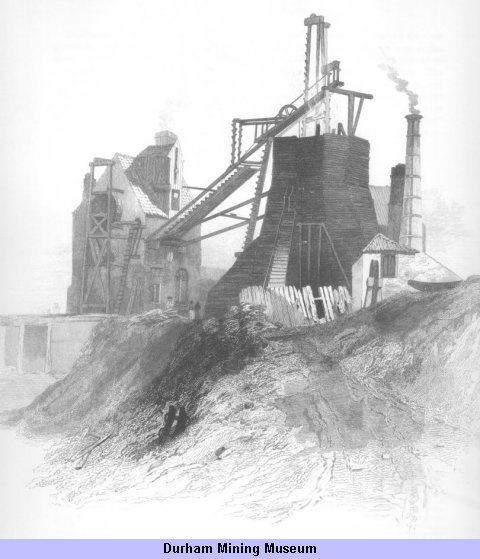
 On the south side of the Tyne, Jarrow01 colliery occupies an important geological situation, being nearly in the centre of the great trough or basin formed by the coal measures, and where they are consequently found at their greatest depth.02 It is situated about 5 miles from the sea.
A notice occurs of a colliery at Jarrow in an account of the rents, &c., of Durham Cathedral, dated 1618. This was an irregular seam of coal, lying near the surface, in the neighbourhood of Monkton, and which was partially wrought in those days.03 At the time Gardner wrote his "England's Grievance," about 1655, the Black Staith was the only one marked in the parish. The present pit, the Alfred, was won by Simon Temple, Esq.; and the colliery was opened on September 26, 1803.04 It is sunk to the Bensham seam, which is found at the depth of 175 fathoms from the surface, and 165 fathoms below high water mark of the river Tyne. The depth to the High Main coal is 128 fathoms, and it is here 6 feet in thickness. The whole of the strata here are broken and dislocated in a most remarkable manner; a circumstance which has rendered it necessary to introduce various drifts and staples to facilitate the workings; and there are two steam-engines employed under ground. In this colliery is remarkably illustrated the growth and progress of the Heworth Band.05 It begins at the river Tyne a few inches thick, but gradually increases in its passage south until it entirely divides the seam. Beneath the church-yard at Jarrow, the coal was wrought under it, and it is there 30 inches thick; but in the space of a few hundred yards south, it was proved to exceed 20 feet in thickness, and the two parts of the seam are never again united in the southern district.
The Bensham seam of this colliery has supplied the writers of the "Fossil Flora of Great Britain" with no less than forty-four specimens of organic remains, many of which are singularly entire and beautiful.06
The following list of explosions here has been collected from Sykes's Records :—
September 25, 1817, when six men lost their lives.
April 28, 1820, two persons killed.
January 17, 1826. — On this occasion, forty-two men and boys were killed, and some others much burnt. Forty-five horses and two asses were also killed. The catastrophe took place in the Bensham Seam, which had been recently sunk to. The number of people in the mine at the time was forty-eight.
March 15, 1828, eight men lost their lives.
August 3, 1830. — This explosion occurred about twenty minutes before six o'clock in the morning, in the Bensham Seam, when forty-two men and boys were deprived of life. Twenty-one of the men were married, leaving widows and sixty-six children. Ten more were much injured, and two horses were killed. There were one hundred and twenty men in the mine, of whom seventy were in the Bensham Seam when the blast took place. An exceedingly interesting and lucid account of this explosion, illustrated by plans and diagrams, was read to the Natural History Society of Newcastle, on the 18th of October following, by John Buddle, Esq., from which it appears that the catastrophe had been caused by "a bag of foulness" (as a latent accumulation of the inflammable gas is termed by pitmen) having suddenly forced out a huge block of coal in the eastern workings, and, rushing out with vast force, had fired at the first flame it met. A subscription was set on foot for the families of the sufferers, which amounted to upwards of £900.
The coals are brought to bank by two winding engines; one of about 80, and the other 43 horse power. The pumping engine is of 90 horse power, containing four sets of pumps, to which a fifth is about to be attached. The coals are conveyed to the drop on the Tyne by means of an inclined plane. The present owners are Messrs. Brown, the assignees of Simon Temple, Esq.; and the coals are known in the market as "Brown's Wallsend." The following are the arrivals in the Thames in the specified years :—
| Ships. | Tons. | Shipping Prices. | Market Price. | ||
| In 1836, | 62 | 21,206 | 6s. 8d. | ||
| In 1837, | 82 | 28,762 | 6s. 6d. | 17s. 6d. |
An obstinate and protracted strike of the pitmen on the Tyne and Wear commenced on March 3, 1832. During its continuance, viz., on the 11th June following, as Nicholas Fairies, Esq., of South Shields, a magistrate for the county of Durham, was riding to Jarrow Colliery, he was accosted by two pitmen, under pretence of asking charity, when one of them took hold of his hand, and the other seized and dragged him from his horse. One of them gave him a violent blow on the head with a brick; and, after they had both kicked and beat him most unmercifully, they left him on the road almost lifeless. The transaction having been observed from a neighbouring house, assistance was immediately sent to him; but, from the dreadful nature of his wounds, he expired on the 21st. A reward of £300 was offered by the government, and £100 by the vestry of St. Hilda, for the detection of the offenders; one of whom, William Jopling, was apprehended; but the other, Ralph Armstrong, succeeded in making his escape. Jopling was tried for the murder at the Durham assizes on the 1st of August following; and being found guilty, he was executed there on the 23rd. In consequence of the revival at that time of an obsolete law, his body was sentenced to be hung in chains on Jarrow Slake, near the scene of the murder. This was effected on the 6th, under a strong civil and military escort. So disgusting an exhibition gave general dissatisfaction, especially as Jopling was popularly considered the least culpable of the criminals; and it was a relief to the public mind when, on the dark night between the 31st of August and the 1st of September, Jopling's body was stolen from the gibbet, and secretly disposed of by some persons unknown.
01 Though the vestiges be few and meagre which mark the ancient sanctity of Jarrow, — and though the former stillness and solitude of the place be exchanged for the bustle of commerce, the clangour of modern mechanical and scientific inventions, and the hum of a dense population, — yet the apathy of that man is not to be envied who can unmoved look around upon the spot where one of our earliest churches was built and beautified by Benedict Biscopius and his pious confreres, and from whence THE VENERABLE BEDE threw the halo of his learning, his industry, and his piety upon the otherwise dark page of Anglo-Saxon history. [Return]
02 "From this point," says Forster, "the beds appear to rise to some considerable distance on each side, particularly in a western direction. The average dip of the coal measures is one inch in twenty; but this inclination is by no means uniform in every part of the district. Thus, that seam called the High Main, which lies buried at Jarrow under 160 [128] fathoms of beds of stone, soon rises to the day in a north-east direction, and bassets out in the cliffs between Cullercoats and Tynemouth. In its north-westerly direction, it reaches Benwell Hills; and at Pontop, nearly 18 miles due west of the sea-shore at Sunderland, it is met with at 38½ fathoms from the surface. In a southerly direction, it is found at 52 fathoms on Gateshead Fell, but bassets out before it reaches the Wear." [Return]
03 It is now called the Monkton, or Hebburn Fell Seam, and "extends over a very limited tract of country, being denudated, and cut off by the river Tyne to the north, and is thrown out to the surface to the south-west and west by a slip-dyke and the natural rise of the strata." The Low Main seam has been proved at Jarrow. — Buddle's Synopsis. [Return]
04 "The fineness of the day, and the general invitation, drew many thousands of people to witness the passage of the coals to the ship Fox, which lay, highly decorated with colours, to receive them. Early in the morning, the South Shields bells announced the intented feast; and all the ships in Shields harbour immediately hoisted their colours. About ten, Mr. Temple arrived at Shields, to proceed with the shipwrights [Mr. Temple carried on business extensively as a ship-builder], attended by the Northumberland and Anglesea bands, to the place of festivity, celebrated in early times as the birth-place of Bede. Immediately on his arrival in the Market-place, the shipwrights took the horses out of the carriage, and drew him, attended by his father and three sons, to Jarrow, with flags flying and music playing. On Jarrow bridge, he was met by a large assemblage of gentlemen, headed by Sir Cuthbert Heron, Bart., who greeted him on his arrival. Their first step was to lay the foundation-stone of a school, for the education of the poor children of the various workmen employed by Mr Temple. This was done by his eldest son, Mr. William Temple, amidst the plaudits of the whole company. They next proceeded to lay the foundation-stone of a building, intended as a seminary for the instruction of poor females in offices more suitable to their sex than several of their employments in the north of England. These commendable acts being finished, the procession moved to another part of the estate, to lay the foundation-stone of a fever-house and hospital, for such of the families employed in Mr. Temple's various works as might require these comforts. By this time, several of the clergy of the cathedral of Durham, the corporation barge of Newcastle, with several members of that body, and a great number of the most respectable gentlemen from all parts of the country, had arrived. They now proceeded to the more immediate cause of their meeting; and the waggons, being loaded with coals, were taken to the ship, under the banners of the South Shields Loyal Volunteers, which were then unfurled, and a general discharge of artillery, the music playing ' Weel may the keel row,' and other appropriate tunes. It was supposed that not less than 10,000 people were assembled on this occasion. In a tent prepared for their entertainment, about 300 gentlemen sat down to dinner. The workmen, in number 500, dined at a long table without." — Local Papers. [Return]
05 So called from its commencing in the High Main seam near Heworth, from whence it extends to the east and south-east, gradually increasing from a mere parting of the coal till it destroys the seam altogether. [Return]
06 The following are a few of the most remarkable :—
Ulodendron Majus. — A scaly trunk with large scars, indicating probably points whence masses of infiorescence have fallen.
Calamites. — Their appearance is that of a circular fiat body, with a crenated margin, from the reentering angles of which run simple lines, converging towards the centre, but uniformly stopping short of it. One specimen exhibits a crushed portion of the stem; another, the base of the stem of some unknown species.
Asterophyllites Foliosa. — This was a tall branching plant, with long slender shoots, which were rather thicker at the base than at the apex. At first sight, it seems to resemble asparagus; but, upon examination, it will be found that, while the branches of asparagus are alternate, those of this plant are opposite to each other.
Noeggerathia Flabellata. — This palm, with another in the museum of Prague from the Bohemian coal-mines, are the only certain species found in the coal-measures of Europe.
Sigillaria Catenulato is remarkable for the appearance of its oval scars, which, touching one another at the ends, form a kind of chain.
Sigillaria Organum, met with in large quantities (as many as 10 in 16 yards) while driving a stone drift.
Cardioearpon Acutum. — This species of fruit or grain occurs occasionally in the shale, and always, or at least most commonly, in groups; from whence it has been inferred that they were clustered together, in pairs applied by their faces, when growing on the plant, and that they were either deposited where they grew, or that they had been drifted but a very short distance.
Bothrodendron Punctatum, the remains of some large plant, the stem being marked with a considerable number of minute dots, and displaying, at intervals of ten or eleven inches, deep circular concavities, four or five inches across, as if something (probably a large cone) had been broken out.
Lepidodendron Sternbergii. — This is a "magnificent individual, which has lately made its appearance in the Bensham coal seam. It occurs in the great deposit of vegetable fossils which is there, as elsewhere, 12 to 18 inches above the seam of coal, and fortunately has been overthrown or settled down in a north and south direction, which being that of the gallery, it is plainly to be seen throughout its whole length. Many much broader stems of Lepidodendra have occurred; but as they did not happen to lie in the direction of the workings, they could only be traced from side to side of the passages. This individual was 39 feet in length from the root to the first division into branches; the greatest breadth 3 feet, and gradually tapering. The ramifications of the branches extended to the coal on each side the passage, being 13½ feet wide, and upwards of 10 feet in a direct line from the first division: here they were suddenly cut off, by a small dislocation, or slip of the strata. The specimen was pressed quite flat, and completely decorticated."
Lepidodendron Plumarium, consisting of a number of slender leaves, closely arranged over their stem, and curved upwards, like the plume of a feather.
Stigmaria Ficoides. — This remarkable fossil, being generally seen from beneath, exhibits a concave surface, varying in diameter, and "very distinctly covered with wrinkles, which, when attentively examined, are seen to be caused by depressed semicircular spots, compactly arranged in a spiral manner, in the centre of which is a roundish scar, to which a little fine coaly matter usually adheres." From this centre, arms, varying from nine to fifteen in number, proceed on all sides; every one, when seen of length sufficient, divided into two branches. These arms, sometimes 44 feet long, are generally truncated, or lost in the coal below. Mr. Steinhawer states that they are sometimes found 20 feet long! "The whole plant is flattened. As we recede from the centre, and approach the fore part of the arms, the circular tubercles, so well known, become more distinctly marked; and upon all the branches the leaf-like bodies remain attached. Upon several of the arms, the course of an internal central axis could be traced by a furrow." — "That a proper idea may be formed of the abundance in which the remains of Stigmariae occur in this bed, it should be stated, that those alluded to above, have all been brought to light in a short period, by the working of the mine; and that only in the roof of the passages."
From the peculiarities of this fossil, the intelligent writer just quoted infers that it cannot have been floated from a distance, but that it stands where it originally grew. "It is worthy of observation," he adds, "that the fossil remains of a Unio (undescribed) occur, in considerable abundance, associated with the Stigmariae, but in a shale which forms the covering of the high main coal in the same colliery; and about 45 fathoms above the Stigmaria. bed, as we may very appropriately designate it, there is, in one spot, a considerable accumulation of this same fossil Unio. The coal has been worked out under the layer of shells in all directions; and they are found to cover an area of 5000 square feet. The shells are partly embedded in the coal itself (which is spoiled by them), and partly in the shale above it; the bed is about 18 inches thick; the animals have evidently died at various ages; and the shells, of all sizes, are, many of them, gaping open. As it is impossible to conceive these, consisting of one species only, to have been brought from a distance and deposited here, we must conclude, that this bed of shells (and there are many more known in other parts of the series) marks what has been, for some considerable period, as compared with the age of man, the uppermost surface of the earth, upon which fresh, and probably still water had reposed, as in the before recited case. Now, although it may be true, that the presence of organic remains, in any stratum, be evidence sufficient of its having once been at the surface, yet the additional evidence in these cases is so far valuable, as it proves that these beds remained uncovered for a period of considerable duration; long enough, indeed, for plants of a large size to flourish, and beds of muscles of considerable thickness to form, by the successive growth and decay of the animals.
"What an amazing idea is thus forced upon us, of the length of the period which might elapse, during the deposition of the coal measures alone, when the beds here referred to are but two in hundreds, any one of which may have been as long uncovered by its successors in the series! and what is the whole coal formation, compared with the great mass of the secondary strata? — a single layer of stones in a stupendous edifice !"
The writer concludes that "we should appear to be fully warranted in considering, that the growth of plants of this class (Stigmariae) was one of the great means made use of by the Almighty Architect of the globe, in absorbing and rendering solid that excess of Carbon, which, it is believed, must, at the period of the formation of the coal measures, have existed in the atmosphere; thus rendering it fit for the support of animal life, and, at last, a proper habitation for man. We cannot contemplate this storing up such a mass of combustible matter, and the iron which always accompanies it in the depths of the earth, at a remote epoch, for the consumption and enjoyment of creatures afterwards to exist on its surface, without being struck with the benevolence and wisdom manifest in the design." — Fossil Flora. [Return]





 Contains public sector information licensed under the

