


|

|

|

|
|
 |
 |
|||
Wylam Colliery
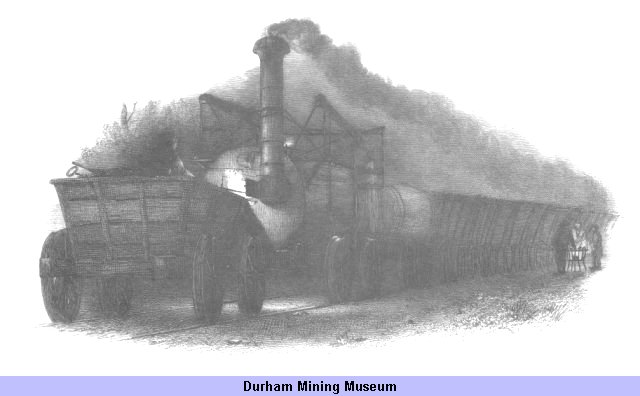
Old Locomotive Engine, Wylam Colliery
 The pleasant village of Wylam is situated close to the north bank of the Tyne, in the parish of Ovingham, and about 9 miles west-by-north from Newcastle. The colliery, the property of Christopher Blackett, Esq., proprietor of the estate, is in the village; and the workings extend beneath the bed of the Tyne, and to a considerable distance beyond it. The antiquity of this colliery is attested by about twenty old pits belonging to it; and some of those in present use are known to have been so for above 90 years.01 During the great flood of November 17, 1771, which destroyed Newcastle bridge, and devastated the whole vicinity of the Tyne, the water reached one of the shafts of this colliery, and inundated all the workings, containing 300 acres. It was estimated that there were 1,728,000 hogsheads of water in the several seams of coal. The following are the depths and average thicknesses of the seams in the colliery :—
| Feet. | Inches. | ||
| High Main at 6 fathoms | 5 | 7 | thick. |
| Five-quarter Coal at 21 do. | 3 | 4½ | |
| Six-quarter Coal at 26 do. | 3 | 8 | |
| Yard Coal at 32 do. | 3 | 0 | |
| Horsley Wood Seam at 41 do. | 3 | 0 | 02 |
A downcast dyke, of 40 fathoms, which crosses the Tyne between Close House and Wylam Colliery, brings the seams which are wanting on the east side of it, down into that colliery. The Horsley Wood seam is supposed to be the last, or lowest, in the series. In its roof are various marine shells, sometimes occurring in great quantities. The coals are drawn by a machine of about 16 horse power; and the pumping engine is of 60 horse power. it draws 73 gallons at each stroke; and as the usual time is 12 strokes per minute, the water discharged in that time amounts to 876 gallons. The railway to the staith at Lemington is five miles in length, along which the waggons are drawn by locomotive engines.03 A bridge across the Tyne, consisting of a wooden platform on stone piers, also contains a waggon-way connecting the colliery with the Newcastle and Carlisle Railway, on the south side of the river.04 The following quantities of coals arrived in the Thames :—
| Ships. | Tons. | Shipping Prices. | Market Price. | ||
| In 1836, | 80 | 31,729 | 8s. | 20s. 3d. | |
| In 1837, | 84 | 35,399 | 9s. | 21s. 6d. |
A new winning, on the south side of the Tyne, was commenced in 1836, and bottomed in 1838. It is called Prudhoe Main Colliery. The workings are connected with the old colliery by a drift. The Townly seam is here 6 feet 5 inches thick, the Five-quarter seam 3 feet 8 inches, the Six-quarter seam averages 4 feet 6 inches, and the Yard coal 3 feet 3 inches. The last-named seam is sunk to at the depth of 38 fathoms; but only the second and third are yet being worked. The Horsley Wood seam, S fathoms below the Sixquarter seam, is not yet worked to. The pumping engine is of 30 horse power. The coals are transmitted to the staiths at Dunston and Gateshead by the Newcastle and Carlisle Railway.
01 The working of coals in Tynedale was carried on at a very early period. After the grand crisis of the capture of Calais by King Edward III., his queen, Philippa, resided chiefly in England. "Our country felt the advantage of the beneficent presence of their queen. Philippa had in her youth established the woollen manufactures: she now turned her sagacious intellect towards working the coal mines in Tynedale, a branch of national industry whose inestimable benefits need not be dilated upon. These mines had been worked with great benefit in the reign of Henry III.; but the convulsions of the Scottish wars had stopped their progress. Philippa had estates in Tynedale; and she had long resided in its vicinity during Edward's Scottish campaigns. It was an infallible result, that wherever this great queen directed her attention, wealth and national prosperity speedily followed. Well did her actions illustrate her Flemish motto, Ich wrude muche, which obsolete words may be rendered, 'I labour or toil much.' Soon after her return from Calais, she obtained a grant from her royal lord, giving permission to her bailiff, Alan do Strothere, to work the mines of Alderneston, which had been worked in the days of King Henry III. and Edward I. From this re-opening of the Tynedale mines by Phiippa proceeded our coal trade, which, during the reign of her grandson, Henry IV., enriched the great merchant Whittington and the city of London." — Lives of the Queens of England, by Agnes Strickland, vol. ii. page 377. [Return]
02 These thicknesses of course occasionally vary; the Horsley Wood scam, for instance, in some places not exceeding 24 inches. [Return]
03 It is pleasant to look back on the passing notices which have been elicited by the first introduction of remarkable inventions or improvements. In Mackenzie's History of Northumberland (published in 1825), vol. ii. p. 372, is the following description of the locomotive engines here: "Each engine draws ten waggons, that carry eight chaldrons of coals, or 21 1/3 tons, which is above two tons and one-tenth to each waggon. Sometimes a dozen or more waggons are dragged by one engine. A stranger is struck with surprise and astonishment on seeing a locomotive engine moving majestically along the road, at the rate of 4 or 5 miles an hour, drawing along from ten to fourteen loaded waggons; and his surprise is increased on witnessing the extraordinary facility with which the engine is managed. This invention is a noble triumph of science." [Return]
04 Until lately this was the most westerly sea-sale colliery on the Tyne; but since the opening of the Newcastle and Carlisle Railway, the colliery at Mickley, about 3½ miles farther west, has, by its means, transmitted coals for shipment. This mine is entered by a drift in the side of a hill. [Return]





 Contains public sector information licensed under the

