


|

|

|

|
|
 |
 |
|||
Walbottle Colliery
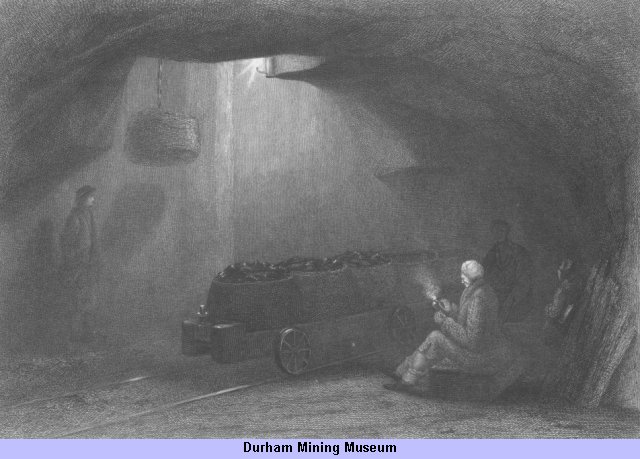
Bottom of the shaft, Walbottle Colliery
 This colliery is situate in the parish of Newburn, about 4½ miles west by north from Newcastle. It is of considerable antiquity, the Duke Pit having been a working shaft upwards of 100 years. Our view exhibits the bottom of the Coronation Pit shaft,01 in which the following seams occur at the annexed depths, and of the specified thicknesses :—
| Fathoms | Ft. | In. | ||
| Engine Seam | 76 | 0 | 6 | top or inferior coal. |
| 3 | 0 | workable coal. | ||
| Main coal | 22 | 0 | 4 | splint. |
| 2 | 8 | good coal. | ||
| Splint seam | 12 | 0 | 8 | splint. |
| 3 | 0 | good coal. | ||
| Total depth | 110 |
Two basalt or whin dykes run through the colliery; and slip dykes and troubles are very prevalent here. The colliery has been remarkably fortunate in its exemption from explosions. There are three working pits, at which the coals are drawn by an aggregate of 83 horse power. There are also three pumping engines, combining 262 horse power. The waggon-way from the Coronation Pit to the staith at Lemington is about 2 miles long; and the waggons are conveyed thither by horses and inclined planes. The coals are forwarded to the ships by keels. Messrs. Lamb and Co. are the proprietors of the colliery. The coals are known in the market by the names of "Holywell Main," "Newburn Main," "Holywell Reins," and "Holywell Reins Splint," of which the following quantities were exported to London :—
| Ships. | Tons. | Shipping Prices. | ||
| In 1836, | Holywell Main | 107 | 41,172 | 9s. 3d. |
| Newburn Main | 1 | 424 | 8s. | |
| Holywell Reins | 12 | 3,932 | 8s. 6d. | |
| Do. do. Splint | 1 | 127 | 6s. 6d. | |
| In 1837, | Holywell Main | 128 | 52,162 | 11s. |
01 We have, in a previous page, alluded to the repulsive feeling excited by visiting the interior of a coalmine. The following anecdotes of two men, both remarkable in their way, may not be uninteresting :—
When Mr. Bruce of Kinnaird returned from his many years' absence in Barbary and Abyssinia, to his country mansion on the carse of Falkirk, he was greatly dissatisfied with the way in which his collieries had been wrought. After some stormy disputes with the individuals who had leased them, he agreed to submit the matter to a committee of coal-engineers, who accordingly met at Kinnaird, inspected the mines, and used every endeavour to form an impartial judgment. Conversing one day with these gentlemen, he challenged something which one of them said respecting the condition of the mines; whereupon the engineer said that, if Mr. Bruce was not afraid, he might go down and satisfy himself on the point by personal investigation. The word "afraid" startled the ear of the traveller, whose commanding figure and bold demeanour had been the chief means of bringing him unscathed through so many dangers. "Afraid !" said he, in his magnificent way; "sir, do you think I would be afraid to go down into my own mines ?" He immediately proposed to go down with them next day, and they as eagerly took him at his word, determined to punish him a little for the unreasonable way in which he had disputed many of their statements. "He speaks of Nubian sands," quoth one to another that evening; "we'll show him something worse to-morrow, if I am not mistaken." Next day, accordingly, the illustrious traveller appeared at the mouth of the pit, and after investing his dignified person in the coarse clothes proper to the occasion, down he went, along with his corps of engineers. The strata are not there very thick at the best, and many of the wastes were considerably crushed or fallen in. It was therefore by no means pleasant walking through Mr. Bruce's mines. Nevertheless, as had been concerted amongst them, on they went, up one waste, down another, leading the unfortunate Abyssinian such a dance as never traveller danced before either on the surface or beneath it, and all the time pretending to demonstrate to him the results at which they had arrived. Sometimes the party would be stooping in a rectangular form; sometimes they would be wading up to the knees in coal-mud; sometimes they would be reduced, for a quarter of a mile together, to crawl on their hands and knees, also in deep mud. At one place the engineers passed through an aperture barely large enough for themselves, who were men of moderate size, but which was evidently too narrow for Bruce. When they had passed, they said they were afraid it would be difficult for him to get through; but he was too proud to own himself defeated — tried the aperture, and fairly stuck in it. They had to pull him out by the head and shoulders; and a sore pull it was. Thus they led him about, he evidently sinking with fatigue and disgust; but never uttering a word of complaint, and they, of course, greatly enjoying his distress, till towards dinner-time, when at length they brought him back to the bottom af the pit, the only place where he could stand upright. The figure which he now cut — one tall mass of black mud and rags — is not to be described. Nevertheless, up to the very last moment he maintained his usual composure, and the only remark he now made, that seemed to denote his feelings, was, that he did not think the wastes had been so dirty. It may be supposed that next day he shewed himself a good deal more ready than he had formerly been to admit the conclusions to which experience and observation had brought his scientific advisers. — Chambers's Edinburgh Journal, No. 421.
When Grimaldi, the celebrated clown, was performing at Newcastle in 1818, the glowing descriptions of the manager induced him to see a coal mine. His stay in the pit, however, was brief enough. He descended some two or three hundred feet in a basket, and was met at the bottom of the shaft by a guide, who had not conducted him far, when a piece of coal, weighing about three tons, fell with a loud noise upon a spot over which they had just passed. "Hollo!" exclaimed Grimaldi, greatly terrified, "what's that ?" "Hech !" said the guide, "its only a wee bit of coal fallen down: we ha'e that twa or three times a day." "Have you ?" replied Grimaldi, running back to the shaft. "Then I'll thank you to ring for my basket, or call out for it, for I'll stop here no longer." The basket was lowered, and he ascended to the light without delay, having no wish whatever to take his chance again among the "wee bits of coal." — Life by Boz, vol. ii., p. 181. [Return]





 Contains public sector information licensed under the

