


|

|

|

|
|
 |
 |
|||
Benwell Colliery
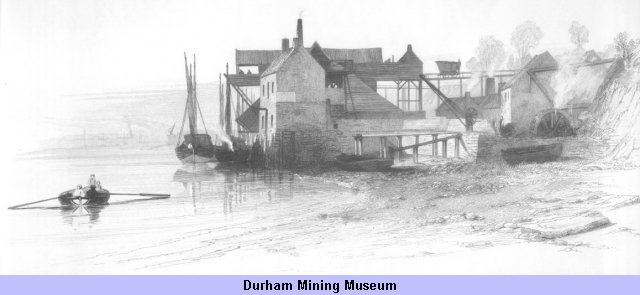
Benwell Staith
 This colliery is situated nearly 3 miles west from Newcastle, and is one of the most ancient on the Tyne. It contains the whole series of the coal seams in a workable state, except the Three-quarter coal. All the seams, from the High Main to the Bensham, crop out in the north bank of the river, between the Roman station of Condercum,01 on the top of the hill, and the staith. The seams above the level of the river were mostly worked out in former times; and the uppermost, or Main Coal, was accidentally set fire to about 160 years ago, and continued to burn for 30 years. It is said that a man offered to go down, at the commencement of the conflagration, and extinguish the fire for a small sum; but so little danger was apprehended, that his offer was declined, The fire "at last extended itself northward into the grounds of Fenham, nearly a mile from where it first appeared. There were eruptions at Fenham in nearly twenty places, sulphur and sal-ammoniac being sublimed from the apertures, but no stones of magnitude ejected. Red ashes and burnt clay, the relics of this pseudo volcano, are still to be seen on the western declivity of Benwell Hill; and it is credibly reported, that the soil, in some parts of the Fenham estate, has been rendered unproductive by the action of the fire."02
During the 17th century, the colliery was won to the Low Main seam, and worked till near the close of that century, when it lay dormant till the year 1789. The present winning was then made to the Beaumont seam,03 at the depth of 60 fathoms, and is still working it. While the former workings of the Low Main seam were in operation, they were carried under the haugh at the west of the manufactury at the village of Paradise; and being near the surface, the water broke in during a great flood of the river, and drowned up the colliery. Vestiges of the crater which the water formed on this occasion, and the dam or dyke which was subsequently built round it, are still visible. This catastrophe happened about the middle of the 17th century; and some years afterwards, the water was drawn out, and the working of the coal in this seam was completed.
On January 19, 1830, a paper by John Buddle, Esq., was read at a meeting of the Natural History Society, Newcastle, describing a whin dyke which passes through the Beaumont seam here. Contrary to the generally received opinion that such dykes have been thrown up from below by the action of heat, this dyke rests on the seam of coal, which it has pressed downward to an extreme thinness. The inferences drawn by Mr. Buddle on this subject, are, that this dyke vertically undulates in a north-west and southeast direction; that it passes under the Main or Ninety-fathom dyke (see note, page 21); and that in the opposite direction it re-appears at the Ouseburn, and again at Simonside near Jarrow, being found in the intervening collieries of Byker, Lawson's Main, and Walker.
An extensive shot manufactory was carried on some years ago at one of the pits of this colliery. The melted lead was poured from the top to the bottom of the shaft, which answered the same purpose as throwing it from the top of a high tower.
The only explosion on record occurred on October 27, 1826, when two young men were killed, and several others injured. There were upwards of 100 men and boys in the mine at the time.
The colliery is drained by two engines, of 40 horse power each. The coals are conveyed by inclined planes from the pits to the staith, where they are put into keels to be carried to the ships lying below Newcastle bridge and at Shields. The first drop used for lowering the waggons down to the keels and ships was erected here in 1808. (See note, page 14.) The colliery is worked by Messrs. Surtees, Dunn, and Co.; and the coals are called "Adair's Main" in the London markets, where the following quantities were delivered :—
| Ships. | Tons. | Shipping Prices. | Market Price. | ||
| In 1836, | 75 | 30,643 | 7s. 6d. | ||
| In 1837, | 54 | 22,875 | 7s. 6d. | 20s. |
01 An eminent antiquary suggests that some reasons might be given for fixing Ad Murum (on the Wall) at Benwell, instead of Newcastle. Bede, who mentions the royal villa of Oswy, is very exact in saying that it had its name from being "near the wall which the Romans drew across the island, and 12 miles from the east sea." Ben-wall means within the wall, at, or close to it, and answers better to the distance than Newcastle. A fragment of the Roman wall still exists in the hollow below Benwell Hill. It measures about 9 feet in breadth, and an apple tree grows out of the middle of it.
Benwell, however, is classic ground in a sense more germain to our present purpose, inasmuch as it is the scene of the celebrated poem called "The Collier's Wedding," by Edward Chicken, — a standard work in Northumbrian poetry, and graphically descriptive of the manners of the pitmen in the last century. [Return]
02 Forster's Section of the Strata, p. 42. A similar circumstance is recorded in the Hull newspapers of September, 1834 :— "SUBTERRANEAN FIRE. — There is a patch of ground at Nether Haugh (Yorkshire), belonging to Earl Fitzwilliam, under which a bed of coal has been on fire for a great number of years. The ignition, it is supposed, was accidentally communicated by the burning of a heap of stone and coal in a quarry. The effects have been singular, and in several respects detrimental, undermining the cottages, rendering the cellars inaccessible through the hydrogen gas, and, in one instance, a portion of the turnpike road, which had been burnt hollow, fell in immediately after a heavy loaded waggon had passed over it. Attempts have been made to extinguish this subterranean fire, but without effect, and when or how it will end it seems impossible to guess. Some years ago, a number of industrious inhabitants of the place bethought themselves that what had seemed, and what in fact was a real evil, might be turned into an advantage; and having obtained the land over the fire, to be laid out in garden patches, it is from thence that, for the last four or five years, have been obtained the finest early potatoes which have been sold in Rotherham and Sheffield markets. [Return]
03 So called from having been first worked at Montague Main Colliery, in the adjoining estate of Denton, by the celebrated Mr. Beaumont, thus mentioned in Grey's Chorographia :— "Mr. Beaumont, a gentleman of great ingenuity and rare parts, adventured into our mines, with his thirty thousand pounds, who brought with him many rare engines, not known then in these parts; as the art to borre with iron rodds, to try the deepnesse and thicknesse of the coale; rare engines to draw water out of pits; waggons with one horse to carry down coales from the pits to the stathes, to the river, &c. Within a few years, he consumed all his money, and rode home upon his light horse." [Return]





 Contains public sector information licensed under the

