


|

|

|

|
|
 |
 |
|||
Fawdon Colliery
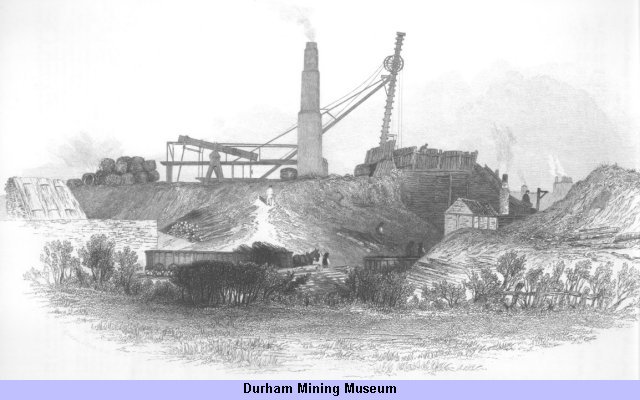
The A Pit, Fawdon Colliery
 The township and village of Fawdon is situated about 3½ miles north-by-west from Newcastle, and in the parish of Gosforth. High Fawdon, Fawdon Square, and Low Fawdon, are pit-villages, which owe their existence to the colliery. The A Pit (see plate) was commenced in March, 1810; and the High Main coal was reached in May, 1811, at a depth of 48 fathoms. The engine power at this pit is 15 horses; but it is not now in operation. The B Pit was sunk in the years 1813 and 1814, and is about the same depth as the A Pit. During the sinking a fossil tree was discovered. No coals have been drawn at this pit for many years; but it is used as a furnace pit for the purpose of ventilation. The E Pit was sunk in the years 1822, 1823, and 1824. Its depth is 51 fathoms, and it is the only pit at the colliery from which coals are now drawn. The engine is of 30 horses power. Another shaft, called the F Pit, was sunk in the years 1836 and 1837, for the purpose of draining the water, which is got to the dip of the colliery by working pillars. The engine power used for this purpose is 100 horses. The High Main is the only seam which has been worked at this colliery. On September 5, 1827, an explosion of gas took place, by which three young men were much burnt, two of whom died shortly afterwards. The waggons are drawn from the screens by an inclined plane to Kenton-bank-top, or Blakelaw, by means of a fixed engine. The coals are called in the London Markets "Newmarch's Wallsend," being wrought by the firm of Newmarch, Sons, and Co. The following is the return respecting the coals delivered in the Thames :—
| Ships. | Tons. | Shipping Prices. | Market Price. | ||
| In 1836, | 137 | 46,819 | 10s. | ||
| In 1837, | 115 | 39,910 | 10s. | 20s. 3d. |





 Contains public sector information licensed under the

