


|

|

|

|
|
 |
 |
|||
Wideopen Colliery
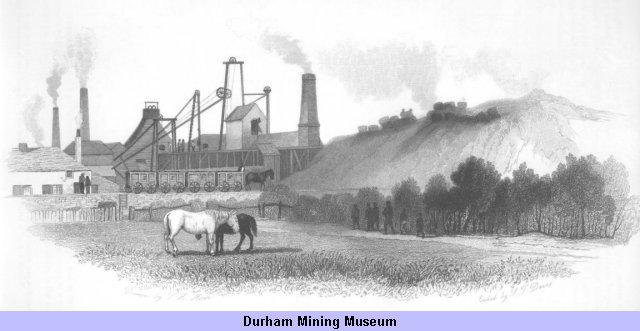
Wideopen Colliery
 The hamlet of Wideopen01 is about 5½ miles north from Newcastle, in the parish of Long Benton. The colliery is situated on the east side of the great north road, and is worked by Messrs. Perkins and Thackrah. Sinking was commenced here in April, 1825; and the first coals were drawn in May, 1827. There are two shafts, contiguous to each other, for the drawing of coal, and another for the pumping engine. The depth to the High Main seam, which here averages 3 feet 10 inches in thickness, is 80 fathoms. This is the only seam yet wrought here; but, 25 fathoms below it, the next seam is 3 feet thick. A boring was made from the High Main to the Bensham seam, which is here 76 fathoms lower; but its thickness was found to be only 10 inches of good coal, and consequently not workable. The working engines are of 18 and 24 horse power respectively; and the pumping engine is 74 horse power. The screens are covered in, so as to protect the men and boys working at them from the weather; and they are lighted at night by gas, for which purpose a neat gasometer has been constructed near the pit. In addition to the workshops usual at collieries, here is a saw-mill worked by a steam-engine of 6 horse power. The waggons used here and at Fawdon colliery differ from those at other places in size and shape, each containing only half a chaldron, and being rectangular in form. The total length of railway from the colliery to the Tyne, near Percy Main estate, is 9¾ miles 193 yards ;02 and there are five standing engines upon it; but there are also several locomotive engines used. The coals are called in the market "Perkins' Wallsend;" and the following are the arrivals in the Thames :—
| Ships. | Tons. | Shipping Prices. | ||
| In 1836, | 58 | 19,619 | 10s. 6d. | |
| In 1837, | 49 | 16,214 | 9s. |
01 On October 10, 1829, a large fossil tree was discovered in a grindstone quarry at this place, at a depth of 42 feet from the surface." This immense fossil measured, in its whole length, 72 feet, and followed a bed or parting of the stone, lying nearly at right angles with the dip of the strata, which is a little to the southward of east, Its direction was nearly north-east and south-west, the lower end being towards the north-east. It tapered gradually from the bottom, which was 4 feet 9 inches, to the top, which was 18 inches in breadth. The substance of the fossil, where the wood was perfectly petrified, was of a siliceous nature, and of a brown colour, having well defined crystals of ferruginous quartz, in cavities interspersed through it, and differing entirely from the surrounding mechanical deposit of sandstone. A few fine veins of white quartz, approaching chalcedony, passed through the substance of the fossil longitudinally. A thickness of 30 feet of solid stone had been worked away before it was discovered, which was at first accidentally, in the operations of the quarry. The Rev. R. H. Brandling, at considerable trouble and expense, caused it to be laid open to its full extent, with the greatest care; and he also caused a drawing of it to be made by an artist, before any attempt was made to move it from its bed.
"When that portion of the stone which covered the fossil was carefully removed, there appeared a dull black carbonaceous substance, soft and wet, and which soiled the fingers; this completely enveloped the whole fossil, and was a little more than an inch thick, but without any markings upon the surface indicative of the bark or outside of the plant. Beneath this was a layer of a bright ochrey yellow substance, also soft and wet, but which, when undisturbed, shewed marks of the woody fibre. These two substances coated the whole of the fossil, but never intermixed. Beneath the yellow matter was the petrified wood; and when the double coating was removed, so complete was the likeness of the fossil to the trunk of a decayed tree, that any one would have been tempted to try it with a knife. — It may be observed, that the cavity in which the fossil lay was never circular, but had one diameter longer than the other, apparently from compression. There was also frequently an empty space between the upper side of the fossil and the covering of stone, as if from the shrinking or diminution of bulk in the tree.
"It is difficult to account for the strongly marked difference of colour in the two enveloping substances, unless we suppose the black to have been the bark, and the yellow to have arisen from the decay of p art of the woody fibre, before the slow petrifying process, by which the siliceous particles were substituted for those of the wood, had time to operate. It is probable the outer part all round, as well as portions of the whole tree, had been in a state of decay before it was deposited where we now find it; as the whole of the fossil, for six feet in length at the lower end, was composed of the soft black and yellow substances, just described; the black always forming the outer coating only, and the yellow being substituted for the entire woody part. Where this occurred, the compression was very great, the breadth being at the lowest part 4 feet 9 inches, whilst the perpendicular thickness was only 9 inches. The higher end of the fossil was also entirely composed of these substances, and very much flattened: in one or two places of the length, also, the woody fibre was almost entirely changed into them. No roots could be seen, nor any thing like branches, except the large knots (whence they had sprung). The greatest diameter of the petrified part was about two feet. In attempting to move it, notwithstanding every possible care and anxiety to preserve it whole, it fell to pieces, so that the largest fragment obtained is not above 18 inches long, and displays little more than half the diameter of the fossil.
"Many impressions of Calamites occur in the sandstone of this quarry; and it is worthy of observation that their whole substance is composed of the same kind of black powdery carbonaceous matter which covered the outside. A thin seam of coal occurs immediately under the sandstone, and about 7 feet below the bed of the fossil." — Fossil Flora, vol. i., Art. Pinites Brandlingi. [Return]
02 An idea of the quantity of ground covered by waggon ways in this district may be formed from the fact, that the content of land damaged by the railway in question is stated at 75 A. 1 R. 27 P. [Return]





 Contains public sector information licensed under the

