


|

|

|

|
|
 |
 |
|||
Coxlodge Colliery
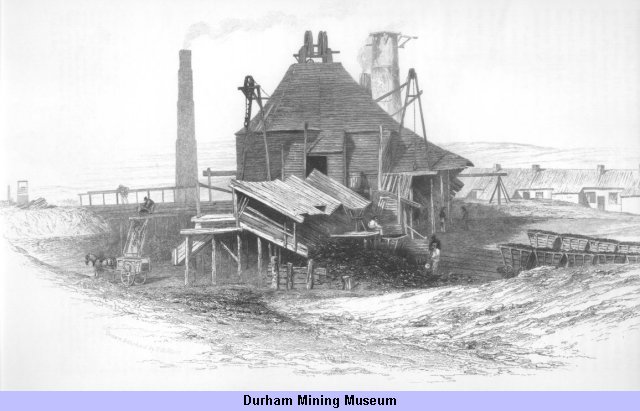
The Jubilee Pit, Coxlodge Colliery
 The present Coxiodge Colliery01 is situated about three-quarters of a mile west from that of Gosforth, and in the north moiety of Coxlodge township. The royalty of the whole township belongs to Ralph Riddell, Esq., of Felton; and the colliery is wrought by the Rev. R. H. Brandling and partners.02 The Jubilee Pit, so called in commemoration of the jubilee held on George III. attaining the 50th year of his reign, is 68 fathoms deep; and the Regent Pit, named in honour of the Prince of Wales, afterwards George IV., is 92 fathoms.03 The same seam of coal, the High Seam, is wrought here as at Gosforth; being further to the rise, it averages from 4½ to 5 feet thick, and is of excellent quality. An explosion occurred here on July 9, 1821, by which one man lost his life. The waggon-way from hence joins that at Gosforth, whither the waggons are drawn by horses. An attempt was made, on September 2, 1813, to establish a locomotive engine on this railway, the following account of which appeared in the newspapers of the time :—
"An ingenious and highly-interesting experiment was performed in the presence of a vast concourse of spectators, on the railway leading from the collieries of Kenton and Coxlodge, near Newcastle, by the application of a steam-engine, constructed by Messrs. Fenton, Murray, and Wood, of Leeds, under the direction of Mr. John Blenkinsop, the patentee, for the purpose of drawing the coal waggons. About one o'clock the new invention was set a-going, having attached to it sixteen chaldron waggons loaded ith coals, each waggon with its contents weighing four tons or thereabouts, making altogether an aggregate weight little short of seventy tons. Upon perfectly level road the machine, so charged, it was computed, would travel at the rate of 3½ miles per hour; but, in the present instance, its speed was short of that, owing, no doubt, to some partial ascents in the railway. Under all the circumstances, it was very highly approved of, and its complete success anticipated. After the experiment was finished, a large party of gentlemen connected with coal-mining partook of an excellent dinner provided at the Grand Stand for the occasion, when the afternoon was spent in the most agreeable and convivial manner."
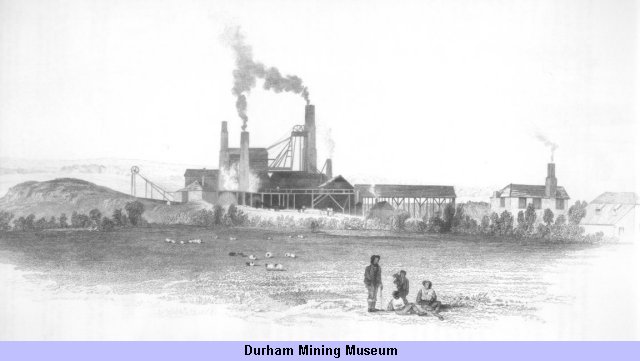
The Regent Pit, Coxlodge Colliery
The coals are called in the markets "Riddell's Wallsend," "Coxlodge," and "West Kenton." The following statements appear in the parliamentary document already referred to
| Ships. | Tons. | Shipping Prices. | ||
| In 1836, | 118 | 39,707 | 9s. 9d. | |
| In 1837, | 67 | 23,489 | 10s. |
01 This Colliery is a continuation of the old Kenton Colliery, remarkable for an undertaking at that period considered one of the most important in the district. This was a project for not only winning the colliery, but bringing the coals to the river Tyne by means of an underground drift, the distance being nearly two miles. The outlet was at Denton Burn, near to the Chain Bridge, and on its passage it drained the Denton Colliery. Although executed, it was found to be ineffective, inasmuch as it only cut in at the rise part of the colliery, — consequently an expense, which greatly exceeded the estimate, was in a manner thrown away. This was the production of a man who stood high in the coal trade of that clay as a colliery viewer, Mr. Chris. Bedlington. The drift was executed about the year 1770, and is to this day a water course drift for the old collieries of Denton and West Kenton.
It was at this West Kenton Colliery, whilst in the occupation of the late Graham Clarke, Esq., that an endless chain was attempted, wherewith to draw the coals; but it was a complete failure, and was discontinued. [Return]
02 A colliery was once attempted in the Fountain Close, a short distance from the Three-mile-bridge, on the north turnpike, and from the workings of which the water was procured with which, before the establishment of the Subscription Water Company, Newcastle was almost entirely supplied. Water had previously been brought to the town from Great Usworth Moor; but that being found inadequate, a lease for 227 years was granted by the corporation, in 1770, to Mr. Ralph Lodge and other proprietors, at an annual rent of 13s. 4d., "to dig and make a reservoir at the south end of the Town Moor, and to lay pipes for bringing water to it from the Coxlodge grounds, and from the reservoir into the town; also for supplying water for a certain number of fireplugs ordered by the corporation." An analysis of the various supplies of water about the town was made on this occasion, the results of which proved the purity of the Coxlodge springs, which was confirmed by Professor Black, of Edinburgh, and Dr. Sanders, an eminent chemist of London. The water is conveyed by pipes through the Coxlodge estate, and across the Town Moor, to what is still called "The New Water Pond." [Return]
03 A prominent feature in our views of these, as well as of some other pits, is formed by an ingenious contrivance called a counterpoise, necessary for aiding and regulating the power of the steam-engine in drawing the loaded corves up the deep shafts on the Tyne and Wear. "The plan is this :— a few yards from the drawing machinery, a pit is sunk for the reception of a ponderous chain, which, passing over a pulley elevated on posts, is attached to the shaft of the drum upon which the main rope winds. When the power of the engine begins to be exerted in raising the corves from the bottom of the pit, this chain, many of the terminal links of which weigh 100lbs., likewise exerts a degree of aid proportional to its weight. As, however, the engine acquires energy by the elevation of the loaded, and the descent of the empty corves, the ponderous links of the chain fall upon each other at the bottom of the counterpoise pit, until the engine, having raised its load to a position which leaves surplus power, the chain, being reversed on its drum, begins to be wound up, thus countervailing the velocity of the machinery at its maximum, as it had previously aided it at its stage of least efficiency." — Fossil Fuel, p. 203. [Return]





 Contains public sector information licensed under the

