


|

|

|

|
|
 |
 |
|||
Gosforth Colliery
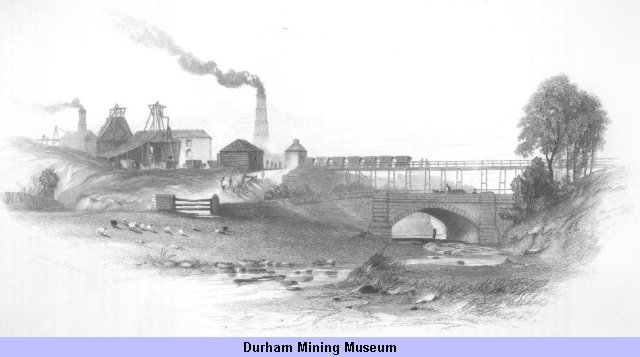
Gosforth Colliery
 This colliery is situated about 3 miles north from Newcastle, and on the west bank of a romantic dean, through which the Ouse Burn winds its way to the Tyne. The sinking was commenced in 1825; and coal was won on Saturday, January 31, 1829. Great expense was incurred in this undertaking, from circumstances which have given a peculiar character to the pit. The High Main coal was come to at 25 fathoms below the surface; but, near it, the seam was thrown down in an inclined direction, by a dyke,01 to the depth of 1100 or 1200 feet. Hence, the quality of the coal, where it was originally met with, was so deteriorated by the proximity of the dyke, that it was necessary to sink the shaft perpendicu larly to the depth of 181 fathoms, in order to come at the level of the lower range of the seam. In this operation, many of the succeeding seams of coal were passed, all more or less shattered by the dyke, and singularly placed at a higher level than the High Main, which, in a geological point of view, they underlie. On reaching the necessary depth, a horizontal drift, 700 yards long, was worked through the face of the dyke to the seam of coal, a little above its junction with the dyke. A great part of the above excavations was cut through solid rock.
This remarkable winning of coal was celebrated in a singular manner. On the 6th of February, a grand subterranean ball was given to the workmen and others. "The ball-room, which was situated at the depth of nearly 1,100 feet below the surface of the earth, was in the shape of an L, the width of which was 15 feet, base 22 feet, and perpendicular 48 feet. Seats were placed on the sides of the room, the floor was flagged, and the whole place was brilliantly illuminated with lamps and candles. The company began to assemble and descend about half-past nine in the morning, and continued to do so till one in the afternoon. Immediately on their arrival at the bottom of the shaft, they proceeded to the face, that is the extremity of the drift, where each person hewed a piece of coal as a remembrance of the descent, and returned to enjoy the pleasures of the ball-room. As soon as a sufficient number of guests had descended, dancing commenced, and was continued without intermission till three o'clock in the afternoon, when all ascended once more to the upper regions in safety, much pleased and gratified with the amusements in which they had partaken. The Coxlodge band was in attendance; and cold punch, malt liquor, and biscuits of all kinds were in abundance. There were present between 200 and 300 persons, nearly one-half of whom were females ! ! !"02
The seam of coal, where it was first met with, had a rise of nearly 12 inches in a yard, down which the corves are conveyed on self-acting inclined planes; but, further on, the workings gradually become more level. The seam, which is of the first quality of Tyne coals, averages from 4 to 4½ feet thick; and the workings are not much incommoded with foul air. The coal on the south side has been worked out at a former period. To expedite the drawing of the corves, there are two shafts, contiguous to each other, each having a machine of 50-horse power; besides which there is a pumping-engine of 150 horse power. The waggon-way to the Tyne is about 3½ miles in extent; and the waggons are drawn thither principally by fixed engines.
The colliery is the property of the Rev. R. H. Brandling.03 The coals are called, in the London market, "Gosforth Wallsend." The following are the arrivals in the Thames in the specified years
| Ships. | Tons. | Shipping Prices. | Market Price. | ||
| In 1836, | 127 | 44,037 | 10s. 0d. | ||
| In 1837, | 124 | 42,307 | 10s. 6d. | 22s. 6d. |
01 This is called, in contradistinction to all the other dykes in the district, "The Main Dyke." It was first discovered at Stella Grand Lease Colliery, and has been successively traced through Denton, West Kenton, Gosforth, Killingworth, Backworth, and thence into the German Ocean, previous to which it is split into branches. It is owing to this dyke that the High Main seam is found at all in the collieries of Gosforth, Coxlodge, Fawdon, Wideopen, &c. [Return]
02 Sykes's Local Records. [Return]
03
The Brandling family, formerly of Felling Hall, in the county of Durham, have long held a distinguished place in this district for gentlemanly urbanity and extensive hospitality. A quaint play upon the name inserted on the monument of Robert Brandling, Merchant Adventurer, in the old church of All Saints, Newcastle. Beneath the representation of a burning brand, was inscribed, —
"Like as the brand doth flame and burn,
So we from death to life do turn."
[Return]





 Contains public sector information licensed under the

