


|

|

|

|
|
 |
 |
|||
Wallsend Colliery (cont.).
 That disasters from fire-damp have been of too common occurrence at Wallsend colliery, may be gathered from the following extracts from the "Local Records" of that indefatigable and accurate collector, the late Mr. John Sykes
"October, (1782.) — An explosion of gas took place in Wallsend colliery, by which one man lost his life. The coal being set on fire, the colliery was drowned up to extinguish it."
"November, (1784.) — An explosion took place in Wallsend colliery, by which three men lost their lives. Another explosion occurred in December, when two men lost their lives. These explosions were supposed to have taken place at the spark of the steel mill, by the light of which the people were working in the shaft. The bodies were not recovered for several months. In repairing the shaft after these explosions, the mode of throwing the rays of the sun down a shaft by a mirror, so as to light it, was accidently discovered in the following manner :— while the people were working in the shaft, at about 80 fathoms from the surface, a carpenter was employed to do something at the head framing immediately above the mouth of the shaft, and in using his saw, he turned the bright blade of it accidentally, so as to throw a pencil of the sun's rays suddenly down the pit, to the great terror of the workmen below, who thought the pit had fired again. The cause of their alarm being, however, soon discovered, it suggested the idea of applying a mirror to throw the light of the sun down the shaft, which mode of lighting has since been frequently resorted to when other lights could not be used."
"June, (1785.) — An explosion occurred in Wallsend colliery, by which one man lost his life. This was the first explosion which was distinctly known to have taken place at the steel mill. Some doubt remained up to this time as to whether the fire-damp would explode at the spark of the steel mill or not; but the fact was clearly ascertained on this occasion, as the person, John Selkirk, who was 'playing' the mill at the time, survived the accident."
"December, (same year.) — An explosion took place in Wallsend colliery, by which unfortunate accident two men lost their lives."
"April, (1786.) — An explosion took place in Wallsend colliery, by which unfortunate event six human beings lost their lives."
"October, (1790.) — This month an explosion took place in Wallsend colliery, by which unfortunate occurrence seven human beings lost their lives."
"September 25, (1803.) — An explosion took place in Wallsend colliery, by which unfortunate circumstance, thirteen individuals lost their lives."
"August 5, (1818.) — An explosion of inflammable air took place in Wallsend colliery, by which four men lost their lives. This is the only explosion that has been known to have happened at the Davy lamp. It occurred as follows :— Two men and two boys were working in an explosive mixture. One of the men extinguished his Davy in trimming it, and sent one of the boys to the 'stationary' light, in a safe part of the mine, to get it relighted. The boy returning with it in haste, fell when near to the man to whom he was carrying it, and falling with the lamp upon the corner of a cast-iron tram-plate, burst a hole in the wire gauze cylinder of the lamp, and the explosion instantly took place. The man survived a few hours, and told Mr. Buddle the circumstance, who took up the Davy on the spot where the boy was killed, and found it in the state described."
"October 23, (1821.) — A dreadful explosion took place in Wallsend colliery (Russell's), by which fifty-two men lost their lives. The explosion shook the ground like an earthquake, and made the furniture dance in the surrounding houses. This alarming the neighbourhood, the friends and relatives hurried to the spot, when a heart-rending scene of distress ensued. The greatest exertions were instantly made by Mr. Buddle, the viewer, who, as soon as it was practicable, descended with his assistants, when a most melancholy scene presented itself. At the time of the explosion there were fifty-six men in the pit, of which number four only survived. The bodies of the deceased were most dreadfully scorched, and many of them most strangely distorted. Forty-six of the bodies were buried at Wallsend, fourteen of whom, being relations, were buried in one grave; some of the remainder were buried at the Ballast-hills, and some at Wallsend old church, amidst sorro wing spectators."
This catastrophe occurred in the Bensham seam, in the first year of its being worked, and was the cause of the additional precautions for ventilation above alluded to. The best proof of the efficiency of those precautions is the fact, that, during fourteen years, this fiery seam was worked without accident. On the afternoon of Thursday, June 18, 1835, how. ever, the most fatal explosion of hydrogen gas took place here that had ever occurred in Northumberland, and by which one hundred and one men and boys lost their lives, and four others were seriously injured. Eleven horses also, which were in the pit at the time, were all killed. At that time, about two hundred and fifty individuals were employed at the colliery. The hewers commenced working early in the morning; and having finished getting the coal, it was, as is customary, left to be brought to the bottom of the shaft by the young men and boys during the day, and hence a great proportion of the sufferer, were of that class. The pit had been examined in the morning by the viewers, and was then considered perfectly safe, there being no indications of any extra escape of gas; and, at the time of the explosion, there were four overmen and deputies down, who had been accustomed to work in the pits for upwards of thirty years, but who were now amongst the sufferers. Two men were working in another shaft at the time, and felt a shock, and a quantity of after-damp; but they happily escaped by being drawn up immediately. The banksman at the Church Pit shaft was first apprized of the explosion by a loud report, accompanied by a rush of after-damp to the mouth of the pit, which carried his hat from his head over the pulleys. Eight men immediately volunteered to go down, in the hope of rescuing some of their unfortunate fellow-workmen; but, on descending, they were so nearly overpowered by the impure air, that it was with extreme difficulty that they regained the ropes, and were almost insensible when drawn to the top. The alarm in the village and neighbourhood was extreme. Mr. Buddle, with assistants, went down the C Pit; but the workings were found in so ruinous a state, that many tons of rubbish had to be brought to bank before the bodies could be come at. In the afternoon of the following day, the bodies of two men and nineteen boys were got out. Some of them were black, shrivelled, and burnt; some were mutilated; but the greater number, having been suffocated by the after-damp, had the appearance of being in a profound and tranquil sleep. In the evening, a coroner's inquest was commenced, which was continued at intervals till Monday the 29th. Much interesting information was obtained as to the general state of the workings of the mine, and the evidence of Mr. Buddle on that subject gave universal satisfaction; but no circumstance was elicited which could in any way account for the calamity, and the inquest terminated in the following verdict :— "We find our verdict to be Accidental Death, arising from an explosion of inflammable air; but how, or in what part of the mine it originated, there is no evidence to shew. In recording the verdict, the jury must express their full conviction, that there has been no want of due care and precaution on the part of those who have the direction and management of the mine."11
In the mean while, the most unceasing and laudable exertions were made by the pitmen, not only of this but of other collieries, in descending the mine to recover the bodies of those who had perished. Instead of timidity or hesitation, the competition amongst these heroic men seemed to be which should go first.12 it was found that the force of the explosion had blocked up the passages with rubbish, otherwise the greater proportion of those below might have escaped; but their flight being thus impeded, they were overtaken by the deleterious after-damp13 About ten o'clock on the evening of Saturday the 20th, three men and a boy were brought up alive. They were all more or less burnt, and the intellects of two of them appeared to be deranged. Though they had been under ground, at a depth of 145 fathoms, for 65 hours, 56 hours of which they had literally been entombed alive, yet they did not appear to have suffered from hunger. One of them, whose leg it was found necessary to amputate, died on the 3rd July following, and is included in the annexed summary :—
| Total number of men and boys dead | 102 |
| Remaining alive | 3 |
| 105 | |
| Women deprived of their husbands | 17 |
| Widowed mothers deprived of their sons | 8 |
| Number of children under the age of 14 left fatherless | 48 |
| Total left unprovided for | 73 |
On Sunday, June 21, crowds of people repaired to Wallsend to witness the funerals of those whose bodies had been recovered. On the following day, the entire vicinity of the mine presented an appearance indescribably agonizing. The little communities around the northern collieries generally intermarry amongst each other, and thus become connected by the ties of relationship. Hence, scarcely a house could be found in the place in which the calamity was not felt, or an individual who had not lost some friend. In the afternoon, about sixty bodies were conveyed in carts to the parish church for interment. A black pall was, in each instance, thrown over the coffin. In some cases, three were taken from one house. The coffins were furnished by the owners of the mine, who also contributed £1 in addition for the interment of each body.
It was afterwards ascertained, in the course of exploring the mine, that the explosion did not take place in any of the working districts, nor at a Davy lamp. The first southwest district in the Church Pit had long been worked out, and gas had consequently accumulated in it, which was conducted by a pipe-drift to the up-cast shaft. At the time of the accident, two men were employed in blasting down a stone roof for a rolley-way adjoining the drift, and communicating with it by a door. From the situation in which one of their bodies was found, there can be little doubt that he had either opened this door, and fired the gas with his candle, or that he had approached so near, that the gas, oozing through the crevices, had ignited at the candle, and, like a train, fired the whole of the inflammable air in the pipe-drift, and thereby caused the explosion.14
The waggon-way from the C Pit to the banks of the Tyne is above half a mile in length. From the Church Pit, which is near the river, the waggons are transmitted to the staith by means of an inclined plane. The staith itself, represented in our view, is, like many others which fringe the steep shores of the Tyne between Newcastle and Shields, a lofty and strong timber framing projecting into deep water. At its extremity is fixed the drop, consisting of a square frame hung upon pulleys, and counterbalanced by back weights. The loaded waggon, together with the square frame, descends by its own gravity to the hatchway of the vessel, delivers its coals, and, in turn, the empty waggon is returned by means of the balance weights, the motion being in both cases regulated by a brake wheel. A man is lowered down with the waggon, whose business it is to unhasp its moveable bottom, and thereby let the coals drop into the hold of the vessel.15
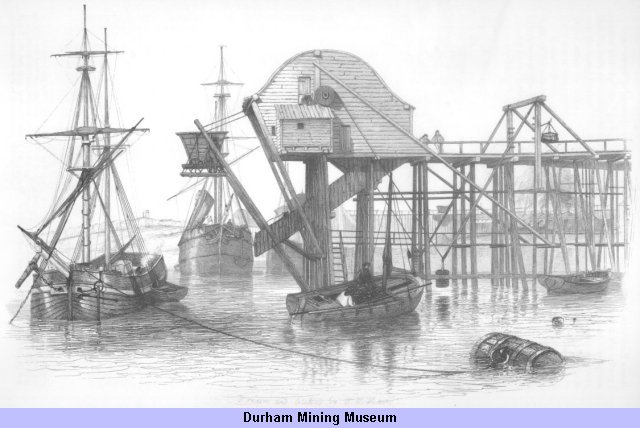
Drops at Wallsend
A "spout" is generally attached to these staiths, by which keels and other small vessels receive their ladings In such cases, the waggon is emptied over a hole in the railway; and the coals are suffered to run down the spout, which is at an angle of about 45 degrees, into the vessel beneath; the force of their descent being broken by traps or hanging doors, placed across the inside of the spout. Brand says, "When a waggon lets fall its contents down one of these spouts, the noise at a distance very much resembles a clap of thunder."16
It is said that a quay of Roman masonry was formerly discovered here, as well as remains of the causeway which led from the station to it. A few years ago, in digging the foundation of Fawdon staith here, about 200 yards from the Roman station, a bath was discovered by the river side, so constructed as to let in the salt water at spring tides. From these circumstances, it has been inferred that at the precise spot resorted to by the vessels of the Romans 1600 years ago, the "colliers" of the present day are moored to receive their lading. Our view comprises a laden Scottish ship at the staith, and a French vessel waiting her turn.
The following statement of the number of ships and quantities of coals which arrived in the London markets from Wallsend during the specified years, is drawn from a parliamentary report, ordered to be printed June 13, 1838
| Ship. | Tons. | Shipping Prices.17 | Market Price. | ||
| In 1836, | Bensham Wallsend, | 1 | 318 | 8s. 6d. | |
| Bensham Main, | 93 | 15,519 | 7s. 9d. | ||
| 94 | 15,837 | ||||
| In 1837, | Bensham Main, | 84 | 13,003 | 7s. 9d. | 16s. 6d18. |
11 In summing up, the coroner observed, "Gentlemen, this unhappy occurrence which has taken place, might any day, any instant of time, for these last fourteen years past, have happened; and can it therefore be said that Providence has been unwatchful of the lives of the numerous individuals who have gained their bread in this perilous employment? For reasons of infinite wisdom, inscrutable to the human mind, it has been suffered to take place. The fiat went forth, and one hundred human beings have instantly been swept away from the face of the earth. But are we to suppose this awful visitation will pass away without any ultimate benefit? May it not be the means of leading to investigation in the highest quarters? Men of science and learning will devote their thoughts, their energies to the enquiry; and who dare deny that the same Providence that so long arrested, and has now willed the deplorable event, may direct some superior individual, whose gigantic mind may successfully grapple with the latent foe, and generations yet unborn look back with gratitude to the cause of future protection. Thus good may spring out of evil." Sincerely do we participate in the aspiration. [Return]
12 While speaking of the self-devotion which ever characterizes the pitmen of the north in times of danger, it would be unpardonable not to do them justice in regard to another trait of character, not so imposing perhaps, but not less truly estimable: we allude to the calm spirit of filial duty which actuates almost every young man amongst them, inducing him to contribute his utmost to the support and comfort of a mother, when the head of the family is unfortunately snatched away. A sense of this truly amiable feeling seems to have inspired the following beautifull ines, entitled, "The Pit-boy's Address to his Mother," which have been set to music by Mr. Topliff, of London :—
| The sun is sinking fast, mother, | My father's voice I hear, mother, |
| Behind the far Clee hills: | When o'er his grave I tread: |
| The signal-bell has ceas'd, mother, | He bid me cherish thee, mother, |
| The breeze of evening chills. | And share with thee my bread. |
| They call me to the pit, mother, | Then, while I see thee smile, mother, |
| The nightly toil to share: | My labour light shall be; |
| One kiss before we part, mother, | And should his fate be mine, mother, |
| For danger lingers there. | Then heaven will comfort thee. |
13 The humane conduct of one of the sufferers, a deputy-overman named Lawson, has been justly recorded. He and eight boys had been working in one of the dangerous parts, about 500 yards from the pit shaft. Within 160 yards of this point of escape they were all found dead together. In front of the body of Lawson were six of the boys; on each side of him was one of the youngest; and near them were the Davy lamps which the boys had used. The obvious conjecture is, that poor Lawson had been attending to his duty, — the explosion in a distant part of the mine had alarmed him, and disdaining to leave his young charge exposed to danger, he had hastily collected the lamps, hurried the six older boys before him through the mine, and taking each of the lesser boys by the hand, had travelled till the after-damp terminated at once their progress and their lives. [Return]
14 Nearly the whole of the above particulars relative to this accident, have been collected from "An Account of the dreadful Explosion in Wallsend Colliery," &c., by John Sykes, dedicated by permission to John Buddle, Esq. [Return]
15 This apparatus is called "a drop." It was the invention of the late ingenious Win. Chapman, Esq., of Newcastle, who took a patent for it about the year 1800; but, like many of the inventions of ingenious men, it was for nearly all the fourteen years of the patent-right treated as a gewgaw. No sooner, however, was one of them erected at the staith of Coxlodge Colliery, than its utility in the saving of breakage became so apparent, that it has sinco been universally adopted throughout the trade; but without the inventor being adequately remunerated. [Return]
16 The keelmen of the Tyne have often complained of the navigation being interrupted by the staiths below bridge; though the real cause of complaint, perhaps, was the dread of their own occupation being superseded by the majority of vessels loading at the staiths. "August 11 (1824)," says Sykes, "the cause so very interesting to Newcastle and its neighbourhood — Rex versus Russell and others, proprietors of Wallsend Colliery, was tried at York before Mr. Justice Bayley and a special jury. It was in form an indictment for an alleged nuisance in obstructing the navigation of the river Tyne, by erecting at the termination of the colliery railways, staiths or spouts for conveying coals directly from the waggons into the ships. Mr. Brougham was counsel or the keelmen, who were the real prosecutors; Mr. Scarlett for the defendants. A great number of witnesses were in attendance, but only 17 were examined on the part of the prosecution. No witnesses were called for the defendants, who obtained a verdict of not guilty, which was returned in three minutes by the jury. The case lasted twelve hours. This cause was again tried, August 14th and 15th, 1828, at Carlisle, before Mr. Baron Hullock and a special jury. Mr. Brougham was again counsel for the prosecution, and Mr. Scarlett for the defendants. The latter did not call a witness. The jury, after a consultation of four hours, returned the following singular verdict :— We find that part of the navigable channel of the Tyne, opposite to Wallsend, has been straitened, narrowed, lessened, and obstructed by the gears described in the indictment; but we find, nevertheless, that the trade of the town of Newcastle, and the harbour of the Tyne, has at the same time greatly improved." [Return]
17 Including 3d. per ton for spoutage. [Return]
18 The total arrivals of sea-borne coals in the port of London were —
| In | 1836, | 8,162 | ships, | 2,398,352 | tons. |
| 1837, | 8,720 | 2,626,997 |





 Contains public sector information licensed under the

