


|

|

|

|
|
 |
 |
|||
The Collieries
of
Northumberland and Durham
Wallsend Colliery.
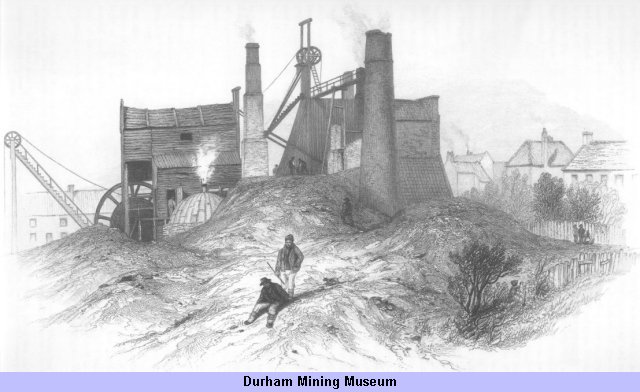
Air Shaft, Wallsend
 We commence our series with views of the collieries at Wallsend ;— a spot famous in antiquity, and still more famous in modern times. We need scarcely remind our readers that the village of Wallsend derives its name from being the undoubted site of the termination of the vallum or wall erected by the Roman emperor Hadrian, A.D. 120, and fortified and strengthened by Severus, nearly a century afterwards. The colliery occupies a field a little to the east of Carville Hall, commonly called by the inhabitants the "Well Laws," or, more properly, the "Wall Laws;" signifying the Wall Hill. This station, of which, in Dr. Horsley's time, there were "distinct traces of the ramparts, and evident remains of three turrets at its western, eastern, and southern corners," appears to have been 140 yards square.01 Here, at the eastern extremity of that immense fortification which defended the Roman conquests from the inroads of the indomitable Caledonians, the "masters of the world" fixed one of their most important stations; and here were employed the hands, of which it is no disparagement to say, that they could wield with equal effect the sword and the mason's hammer.02 This station was garrisoned by a cohort of the Lergi, and included a temple to the goddess Diana. But "sic transit gloria mundi." The name of Segedunum is now merely a matter of history, or rather of antiquarian research. The shrill trumpet of the Roman legion no more re-echoes through its valleys. No more does the heathen priest present his offerings to the gods of his comprehensive and poetical mythology. The tide of Saxon conquest, and the torrent of Danish devastation, have successively rolled over the spot, tending to obliterate in their sweep the vestiges of its former lords; the hand of modern innovation has completed the change; and the airy, pleasant, and quiet village of Wallsend overlooks the site of revolutions which are identified with the fate of empires03 Instead of the pagan altar, the Christian church rears its heaven-pointed spire ;04 or the more humble Dissenting chapel receives its pious worshippers; while the only tocsin heard is the lonely cry of the "caller," arousing the sleeping collier to his stated labour.05
But though the military glories of Segedunum are no more, a reputation of, we believe, a more enduring, because of a more useful character, has been achieved for its site. Its mineral treasures have achieved a celebrity which has extended itself, during later generations, to regions —
"Where Roman eagles never flew."
The winning of the colliery at Wallsend, about 60 years ago, was attended with great expense and difficulty, owing to the then imperfect state of machinery as applied to such purposes. So discouraging, indeed, did the prospect appear, that the ancestor of the present proprietor, William Russell, Esq., after embarking in it, took measures for abandoning an enterprize which was destined afterwards to constitute one of the chief sources of his princely fortunes. The high main seam, however, was found throughout the property nearly six feet thick, of the most unexceptionable quality, and under the most favourable circumstances as to mining. Owing to the far-famed prosperity of the colliery, the designation of "Wallsend coal" has continued for many years a passport to the quickest sale and the highest prices; and though the above-mentioned high main seam, which originally obtained this celebrity, has long been worked out, the appellation is still considered advantageous in the recommendation of coal.06 Indeed, this favourite and important cognomen has been assumed with respect to the coals shipped from the Wear, the Tees, and other districts both in England and Scotland. To distinguish the coal sent from the colliery now under consideration, it was for some time called "Russell's Wallsend." It is now, however, termed in the coal certificates, "Bensham Wallsend," and "Bensham Main."
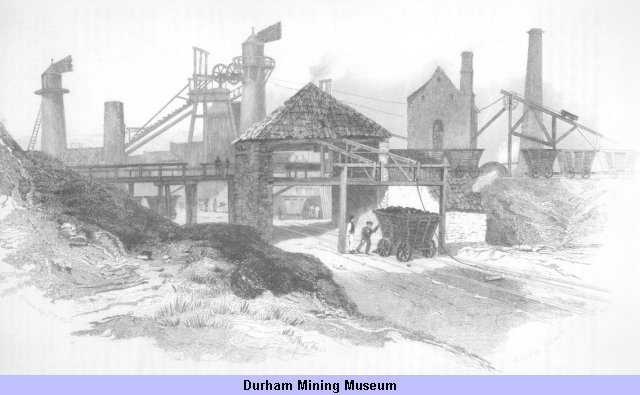
The Church Pit, Wallsend
The view of the "Church Pit," so called from its vicinity to the parish church, comprises nearly all the peraphernalia of an extensive colliery. On the railway in front, the efficiency of that mode of transmission is exemplified by the fact of a ponderous waggon full of coals being moved on a gentle incline by the hand of a single individual. A railway from another colliery crosses the above by means of a wooden bridge, illustrative of the numerous intersections and junctions which occur amidst the varied ramifications of the colliery district. Behind, and in the centre, is the "shaft-frame," supporting the pulleys which overhang the pit. Over these wheels the ropes are passed by which the men, corves, &c., are lowered or raised to or from the bottom of the mine. Contiguous is a lofty brick chimney or funnel, attached to the upcast shaft, and having a smoke disperser at the top, through which the impure air from the workings of the pit is ejected. The railed platform near the top is used for cleaning or making repairs in the chimney. On the right is the engine-house, containing the machinery for working the ropes; and close adjoining are the boilers, &c., wherein is generated that immense power which raises all the produce of the pit to the surface.
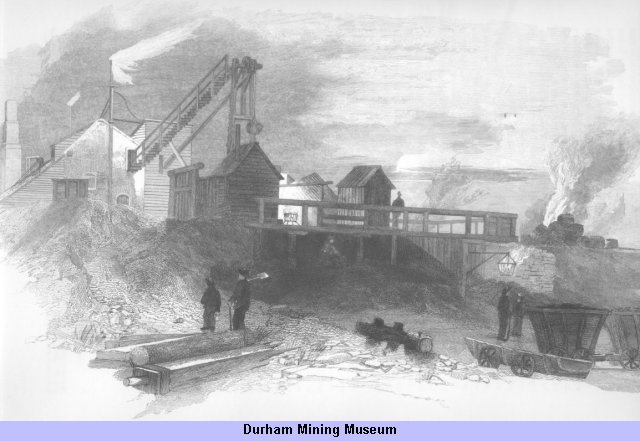
Wallsend Colliery
At the C Pit, belonging to the same colliery, and represented in our second view, is seen a practical display of that fearful agent which has so often hurled the miner into the presence of his Maker, and surrounded by which he pursues his avocations. By a four-inch metal pipe, the carburetted hydrogen gas is conducted from the bottom of the pit, and consumed by ignition. It may here be observed, that, generally, the discharge of gas from coal is slow and imperceptible; but when met with in the shape of "blowers," issuing from chinks in the roof, or fissures in the face of the coal, it rushes into the workings in a stream of more or less violence, and with a noise in some instances like the letting off of steam. In ordinary cases, these "fizzers," as they are called by the pitmen, excite little apprehension,07 and are suffered to evaporate of themselves. Sometimes, however, the gas is emitted in such considerable quantities, and so continuously, as to overpower the atmospheric air and occasion explosion. To return to this special case, however, the vast evolution of gas here consumed is derived from an insulated portion of coal strata, of about five acres in extent, and is carried, by means of the pipe above mentioned, to the top of the head gear, where it burns with the utmost fury. This dreadful oriflamme waves its fierce streamers in the wind to the extent of eight or nine feet of flame; and its sound is like the roaring of a blast furnace, it has been computed that the quantity of gas drawn off from the mine, and consumed by this means, is eleven hogsheads per minute! amounting to the enormous quantity of 15,840 hogsheads per day!! Were this volume of gas suffered to pass through the workings, instead of being discharged by the pipe, it would require from 150 to 160 hogsheads of atmospheric air per minute to dilute it below the firing point, so as to admit of its being safely carried through the fire of a furnace. It was observed by Mr. Buddle, in his evidence relative to a late disastrous explosion, that, had it reached this part of the workings, the effect would have been similar to that of an earthquake, and the whole village of Wallsend might have been shaken. It is remarkable that the direction of the wind, and the state of the atmosphere, should influence so vast a subterranean gasometer; but it has been observed that the emission is most violent when the wind is from the south-east, and the barometer is low. Even in the day-time, it presents a spectacle of wonder to the passenger; but, in the night, the intense light thrown out by the flame illuminates the adjacent fields and scenery, and may be seen at a considerable distance. Our artist has chosen to represent it thus, casting its brilliant gleams on the dark objects around, and lighting the adventurous miner to the shaft which must place him in close proximity to the fearful laboratory of fire. The moon rising in the east throws but a partial ray over the scene.08
In Casson's Plan of the Collieries of the Tyne and Wear, the depth of Wallsend colliery is stated at 630 feet; but, according to Mr. Buddle, the present depth to the lowest workings of the pit is between 140 and 150 fathoms from the surface. Next below the high, or main seam, is the metal coal seam, three feet thick, which has been very partially worked; beneath is the low main; and the lowest, or Bensham seam,09 which was first opened in 1821, is now in course of working, being about five feet six inches in thickness from the roof to the floor. A stone band runs through it, exactly two feet ten inches from the roof, and which thickens towards the west from a mere parting of the coal, about an inch thick, to about fifteen inches in thickness. Previous to the explosion in the Bensham seam in 1821, only one pit had been sunk to that part of the workings; but that disaster having shewn the necessity of increased ventilation, the pit was laid in until other shafts were sunk, of which there are now five used in ventilation; three of them being down-cast and two up-cast.10
01 "Here have been found a wall composed of Roman bricks, a fibula, some Roman tegulae, and coins, a ring, &c. ; immense quantities of bones, horns and teeth of animals that had been sacrificed; also stones with inscriptions, and Roman hand-mill stones, by which the soldiers ground their corn. A very curious piece of Roman pottery found here was in the possession of the late Hugh Hornby, Esq., alderman of Newcastle. It was afterwards in the possession of William Chapman, Esq., of Newcastle, who presented it to the Antiquarian Society of that town." — Sykes' Local Records, vol. i., p. 2. [Return]
02 "The magnificent vestiges of the Romans in Britain evince their unrivalled skill, industry, and discipline. Their veterans were no less famed for their knowledge and assiduity in architecture and sculpture, than for their valour in the field, for they fought and laboured with equal skill and vigour. It is much to be regretted that this wise policy should have been abandoned by the modern nations of Europe, who now, in times of peace, support in idleness many hundred thousands of soldiers, who might be usefully employed in public works, for the safety, defence, or convenience of their countrymen and themselves." — Parson and White's Directory, vol. ii., p. 142. [Return]
03 The Roman town seems to have stood on the south-west side of the fort, within the wall. The present village of Wallsend is more than a mile to the north-east of the "station" at the end of the wall, and on the outside of it. The house of John Buddle, Esq., with the colliery stables, store-houses, granary, and raff-yard, are built within the quadrangle of the fort. [Return]
04 A former church stood on a little eminence to the north-east of the village; but, having been long in dilapidated state, it was taken down, and the present edifice erected on the south side of the turnpike road between Newcastle and Shields. The foundation stone was laid November 10, 1807; and the edifice was consecrated April 27, 1809, by Dr. Burgess, lord bishop of St. David's, when an appropriate sermon was delivered by the Rev. Henry Philpotts, now bishop of Exeter. The ceremony was imposing and numerously attended. [Return]
05 There is something solemn in the nocturnal appeal of this functionary at the door of each house. It is generally in some such form as the following :— "Robin W-i-n-s-h-ip, (the name drawled out,) up and to wark i' the neame o' God, hinny." [Return]
06 The "Wallsend," or best Newcastle coal, kindles easily; in burning, it cakes or runs together, but not to such a hard solid mass as some other sorts, emitting, at the same time, a great deal of heat, as well as of smoke and flame; it leaves a small quantity of dark-coloured residuum or ashes. — History and Description of Fossil Fuel, &c., p. 339. [Return]
07 In some instances, the gas from the blowers has been collected in bottles by the pitmen, closed with clay, and afterwards lighted in their houses by making a small hole in the clay. [Return]
08 This method of consuming "fire-damp" was pursued many years ago in the pits at Workington and Whitehaven. The agent of the Earl of Lonsdale, indeed, at one period offered to supply the latter town with gas from the its. [Return]
09 So called from the first attempt to work it, in the neighbourhood of Newcastle, having been made at Bensham, about the year 1710 when an explosion occurred at that place, by which from 70 to 80 lives were lost. [Return]
10 Evidence of Mr. Buddle before a coroner's inquest, held June 22, 1835. [Return]





 Contains public sector information licensed under the

