


|

|

|

|
|
 |
 |
|||
Willington Colliery.
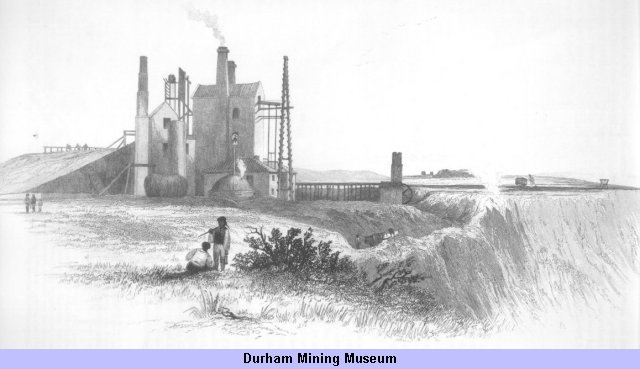
Willington Colliery
 This colliery is situated about a quarter of a mile east from the village of Wallsend. It was begun about 1806, and has been wrought by three shafts, including a water shaft to the Bensham seam. The shaft and engine represented in our view occupy the summit of an eminence overhanging a deep dean, through which a rivulet makes its way to the Tyne near Willington Quay.01 The shaft is 108 fathoms deep to the thill of the main seam, which is here six feet thick. The Bensham seam is 37 fathoms lower, and is expected to average at least four feet thick; though, where it has been won, it is of even more promising dimensions. For many years, however, this seam remained unworked; and an attempt to open it in 1831 was attended by a fatal accident. In sinking a staple from the High Main or Wallsend seam to the Bensham, an explosion of gas occurred, about nine o'clock in the morning of the 20th of September in that year, by which three men and eight horses were killed on the spot, and other fourteen of the men were severely burnt, four of whom afterwards died in consequence. The whole complement of men were in the colliery at the time of the accident; but the greater part were enabled to effect their escape by means of another shaft, up which they were drawn in time to save their lives. So great was the evolution of gas from the staple, that it was found necessary to arch it over in the manner of a gasometer, and, by a number of pipes, the inflammable air was, for a considerable period, conveyed "to bank," where it was consumed by ignition, in the same manner as at Wallsend. Such, however, have been the improvements effected in the ventilation of the pit, by the sinking of an additional shaft to the Bensham seam, and by other means, that the working of that seam is about to be resumed with increased vigour, and for which preparations are making on an extensive scale.
Besides the catastrophe above noticed, only two more are recorded to have occurred here. The first is narrated in Sykes as follows :— "Dec. 3, 1829, an unfortunate accident happened at Willington colliery, by which four men lost their lives by an explosion accompanied by a rush of water from some old workings." The other occurred on the morning of March 30, 1840, when three men and five boys were severely burnt, and one of the former died on the following day. The coals wrought here are not only abundant in quantity, but of the very best quality. They are called in the London market "Bell and Brown's Wallsend," from the names of the lessees of the colliery, who are also proprietors of the superincumbent estate, consisting of 297 acres. The working engine is of 50 horses' power. The colliery communicates with the staith by a waggon-way of about half a mile in length. The following is a statement of the quantities and prices of coals brought from this colliery into the London markets during the specified years, as given in the parliamentary document already quoted
| Ships. | Tons. | Shipping Price. | Market Price. | |
| In 1836, | 29 | 8,606 | 10s. | |
| In 1837, | 56 | 16,414 | 10s. | 21s. 3d. |
01 In this dean are a ropery and several manufactories, &c.; and an extremely curious and picturesque addition has been recently made to its other features, viz.: one of the timber viaducts of the Newcastle and North Shields Railway, erected from the designs of John and Benjamin Green, Esqrs. It consists of seven arches, five of 120 feet span each, and two of 115 feet each; the height from the dean to the roadway being 82 feet, and the entire length of the structure 1080 feet. [Return]





 Contains public sector information licensed under the

