


|

|

|

|
|
 |
 |
|||
Preliminary Observations (cont.)
 Until late years, coals were an article of import in the Tees. Now, however, by the formation of the Stockton and Darlington and the Clarence Railways, a large extent of coal-field has been rendered available for exportation from thence, being transmitted to staiths at the mouth of that river. Improvements have likewise been made in the ancient harbour of Hartlepool, long neglected, but once the emporium of the fleets belonging to the prince bishops of the palatinate of Durham. Thither, and also to Seaham Harbour, opened in 1831, railways have been extended from the centre of the county. Hartlepool and Seaham are considered members of the port of Stockton. In 1831, their united export was 161,123 chaldrons.
In a Parliamentary document, just published, the number of tons of coals and cinders exported from the north is thus stated :—
| Coastwise. — 1837. | Foreign. — 1837. | ||||||||
| Coals. | Cinders. | Total. | Coals. | Cinders. | Total. | ||||
| Newcastle | 2,385,192 | 7,302 | 2,392,494 | Newcastle | 471,150 | 5,007 | 476,157 | ||
| Sunderland | 931,944 | 191 | 932,135 | Sunderland | 242,252 | 211 | 242,463 | ||
| Stockton | 1,145,827 | 10 | 1,145,837 | Stockton | 46,407 | 109 | 46,516 | ||
| 1838. | Increase. | 1838. | Increase. | ||||||
| Newcastle | 2,453,235 | 6,503 | 2,459,728 | 67,234 | Newcastle | 545,972 | 8,203 | 554,175 | 78,018 |
| Sunderland | 948,388 | 41 | 948,429 | 16,294 | Sunderland | 307,828 | 340 | 308,168 | 65,705 |
| Stockton | 1,219,938 | 1,219,938 | 74,101 | Stockton | 86,535 | 164 | 86,699 | 40,183 | |
From the above it appears that the increase in the coal trade in the last named year, as compared with the preceding one, was 339,114 tons of coals, and 2,421 tons of cinders.
In his evidence before a Committee of the House of Commons, in 1829, Mr. Buddle stated his opinion that the aggregate capital employed by the coal-owners of the Tyne amounted to about £1,500,000, exclusive of the craft in the river; and it was conjectured that the capital employed on the Wear was little short of £1,000,000 Somewhat near an equal sum with the last has since been advanced on the various new collieries sunk in the southern parts of the county of Durham. The hazard attending this sort of property is so great, that it has never been possible to effect an insurance on a coal-work against fire, water, or any other accident. The gentleman just quoted, stated the number of persons employed in the coal trade as follows
| Colliers on the Tyne, under ground,09 men | 4,937 | Suppose 1400 ships, of 220 London chald. each, | |
| boys | 3,554 | in the trade, they will require, men and boys | 15,000 |
| above ground, men | 2,745 | Keelmen, coal-boatmen, casters, and trimmers | 2,000 |
| boys | 718 | In London, whippers, lightermen, &c. | 5,000 |
| In round numbers, say | 12,000 | Factors, agents, &c., in the Coal Exchange | 2,500 |
| Do. on the Wear | 9,000 | Persons similarly engaged at the out-ports | 4,500 |
| On the collieries of the Tees and Blyth | 5,000 | 29,000 | |
| 26,000 | To which add, colliers | 26,000 | |
| Total employed in the coal trade of the district | 55,000 |
In consequence of the progress of scientific knowledge, the "winning" of coal, even at greater depths than were formerly considered practicable, is now less a matter of uncertainty than when Grey wrote, that the ingenious Master Beaumont "within a few years consumed all his money (in mining adventures), and rode home upon his light horse." The first operation in new districts is "boring," the apparatus for which has been much improved of late: its object is to ascertain with precision the quality and thickness of each succeeding stratum. On the discovery of a seam of workable coal, the sinking of a perpendicular "shaft" is commenced, which is a work of considerable labour, difficulty, and danger. Immense feeders of water frequently rush into the works, which are also occasionally obstructed by quicksands. To counteract such contingencies, and to evade the direful consequences, "tubbing" is resorted to, or lining the sides of the shaft with water-tight segments of wood or cast iron.10 The materials are drawn up progressively, first by a windlass, and afterwards by a gin, or the more efficient power of a steam-engine. The expense of sinking and establishing collieries varies, of course, in different situations, from £10,000 to £100,000; but the average cost, including steam-engines, railways, staiths, and other appendages, may probably be taken at from £20,000 to £30,000.
In some cases, two shafts are sunk, for the purposes of ventilation, and for carrying off the gases of the mine; whilst, in others, a single shaft is used, divided from top to bottom, by a brattice of wood, into a "down-cast" and "up-cast" communication with the workings beneath. Near the bottom of the up-cast shaft or division a rarefying furnace is placed, for the purpose of producing a current of air throughout the mine, the down-cast shaft supplying the fresh air. This current is directed through the various ramifications of the pit by "stoppings" and "trap-doors." It will be obvious that the proper management of this department is of the most vital importance to the lives and health of the men employed in the pits. The quantity of air passing through a well-ordered pit is taken, as a standard, to consist of a current, 6 feet square, moving at the rate of from 30 to 40 yards, or upwards of 4000 cubic feet, per minute.
Another essential consideration is the draining of the mine. For this purpose, the engine is generally placed at the lowest part of the coal-field, so that the water may naturally run thither. Water-wheels and chain-pumps were anciently used for drawing it to the surface. Gins, wrought by horses, succeeded to these primitive essays; but the introduction of the steam-engine12, with its successive improvements, seems to have carried the modern system of drainage nearly to perfection.
When the "sinkers" have completed the shaft, the labours of the "pitmen," properly so called, commence.12 Deep in the bowels of the earth, the daring miner prosecutes —
|
"Howe'er the daylight smiles, or night-storms rave, His dangerous labour, deeper than the grave. Alike to him, whose taper's flickering ray Creates a dubious subterranean day, Or whether climbs the sun his noontide track, Or starless midnight reigns in coif of black; Intrepid still — though buried at his work, Where ambushed deaths and hidden dangers lurk." |
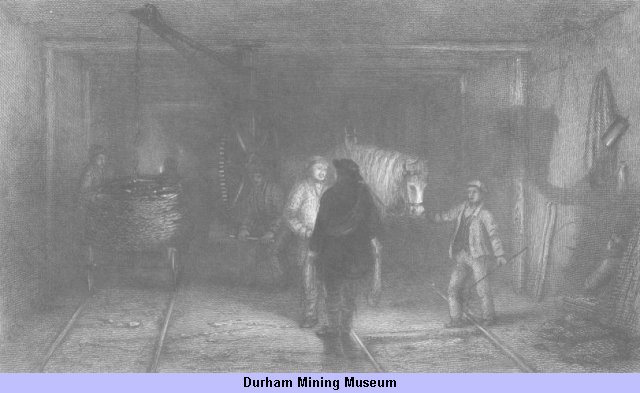
Crane for loading the rollies
Few persons, even of those resident in the coal district, are possessed of sufficient nerve to descend a pit. A feeling of danger, combined with the obvious inconvenient and disagreeable nature of the investigation, generally deter the most inquisitive. Without occular proof, however, it is difficult adequately to conceive either the wonders or the horrors of the scene. Though the eye soon becomes accustomed to the dim lights used in the pits, yet the sense of utter darkness, in all but their immediate vicinity, is ever present. Long, dreary, and apparently interminable passages, branch off in every direction. The floor is generally wet; the roof consists of stone, not unfrequently marked with petrifactions of vegetables or of fishes, buried there for countless ages, and impressing an idea of the immense depth to which the visitor is removed from the cheerful surface of the earth. The walls of the various alleys, called "boards" and "headings," are of coal; and the whole prospect, partially displayed as it is by dim twinkling lights, which appear like preternatural meteors, is dreary in the extreme. The sound of the rushing or dripping of water — the clanking of chains — the rattling of "trains," or small carriages containing the baskets of coal, as they are dragged along the "rolly-ways" to the bottom of the shaft — and the occasional report of gunpowder — enhance, in no small degree, the terrors of the stranger. Here and there the workmen are seen "kerving," or undermining, a block of coal, called a "judd," which is afterwards to be thrown down by blasting. In many places, horses are employed in drawing the trams; in others, that operation is performed by men and boys, technically called "dragsmen and foals." The activity — the bustle — nay, the boisterous mirth frequently exhibited by the "begrimed and black" beings which flit in every direction amidst the gloom, appear in strange contrast with the awful sensations of the casual visitor.
It will form a melancholy part of our duty to notice, in the following pages, some of the overwhelming calamities which have occurred to the persons employed in the coal-pits. Of these, the most frequent are caused by the explosion of "fire-damp," or hydrogen gas. To prevent such catastrophes, various lamps, each possessing more or less of merit, have been invented; but perhaps, as has been observed, no contrivance of this kind can effectually answer the purpose, which can only be accomplished by a more perfect system of ventilation than that already in use. The obstacles to such a blessed consummation, however, are greater and more numerous than are generally conceived. In working away the pillars of coal, the roof is necessarily let down, and ventilation in those parts becomes impossible. The consequent accumulation of gas must therefore be conducted by pipes or bye-passages, or diluted by overpowering ventilation of fresh air. Without presuming to give an opinion on the various schemes which have been proposed by men of genius, by theorists, or by practical men,13 we cannot but express a hope that public attention will shortly be aroused to this subject, and such improvement elicited as will signalize the present age in the annals of scientific discovery.14
When the corves containing the coals are brought to the mouth of the shaft,15 they are dexterously unhooked from the rope by the "banksman," whose business it is to place them on small hurdles, in which they are drawn to a range of "screens," consisting of sloping cast iron gratings, about half an inch asunder. Over these the coals are poured, for the purpose of separating the large from the small. The different kinds are then placed in "waggons," each containing 53 cwt., shaped like an inverted prismoid, and provided with a brake, for retarding its speed when necessary. They are emptied by means of a trap-door at the bottom. The railways on which they travel have already been noticed; and some of them will be more particularly described in this work.16 Representations of staiths17 on the Tyne, the Wear, and the Tees, will also be given, illustrative of the various methods of loading the keels and ships employed in the coal trade.
The "keels" which navigate the "coaly Tyne" are strong vessels, of eight chaldrons burthen, each managed by three men and a boy styled a "pee-dee." Those on the Wear have one man and a boy; but on that river the coals are transferred to the ships by a separate class of men, called "casters ;" or, being placed in tubs, they are lifted out of the keel on to the hatchway of the ship by machinery. On the Tyne, the "casting" is performed by the keelmen themselves. We have already seen that Mr. Buddle estimates the number of ships in the trade at 1400, and probably that is somewhat below the mark.
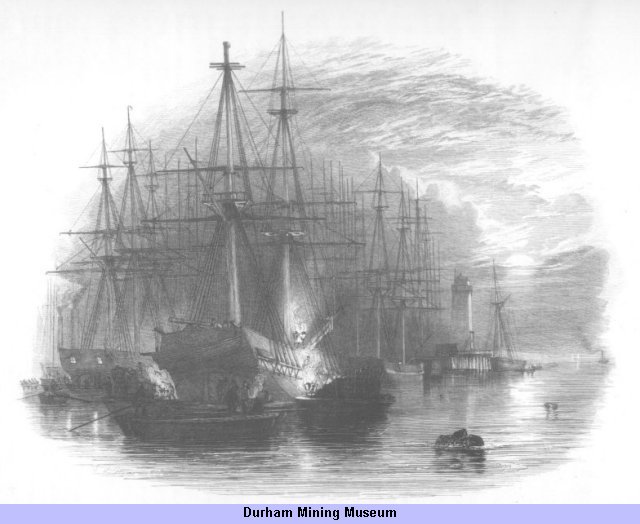
Colliers Loading at Shields
It is hoped that the preceding brief and rapid sketch of the history of the coal trade, as also of the manner of working that valuable fossil, will be useful to such of our readers as were previously unacquainted with the subject, and will supersede the necessity, in the succeeding part of the work, for tedious explanations and frequent repetitions. To those who, in the immediate vicinity of coal-mines, are "to the manner born," we trust that we need offer no apology for brevity. The following pages will be devoted to historical and descriptive notices of the respective subjects introduced in the work; the first, we believe, which has hitherto appeared professedly to illustrate, by graphic representations, those prevailing features in the scenery of our native north — THE COLLIERIES.
09 The late Mr. Cobbett, who visited this part of the country in the autumn of 1832, inserted the following astounding passage in his "Political Register" shortly afterwards :— "Here is the most surprising thing in the whole world; thousands of men and thousands of horses continually living under ground: children born there, and who sometimes never see the surface at all, though they live to a considerable age"!!! [Return]
10 The use of iron was introduced at the King Pit, Walker Colliery, about the year 1795, when entire circular rims were placed in the shaft. In the following year, Mr. Buddle caused the iron circles to be constructed of segments, fastened together by screw bolts. These bolts were dispensed with in 1805, in the winning of Howden Pit. In some collieries, the tubs are sustaining water under a pressure of 40 fathoms, or 100 lbs. per square inch. The practice of tubbing was first introduced into Scotland in 1830 by Matthias Dunn, Esq., in the sinking of a shaft at Preston Grange, where, for want of such an expedient, the coal had not been worked from the year 1746. For this he received the silver medals of the Natural History Society and the Society of Arts, Edinburgh. The same gentleman had previously adopted the practice in the Castle Coiner Pits, Kilkenny, Ireland. [Return]
11 The first of these useful machines erected in this neighbourhood was at Oxclose, near Washington; the second at Norwood, near Ravensworth; and the third, in 1713 or 14, at Byker Colliery. About 1720, they appear to have been generally in use; and hundreds have since been erected in this district. The quantity of water drawn off from the mines, by their means, is almost past belief. Mr. Buddle states, that in a colliery with which he is connected, they draw eighteen times the weight of water which they do of coal. By taking the average of 33 engines, it was calculated, in 1815, that for every bushel of coals consumed, 21,500,000 lbs. of water was raised one foot high. [Return]
12 "When the pitman is about to descend to the cavern of his labour," says a writer in a late periodical, "he is dressed in a checked flannel jacket, waistcoat, and trowsers, with a bottle or canteen slung across his shoulders, and a satchell or haversack at his side, to hold provender for his support during his subterrene sojourn. At all hours, night and day, groups of men and boys are seen, dressed in this fashion, wending their way to their colliery, some carrying Sir Humphrey Davy's (called by them 'Davy's') safety lamp, ready trimmed, and brightened for use. They escend the pit by means of a basket or 'corfe,' or merely by swinging themselves on to a chain, suspended at the extreme end of the cordage, and are let down, with inconceivable rapidity, by a steamengine. Clean and orderly, they coolly precipitate themselves into a black, smoking, and bottomless-looking crater, where you would think it almost impossible human lungs could play, or blood dance through the heart. At nearly the same moment, you see others coming up, as jetty as the object of their search, drenched and tired. I have stood in a dark night, near the mouth of a pit, lighted by a suspended grate, filled with flaring coals, casting an unsteady but fierce reflection on the surrounding swarthy countenances; the pit emitting a smoke as dense as the chimney of a steam-engine; the men, with their sooty and grimed faces, glancing about their sparkling eyes, while the talking motion of their red lips disclosed rows of ivory; the steam-engines clanking and crashing, and the hissing from the huge boilers, making a din, only broken by the loud, mournful, and musical cry of the man stationed at the top of the pit 'shaft,' calling down to his companions at the bottom. This, altogether, is a scene as wild and fearful as a painter or a poet could wish to see." [Return]
13 A late writer observes that this "has been the theme of a great deal of discussion, — not always temperately conducted. The philanthropist has sometimes upbraided the coal-viewer with murder, for neglecting the trial of some theory of injecting or circulating air; while the viewer, in turn, has occasionally scouted, with perhaps too little ceremony, schemes which appeared ingenious and plausible enough on paper, but which might be to him obviously unavailable in practice." [Return]
14 It is no more than justice to the respectable body of colliery owners in the north of England, to add, that their benevolence is largely exerted in all cases of accident or bereavement. Not only is their charity exerted in a direct manner to the unfortunate sufferers, or their widows and orphans, but often more extensively, and even more usefully, in providing employment and remuneration for the maimed and the younger children of widows; and the latter are never disturbed in their possession of the houses occupied during the lives of their husbands. Some years ago, after the occurrence of a succession of the melancholy events above alluded to, the sympathy of the colliery owners was roused to the project of a grand and general provision for the maimed, destitute, and superannuated, by the erection of hospitals, and a general and parliamentary contribution for their endowment; but the objections, on the part of the colliers, were so numerous and so general, that the design was necessarily abandoned. [Return]
15 Corves of wicker-work are now being fast superseded by the adoption of square tubs, made of wood or iron, with wheels attached. They are conducted up the shaft upon cages or cradles, sliding between guides of wood, extending from top to bottom even of the deepest pits. [Return]
16 Anciently the coals were conveyed on horseback, or in "waynes," which "did usuallie cary and bring eighte boulls of coles to all the staythes upon the ryver of Tyne." Amongst Master Beaumont's "rare engines" were waggons with one horse," for the same purpose. Lord Keeper Guildford's description, in 1676, app roaches to that of the wooden railways which were generally used until of late years, when they were superseded by rails of iron. [Return]
17 Stathe, stade, or steed, are Anglo-Saxon terms, formerly applied to single fixed dwellings, or to places on the banks of rivers, where merchandise was stored up, and at which vessels could lie to receive it." — Picture of Newcastle. These erections are also called by the keelmen "dikes," probably on account of their being diked, or defended, from the river. They are mentioned so early as 1338. [Return]





 Contains public sector information licensed under the

