


Mail: Webmaster

|

|

|

|
|
 |
 |
|||
Extract from NCB Publication — 1973
NOXIOUS GASES UNDERGROUND
SELF-RESCUERS
 Of the toxic gases formed underground, carbon monoxide is the most dangerous because it is colourless and odourless and men have no natural means of detecting its presence. For this reason special respirators were developed for men to put on whenever there is reason to suspect a fire or similar occurrence. All collieries have been supplied and men are required to carry the self-rescuers at all times when they are underground.
The self-rescuer has been designed to give protection against concentrations of up to 1.5% carbon monoxide for a period of not less than 60 minutes. The active component is hopcalite which oxidises any carbon monoxide in the air stream to carbon dioxide, which is harmless in the concentrations involved. Hopcalite does not provide its own oxygen and therefore cannot give any protection if the atmosphere is seriously oxygen-deficient, as may occur near the seat of, or down wind of, a severe fire or an explosion.
The air going into the self-rescuer must be passed through a chemical to dry it as moisture de-activates the catalyst. Both this drying and the oxidising action of the catalyst generate heat, and the M.S.A. W.2 65, illustrated opposite incorporates a cooler.
The reliability of the self-rescuer is assured by regular and frequent maintenance. Each day it must be visually inspected and its exterior cleaned e.g. by brushing.
Self-rescuers are divided into three classes:
'A' —satisfactory
'B' —satisfactory but requiring additional attention
'C' —not up to standard.
All Class C self-rescuers must be withdrawn from service
Class A self-rescuers must be weighed on an approved balance once a month. If the total change of weight since the date of issue amounts to 2g or more it must be re-classified as Class B. During the calendar month subsequent to such re-classification it must be weighed weekly and if these weighings show a continuing increase the self-rescuer must be sent to Scientific Department for resealing. It must be re-classified as 'C' if the total weight change exceeds 4g.
Self-rescuers must be in good apparent condition. Any that sustain mechanical damage become Class C and must be returned to Scientific Department for overhaul and re-casing. An undamaged unopened Class C self-rescuer must also be returned to Scientific Department for possible regeneration. A regenerated self-rescuer will have an R added to its serial number.
Opened and worn self-rescuers must be returned to Scientific Department for inspection, together with their record cards. They will not be re-issued.
The N.C.B, and the Department of Trade and Industry jointly prepared notes for guidance on various aspects of self-rescuers (N.G.S.R. Nos. 1-8), copies of which may be obtained from Safety Branch. Details of the routine maintenance that is required are set out in No. 7.
A self-rescuer must never be regarded as a substitute for closed circuit breathing apparatus.
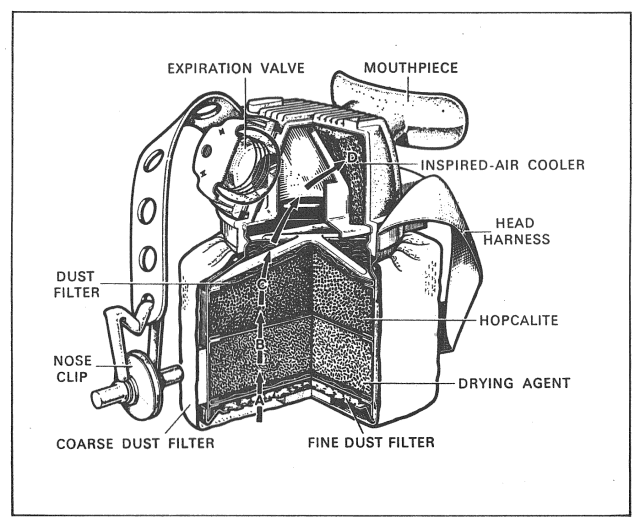
| 1. |
Mine air passes into the self-rescuer through dust filters (A).
| |
| 2. |
The filtered air passes through the drying agent (B), and carbon monoxide is removed as it passes through the hopcalite (C). During these processes the air becomes warmer.
| |
| 3. |
Before it reaches the mouthpiece, the purified air is cooled by the inspired-air cooler (D).
| |
| 4. |
The air breathed out passes away through the expiration valve.
|


Back |

Home |
Copyright © 1999-2012 by The Durham Mining Museum and its contributors
Page last updated: 01 Jan 2008 |

Search |

|